
3D-printed contact lenses in 20 minutes: personalization comes from digital
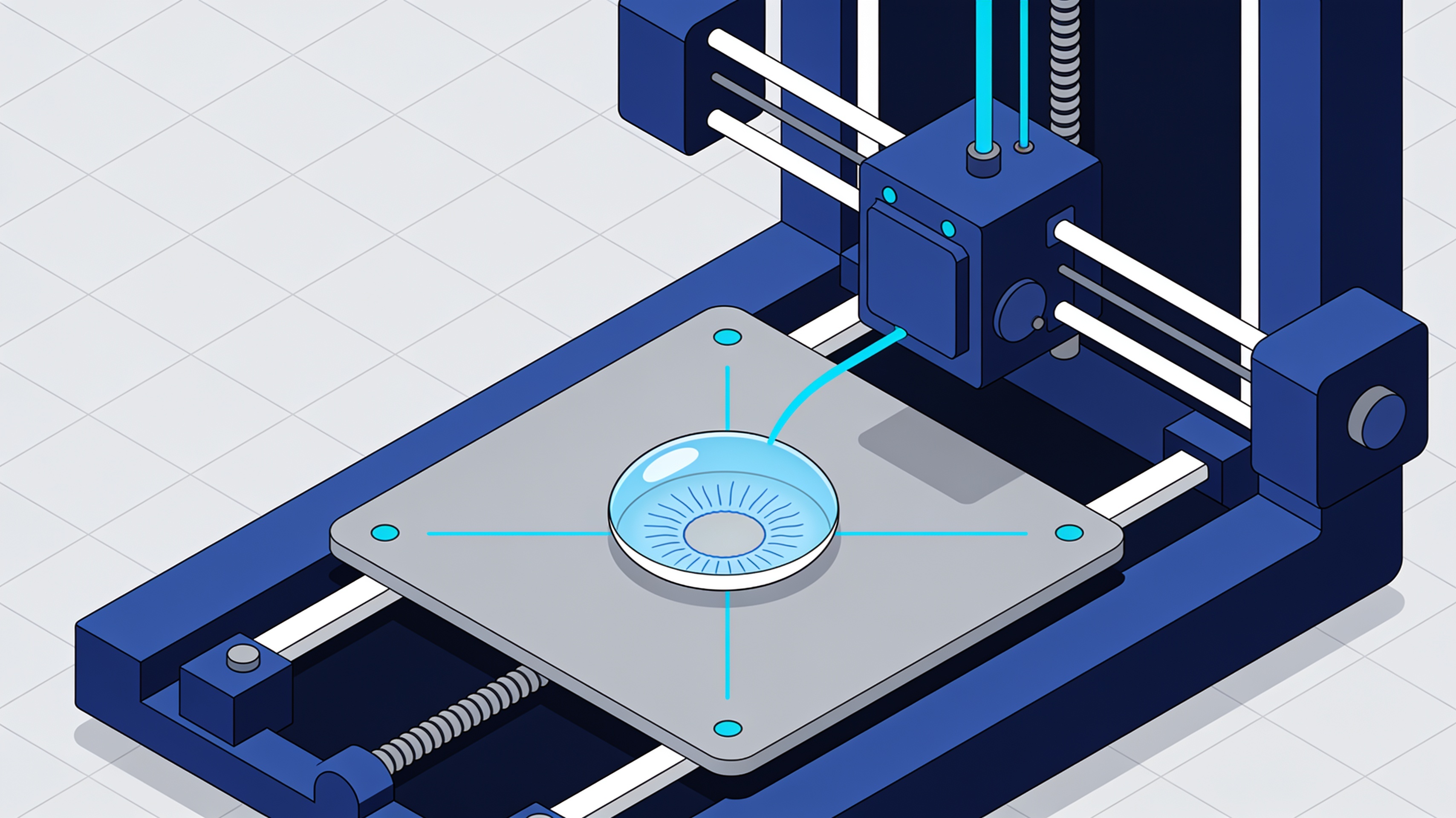
The University of Waterloo has developed a platform that integrates corneal topography, digital design, and DLP printing to produce rigid contact lenses customized to the geometry of the individual eye. The manufacturing cycle takes about 15-20 minutes per lens and allows both surfaces to be digitally controlled: the inner surface conforms to the cornea, while the outer surface provides optical correction.
The study, published in 2026 in Materials & Design by Sayan Ganguly, Astrid Stinson, Fatemeh Parniani, and Xiaowu Shirley Tang, represents a qualitative leap compared with previous feasibility demonstrations.
Rigid lenses, not soft: the clinical target
The technology does not aim to replace disposable soft lenses produced in millions of units, but to solve complex clinical cases where customization is essential.
These are hard contact lenses, rigid lenses customized for patients with irregular corneas, complex astigmatisms, or other conditions requiring highly specific gas-permeable rigid lenses.
Today, fitting these lenses may require multiple attempts, several diagnostic lenses, and repeated visits before finding a satisfactory combination of centration, comfort, and visual correction.
- Production time: 15-20 minutes per lens
- Technology: Digital Light Processing (DLP)
- Material: photopolymerizable hydrophilic silicone-acrylate
- Customization: both surfaces of the lens
From iterative workflow to digital process
Waterloo's proposal transforms a process made of repeated attempts into a fully digital pipeline, from scanning to printing.
The workflow is structured in a precise sequence: corneal topography → mathematical model → patient-specific geometry → DLP printing → surface finishing → lens.
The difference compared with a standard lens customized only in dioptric power is substantial. The software does not merely modify the optical correction, but generates an inner surface shaped to the specific topography of the cornea.
Two surfaces, two functions
A contact lens must simultaneously solve two distinct engineering problems, and 3D printing makes it possible to address them separately.
The inner surface must interact correctly with the cornea, tear film, and ocular geometry. The outer surface, on the other hand, must provide the necessary optical power.
The independent digital control of the two surfaces represents the main advantage of the platform developed in Waterloo.
Production pipeline
- Acquisition: patient corneal topography
- Design: patient-specific digital model
- Print: Digital Light Processing with silicone-acrylate
- Finishing: non-contact fluidization coating
Material and process: silicone-acrylate and DLP
The group developed a photopolymerizable formulation specific to the application, combining optical properties, biocompatibility, and DLP processability.
The material used is a hydrophilic silicone-acrylate formulated specifically for contact lens printing. The printing technology is Digital Light Processing, a vat photopolymerization process that uses liquid photopolymerizable resins.
The surface finish is achieved by non-contact fluidization coating, a process without mechanical contact that reduces the staircase effect typical of layer-based printing.
Non-contact fluidization coating is essential to obtain optically valid surfaces without damaging the printed geometry. The staircase effect would compromise both comfort and optical performance.
Perspectives: from research to clinical practice
The study demonstrates technical feasibility, but the path toward clinical application will require large-scale validation and regulatory approvals.
The production time of 15-20 minutes refers to the experimental conditions reported in the study. The scalability and repeatability of the process will need to be demonstrated in real clinical settings.
Publication in Materials & Design in 2026 positions this work in the context of advanced research on additive manufacturing for personalized medical devices.
The group led by Xiaowu Shirley Tang demonstrated that 3D printing of contact lenses can move beyond the purely demonstrative phase to address concrete clinical problems.
article written with the help of artificial intelligence systems
Q&A
How long does it take to produce a rigid contact lens with this technology?
The fabrication cycle requires about 15-20 minutes per lens. The process integrates corneal topography, digital design, and DLP printing into a single pipeline.
Which 3D printing technology is used for the lenses?
The platform developed by the University of Waterloo uses Digital Light Processing (DLP). The material employed is a photopolymerizable hydrophilic silicone-acrylate.
What type of contact lenses does this technology produce?
These are custom rigid gas-permeable lenses, not soft disposable lenses. The clinical target is patients with irregular corneas, complex astigmatisms, or conditions requiring highly specific rigid lenses.
What differentiates these lenses from a traditional custom lens?
The software digitally controls both surfaces: the inner one is shaped on the specific topography of the cornea, while the outer one provides optical correction. A standard custom lens only varies the dioptric power.
What problems does the digital workflow solve compared to traditional fitting?
Traditional fitting may require multiple attempts, diagnostic lenses, and repeated visits. Waterloo's digital pipeline transforms this iterative process into an automated sequence: topography, mathematical model, patient-specific geometry, DLP printing, and surface finishing.


