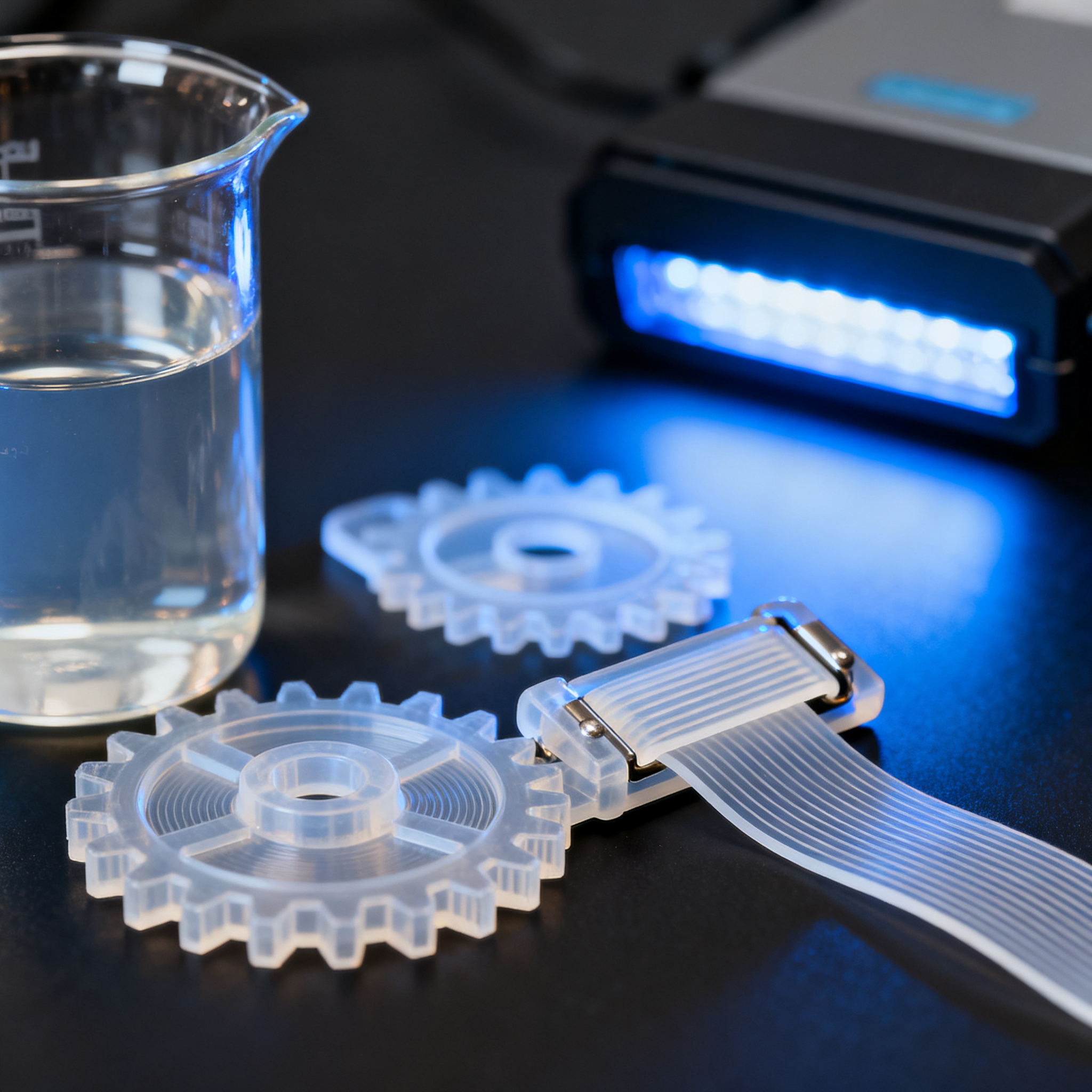
Why does this resin cost 5x but print twice as much?
Next-generation photopolymer resins are not simply “liquids that harden”: each formulation is designed to replicate specific properties of engineering plastics, directly influencing the quality of the final part. The price difference reflects years of chemical development aimed at achieving mechanical, thermal, and process performance comparable to established materials like polypropylene or thermoplastic polyurethane.
Custom Chemistry for Critical Applications
Advanced resins differ not only in color or viscosity, but in molecular composition studied to replicate precise mechanical and thermal characteristics.
Professional photopolymers use proprietary chemical formulations that activate at 405 nanometers. The triggered light induces hardening only in the exposed areas, allowing for the precise construction of components layer by layer.
The main difference lies in the chemical modifications that control hardness, flexibility, and thermal resistance. For example, Formlabs develops each resin to emulate common plastics like polypropylene (PP) or thermoplastic polyurethane (TPU). This level of engineering explains why materials that appear similar can have significantly different costs.
- 405 nm photopolymer activation with precise control of polymerization
- Specific chemical formulations to emulate the properties of engineering plastics
- Regulation of hardness, flexibility, and thermal resistance through molecular composition
Low Force Display and Resin Compatibility
The interaction between printing technology and resin formulation determines the success in achieving precision and structural integrity without distortions.
Low Force Display technology requires compatible resins to minimize stresses during printing. Every Formlabs material is developed specifically for this technology, ensuring greater speed while maintaining precision and reliability.
Chemical compatibility between resin and printing system is not a secondary aspect. Mechanical stresses during the detachment of each layer can compromise the final geometry if the material is not formulated for such display technology.
Simulate Standard Polymers with Photopolymers
Thanks to targeted chemical modifications, some resines can emulate the performance of materials like ABS or TPU, opening new application possibilities.
Advanced resins reach quality comparable to injection molding thanks to years of research on photopolymer chemistry, not from simple variations in viscosity or cure time.
Materials like Grey Resin V5 completely eliminate post-curing requirements, reducing production times by several hours per part. Clear Resin V5 produces transparent components with transmittance up to 90% beyond 450 nm, approaching PMMA and N-BK7 optical glass.
| Properties | Standard Resins | Advanced Resins |
|---|---|---|
| Optical transmittance | 60-70% | 85-90% |
| Post-curing required | Always | Optional/Removed |
| Material simulation | Limited | PP, TPU, ABS-like |
Open Material Mode: Freedom with Hidden Risks
Using third-party resins can increase versatility but involves risks related to chemical compatibility and loss of official technical support.
Open Material Mode allows the use of compatible 405 nm resines from external suppliers. A one-time license is required to remove material limitations, with free access for educational institutions.
However, freedom comes at a price: the use of non-original materials results in limited warranty coverage for any malfunctions. This mode is intended exclusively for expert users capable of modifying print parameters and resolving chemical compatibility issues.
Open Material Mode requires advanced skills in managing print profiles and understanding the chemical properties of photopolymers. The lack of official validation can cause costly print failures on complex geometries.
Post-processing remains crucial: all materials require washing in isopropyl alcohol and specific curing cycles. High-temperature resins require additional heat treatments to achieve maximum thermal resistance.
Conclusion
Choosing the right resin means understanding not only what it does, but also why it does it – and this requires chemical knowledge applied to the production context. The cost difference between materials reflects investments in chemical research, process validation, and compatibility with specific printing technologies.
Advanced formulations are not marketing: they represent molecular engineering that brings 3D printing from rapid prototyping to the production of functional components. 90% optical transmittance, elimination of post-curing, or precise TPU simulation result from years of targeted chemical development.
Analyze the technical data sheet of your next resin as if it were a traditional engineering material: the result will repay its cost. Verify chemical compatibility, post-processing requirements, and certified mechanical properties before basing your choice on price alone.
article written with the help of artificial intelligence systems
Q&A
Why do next-generation photopolymer resins cost more than standard versions?
Their higher price reflects years of chemical development aimed at replicating the properties of established engineering plastics, such as polypropylene or thermoplastic polyurethane. These resins are formulated to offer superior mechanical, thermal, and processing performance, justifying the additional cost.
What chemical characteristics distinguish advanced resins from standard ones?
Advanced resins feature proprietary chemical formulations that allow precise control over hardness, flexibility, and thermal resistance. Moreover, they are designed to emulate specific properties of traditional materials like ABS, TPU, or PP, with accurate control of polymerization at 405 nm.
How does Low Force Display technology affect resin selection?
This technology requires resins specifically formulated to minimize stresses during printing, ensuring precision and structural integrity. Using incompatible resins may cause distortions or layer detachment failures.
What advantages do advanced resins such as Grey Resin V5 or Clear Resin V5 offer?
Grey Resin V5 eliminates post-curing, reducing production times, while Clear Resin V5 offers optical transmission up to 90%, approaching materials such as PMMA and optical glass. Both provide quality comparable to injection molding.
What are the risks of using third-party resins in Open Material Mode?
Using non-original resins may lead to chemical compatibility issues, print failures, and loss of official warranty. This mode requires advanced expertise to manage custom print profiles and address potential issues.