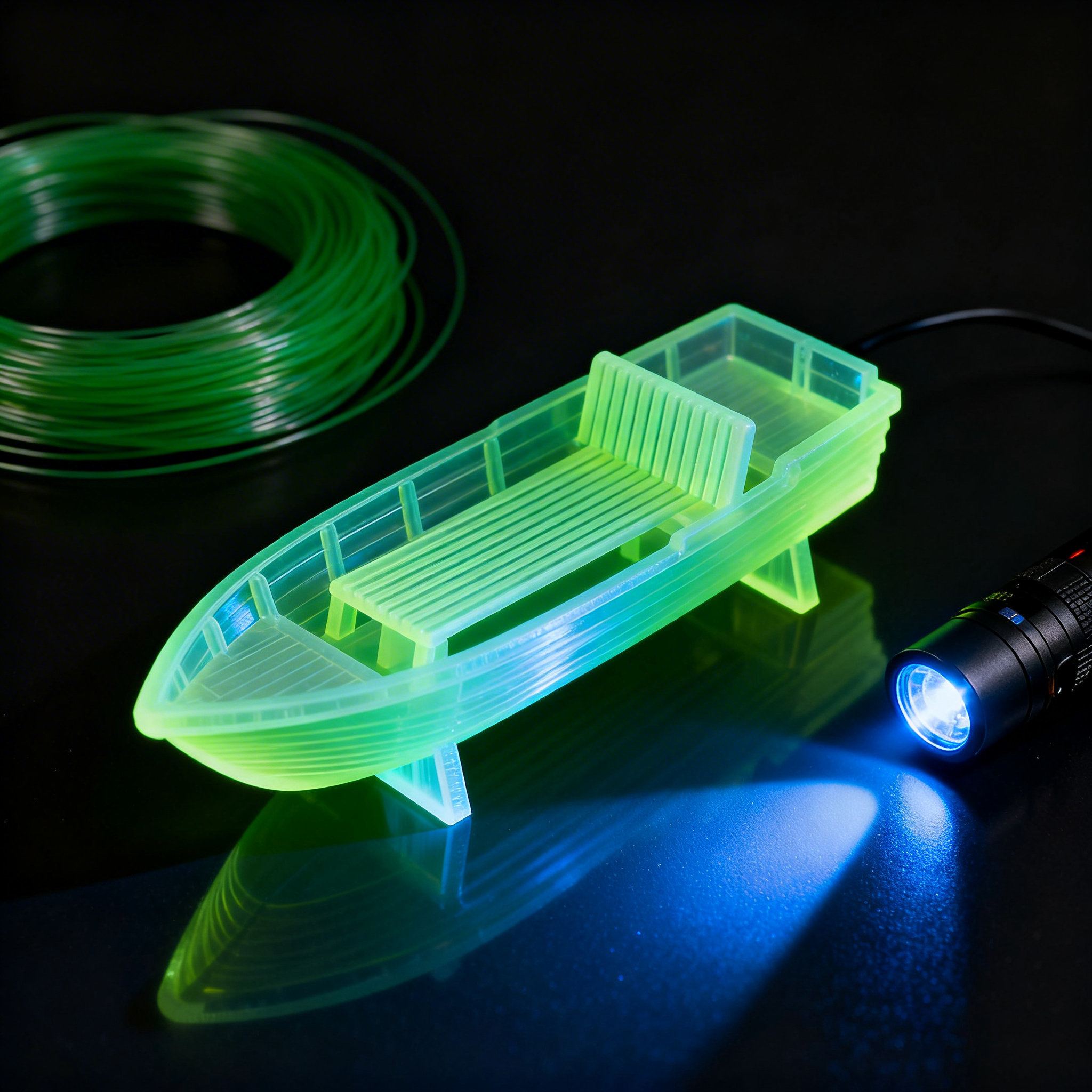
Prusa PETG Ultraglow vs. Alternatives: Is it the True Leap Forward for Nighttime 3D Printing?
Prusa Research launched the Prusament PETG Ultraglow Green, defining it as «the brightest glow-in-the-dark filament on the market». But does this promise hold up when compared to existing phosphorescent PLA alternatives? And above all, do its mechanical properties justify switching to a more expensive and complex material to print?
Brightness and Signal Duration: Who Wins?
The Prusament PETG Ultraglow clearly stands out from common phosphorescent PLAs for its initial light intensity and persistence over time, thanks to an extreme concentration of strontium aluminate.
Prusa conducted direct comparative tests by printing the same model (a “benchy”) with its own PETG Ultraglow and various glow-in-the-dark PLA filaments from competing brands. After 20 minutes of exposure to 405 nm UV light, the Prusament showed a significantly higher brightness compared to all tested alternatives. The company states that it filled the PETG with «the maximum physically possible quantity» of strontium aluminate, while still maintaining printability.
Strontium aluminate is the modern standard phosphorescent material: non-toxic, non-radioactive and chemically stable. It charges by absorbing light energy (from LED, sunlight, or UV) and releases it gradually. Unlike old phosphorus compounds, it offers more intense and prolonged luminescence. In Prusa tests, Ultraglow PETG maintained measurable luminance for extended periods, significantly outperforming standard glow-in-the-dark PLA, which tends to fade quickly.
This difference is not just aesthetic: in applications such as safety signage (emergency exits, directional arrows) or components that must remain visible in the dark for hours, the duration of the light signal becomes a critical functional requirement.
Mechanical and Thermal Properties: From Hobby to Functional Use
PETG as a polymer base transforms the glow-in-the-dark filament from a decorative material to a structural component, with superior mechanical and thermal resistance compared to PLA.
The choice of PETG instead of PLA is not random. Prusa emphasizes that PETG is more resistant than PLA and tolerates higher temperatures, making it suitable for functional parts and not just decorative ones. This feature allows the filament to be used for components exposed to mechanical or thermal stress: handles, switches, indicators, containers for outdoor or underwater equipment.
Ultraglow PETG retains the typical properties of standard PETG: good impact resistance, greater flexibility than PLA (reducing the risk of brittle fractures), and dimensional stability. It can be combined with standard PETG in multi-material prints to create functional objects with strategic bright accents: for example, frames for locks, light switches, or safety components where nighttime visibility is essential.
However, there is a price to pay. Strontium aluminate is the most abrasive material ever used by Prusa in a filament. The company explicitly warns: a hardened nozzle is mandatory, since the material would rapidly destroy a brass nozzle. A diameter of 0.6 mm is recommended (even though profiles for 0.4 mm exist) and standard (non high-flow) nozzles to prevent clogging. Intensive use can accelerate wear even on hardened components, PTFE tubes, and extruder gears. For high-volume applications, Prusa suggests diamond nozzles (E3D DiamondBack), which are harder than the strontium aluminate itself.
The cost is 82.99 USD / 69.99 EUR for an 800 g coil, significantly superior to cheap glow-in-the-dark PLAs.
Practical Applications: When and Where to Use It Advantageously
PETG Ultraglow excels where nighttime visibility meets strength requirements: industrial safety, outdoor equipment, components exposed to high temperatures or mechanical stress.
Ideal applications leverage both the luminescence and the properties of PETG:
- Safety and orientation signage: emergency exit signs, directional arrows for scuba diving, indicators for evacuation routes. The superior brightness and signal duration make these components truly functional, not just decorative.
- Functional components visible in the dark: luminous frames for locks or switches, handles for camping equipment, EDC (Every Day Carry) capsules that are not lost in the dark. The mechanical resistance of PETG ensures durability for daily use.
- Technical parts with luminous accents: in multimaterial prints, it is possible to create standard PETG objects with Ultraglow inserts to highlight switches, status indicators, or components that require rapid identification in low-light conditions.
- Objects exposed to moderate temperatures: unlike PLA, PETG tolerates higher temperatures without deforming, making it suitable for components in hot environments (car dashboards, equipment exposed to the sun).
Prusa emphasizes that, although toys and decorations remain valid applications, the choice of PETG deliberately aims at functional parts where luminescence serves a practical purpose, not just aesthetic.
Conclusion
The Prusament PETG Ultraglow represents a tangible evolution compared to classic PLA glow-in-the-dark, especially for those seeking reliability beyond the scenographic effect.
Prusa's comparative tests demonstrate a measurable luminous superiority compared to common phosphorescent PLAs. The PETG base transforms the filament from a material for decorative projects into a component for light engineering applications and safety signage. The superior mechanical and thermal resistance justifies the higher cost and printing complexity for users who need durable functional parts.
The extreme abrasiveness of the material requires investment in hardened nozzles and awareness of accelerated component wear. It is not a filament for occasional prints with basic configurations, but for those with specific needs where prolonged nighttime visibility and structural resistance are simultaneous requirements.
Try the filament in a critical application like a safety plate or a component exposed to heat – the results will speak for themselves. If your needs are limited to occasional decorations, an inexpensive glow-in-the-dark PLA might suffice. But for professional signage, outdoor equipment, or functional components that really need to shine when it matters, PETG Ultraglow sets a new benchmark.
article written with the help of artificial intelligence systems
Q&A
- What is the main feature of Prusament PETG Ultraglow compared to alternative phosphorescent PLAs?
- Prusament PETG Ultraglow offers significantly higher initial brightness and persistence over time thanks to the maximum possible concentration of strontium aluminate. In Prusa tests, it outperformed all tested glow-in-the-dark PLAs after 20 minutes of UV light exposure.
- Why was PETG the base choice for this phosphorescent filament?
- PETG was chosen because it gives the filament superior mechanical and thermal properties compared to PLA, making it suitable for functional components and not just decorative ones. It has greater impact resistance, high-temperature tolerance, and dimensional stability.
- What precautions are necessary during printing with Prusament PETG Ultraglow?
- The use of a hardened nozzle is mandatory, as strontium aluminate is very abrasive and damages brass nozzles quickly. A 0.6 mm nozzle is recommended, and the use of diamond nozzles is recommended for intensive applications.
- In which application areas is Prusament PETG Ultraglow particularly advantageous?
- This filament is ideal for safety signage, functional components visible in the dark, outdoor equipment, and parts exposed to heat or mechanical stress. It can also be used in multi-material prints to add luminous details to technical objects.
- How does the cost of Prusament PETG Ultraglow compare to traditional phosphorescent PLAs?
- The cost is significantly higher: $82.99 USD or €69.99 EUR for an 800 g spool. However, its durability, brightness, and resistance justify the price for professional or functional applications where quality is a priority.