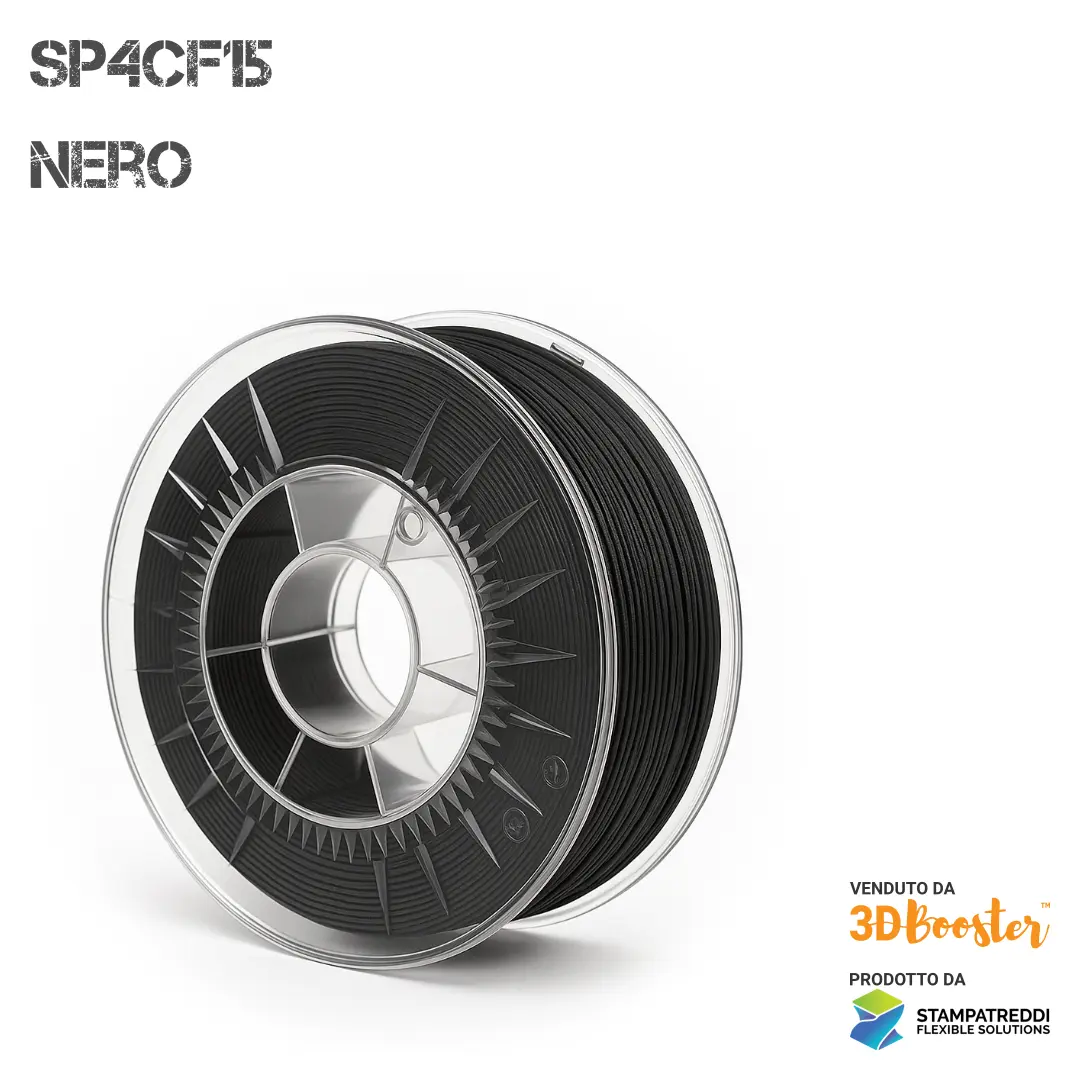
Polyamide is one of the most appreciated technical materials in additive manufacturing. High mechanical strength, excellent chemical compatibility, long-lasting durability: on paper, nylon seems the ideal material for demanding functional applications. However, anyone who has worked with traditional PA filaments knows the other side of the coin well.
The real problem with classic polyamides
Printing nylon is technically challenging. The main obstacles users encounter daily are:
- Moisture absorption: the filament degrades quickly if not stored in a controlled environment
- Severe warping: thermal contraction causes detachment and deformation even with a heated bed
- Mandatory closed chamber: most technical PAs require advanced setups for acceptable results
- High failure rate: complex setups lead to lost time and wasted material
The result? A material with great potential that in practice requires experience, dedicated equipment, and tolerance for errors.
A new category of polyamides for FDM
In recent years, some manufacturers have abandoned the approach of adapting industrial materials for 3D printing, instead choosing to design filaments natively for FDM: formulations optimized not only for final performance, but for the entire printing process.
The result is a generation of polyamides that combines technical material performance with usability close to that of consumer materials. In practice: it prints in an open chamber, with parameters similar to PLA, without sacrificing rigidity, heat resistance, and dimensional stability.
SP4 CF15: industrial performance, plug & play experience
The filament SP4 CF15 by 3DBooster represents this approach in its most advanced form. It is a special polyamide loaded with 15% medium carbon fiber, formulated to offer:
- Stiffness modulus ~8.5 GPa — comparable to industrially reinforced PAs
- Thermal resistance up to 180°C — beyond the limits of standard PA12 CF (~150°C)
- Low moisture absorption — optimized molecular structure to reduce hygroscopicity
- Premium surface finish — superior look and feel compared to conventional reinforced PAs
- Open-air printability — no enclosure required
Comparison with the most common materials
| Properties | PLA | PETG | PA12 CF | SP4 CF15 |
|---|---|---|---|---|
| Printability | ★★★★★ | ★★★★ | ★★ | ★★★★★ |
| Mechanical resistance | ★★ | ★★★ | ★★★★ | ★★★★★ |
| Thermal resistance | ~60°C | ~80°C | ~150°C | ~180°C |
| Dimensional stability | ★★ | ★★★ | ★★★★ | ★★★★★ |
| Moisture absorption | low | medium | high | low |
| Closed chamber required | no | no | often yes | no |
Typical applications
SP4 CF15 is suitable for contexts where traditional PAs would be the technically correct choice, but their operational complexity makes them impractical:
- Brackets and supports for automotive applications
- Components for machinery and industrial equipment
- Functional prototypes with high mechanical stress
- Lightweight structural parts as a replacement for metal
Conclusion
If you work in additive manufacturing and need a technical filament that doesn't require complex setup to deliver reliable results, SP4 CF15 is the concrete answer to a problem that traditional PA has never fully solved.
Industrial-grade performance. Consumer-grade user experience.
Discover SP4CF15 on 3dbooster.com →
Q&A
Can SP4 CF15 be printed on an open-frame 3D printer?
Yes. Unlike traditional technical PA filaments, SP4 CF15 is formulated to print on open-frame printers with parameters similar to consumer-grade materials like PLA. No dedicated enclosure is required.
What is the heat resistance of SP4 CF15?
SP4 CF15 achieves a heat resistance of up to 180°C, which exceeds standard PA12 CF filaments that typically top out around 150°C. This makes it suitable for applications in high-temperature operating environments.
Is moisture absorption a concern with SP4 CF15?
No. The molecular formulation of SP4 CF15 is optimized to reduce hygroscopicity compared to traditional polyamides. As a best practice, the filament should still be stored in a dry environment or with a filament dryer.
Can SP4 CF15 replace metal components?
In many applications, yes. With a stiffness modulus of approximately 8.5 GPa and high thermal resistance, SP4 CF15 is well-suited for producing lightweight structural parts as a metal replacement, especially in weight-critical applications.
Which nozzles are compatible with SP4 CF15?
Since SP4 CF15 contains 15% carbon fiber, it is abrasive. Hardened nozzles — such as hardened steel or ruby-tip — are strongly recommended to prevent premature nozzle wear.