Metal Additive Manufacturing in the Aerospace and Defense Industry: Advanced Technologies and Critical Applications
Introduction to Metal Additive Manufacturing Technologies
Metal additive manufacturing is radically transforming the aerospace and defense sector, moving from niche applications and prototyping to an essential tool for critical in-flight components. After more than twenty years of use primarily in research and development, metal additive manufacturing (AM) is reaching a certification maturity that enables large-scale applications. The main historical obstacle has been the lack of sufficient statistical data to understand component behavior during long service periods. Today, thanks to a growing body of research and testing, manufacturers have gained greater confidence in applying these technologies to aeronautical design, moving from cautious steps to more decisive adoption.
Metal AM is not limited to replacing existing parts, but allows the functionality of components to be completely rethought. The technology makes it possible to consolidate multiple pieces into a single component while simultaneously reducing weight, a crucial advantage in aeronautical engineering where every gram saved contributes to greater efficiency and lower operating costs.
Metallic Materials for Aerospace and Defense Applications
Metallic materials for aerospace and defense applications represent a critical element for the expansion of AM. Advanced alloys include Ti64 titanium, 17-4 PH stainless steels, H13 tool steels, and copper, each selected for specific mechanical and thermal properties. The metal fused filament fabrication (FFF) process uses bound metal powders that are subsequently sintered to obtain fully metal parts.
The metal powder supply chain is evolving toward more sustainable and secure models. Strategic agreements include closed-loop “upcycling” programs that transform production waste into reusable powder through proprietary systems such as UniMelt, ensuring a fully domestic supply chain and significantly reducing waste and costs. In the suppressor sector, this capability has transformed what was a logistical and financial burden into a high-value asset.
Production Processes: DMLS, EBM, and Emerging Technologies
The main metal AM technologies include Direct Metal Laser Sintering (DMLS), Electron Beam Melting (EBM), and directed energy deposition (DED). Wire-fed DED technology, such as Rapid Plasma Deposition (RPD) used by Norsk Titanium, is gaining ground for high-value components in collaboration with Boeing and Spirit AeroSystems. Airbus is evaluating extending w-DED toward more critical applications, including wing sections and landing gear, exploring different energy sources (plasma, arc, laser).
The Asian market is emerging as a significant competitor in EBM as well, traditionally dominated by a few Western players. Companies such as QBeam, Xi’an Sailong Metal, and JEOL are entering this space, while established manufacturers such as Farsoon, E-Plus-3D, and BLT are strengthening their capabilities in other metal AM technologies.
The metal FFF process is divided into three stages: printing the component with bound metal powder (the “green” part), washing to dissolve the plastic material (the “brown” part), and furnace sintering to solidify the metal powder. This method is considered the most accessible and safe among metal AM technologies.
Qualification and Certification of Components Produced with AM
Certification represents the most complex challenge for metal AM. Before components can be used in flight, they must pass extremely rigorous qualification processes. Engineers define statistical “allowables” that describe material behavior, traditionally requiring the production and testing of thousands of samples over years, at costs of millions of dollars.
For metal additive parts, this process is even more complex because each machine and parameter set can create different material properties, and a single component can include thick sections and very thin internal walls. Inspection technologies are improving significantly: CT scanning and advanced techniques such as access to synchrotron facilities make it possible to examine printed parts at the microscopic level, providing essential structural data to develop reliable statistical allowables.
The National Defense Authorization Act (NDAA) in the United States has recently formally recognized AM as critical infrastructure within the Department of Defense, establishing clear standards for security, traceability, certification, and scalability. This legislation prohibits the use of AM systems produced by or connected to entities from countries such as China, Russia, Iran, or North Korea, redefining trust requirements in defense.
Case Studies: Engines, Structures, and Control Systems
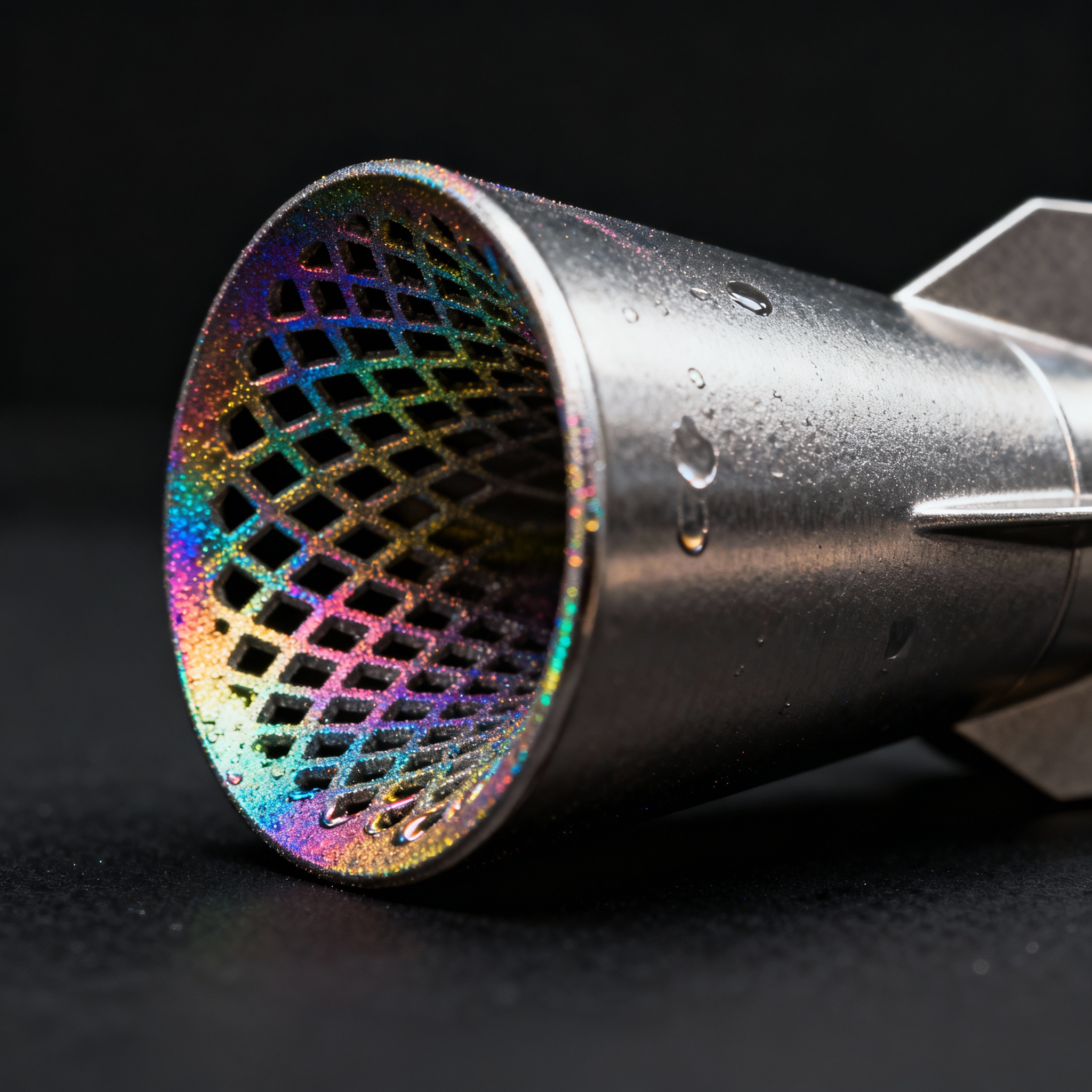
In the aerospace sector, heat exchangers represent an exemplary application. AM enables the creation of highly efficient, lightweight, and conformal structures that follow the natural curves of a fuselage or engine manifold, using space more intelligently and improving thermal performance. Components such as aircraft nozzles in 17-4 PH stainless steel, milling cutter bodies in H13 steel, copper tool coolers, and jaws for robotic grippers demonstrate the versatility of metal AM.
In the defense sector, the U.S. Coast Guard has installed its first critical 3D-printed metal component: a cover for a fin seal housing. Other applications include Ultem polymer exhaust covers that replace bronze components, eliminating corrosion and reducing installation times from three days to three hours, with estimated savings of $200,000 per ship.
In 2025, multiple companies conducted tests and validations of rocket engines incorporating 3D-printed parts into operational systems, with examples from New Frontier Aerospace, POLARIS Spaceplanes, AVIO SpA, and Agnikul Cosmos.
Economic Benefits and Time-to-Market Reduction
The economic benefits of metal AM are substantial. The design freedom offered makes it possible to create parts from 30 to 40% smaller and lighter while maintaining or improving performance. For low-volume production, AM can be more economical than conventional production, with a consistent cost per part independent of print volume, since the process is largely automated.
AM also offers practical solutions for aircraft that have been in service for decades, for which spare parts can be extremely difficult to find. Additive manufacturing makes it possible to produce these low-volume spare parts without having to restart entire production lines, drastically reducing downtime.
In the defense sector, programs generally have tighter development cycles and accept higher levels of technical risk when performance benefits are clear, making them natural early adopters. Civil aviation faces longer qualification cycles and stricter safety requirements, but the long-term potential is enormous for reducing emissions and fuel consumption.
Technical Challenges and Current Limitations
Despite progress, significant challenges persist. The complexity of certification remains the main obstacle, especially for critical components such as airframes and engines that must operate reliably for many years. Understanding and meeting the certification requirements for these parts is absolutely essential.
The metal powder supply chain faces an economic dilemma: business models that support premature alloys or production cleanouts can cause costly downtime for production assets. Advancing development without overburdening the manufacturing supply chain is difficult, and producing small pilot batches of powder without causing disruptions elsewhere proves problematic.
Thicker parts require longer washing times in the metal FFF process, and optimization for sintering requires attention to stress concentrations and balancing of characteristics. Qualification of new alloys can take years without accelerated pathways, delaying development cycles and putting programs at risk.
Future of Metal Additive Manufacturing in the Sector
The future of metal AM in the aerospace and defense sector looks promising. Initiatives such as the Critical Alloy Powder Pilot (CAPP) are building coordinated pathways to develop and supply critical alloy powders at pilot scale (about 2,000 pounds per batch), reducing timelines from years to months and enabling research teams to iterate faster.
Collaboration is essential for advancing the technology. No company can progress alone in the qualification and certification of additive parts, requiring strong collaboration among large manufacturers, smaller technology specialists, research institutions, and governments. Partnerships with Airbus, AMSL Aero, and consortia such as TheMa4HERA led by Honeywell demonstrate the value of this collaborative approach.
Compliant designs could support entirely new aircraft architectures, with shapes and configurations previously impossible to build. Metal 3D printing in zero gravity remains an active vision, with multiple tests conducted in 2025 to determine which materials and processes work effectively in microgravity, including projects to print semiconductors in space.
Prospettive Evolutive e Impatto Strategico
Man mano che la tecnologia continua a maturare, la produzione additiva metallica non solo migliorerà il modo in cui produciamo aeromobili, ma trasformerà anche il modo in cui li progettiamo. Aeromobili più leggeri, veloci ed efficienti definiranno la prossima generazione dell’aviazione, e l’AM giocherà un ruolo centrale nel rendere possibile questo futuro.
L’impatto strategico è duplice: industrializzazione dell’AM con processi più stabili e maggiore integrazione della qualità, e capacità scalabile attraverso sistemi operativi di fabbrica che governano tempi, qualità e ripetibilità. Il riconoscimento dell’AM come infrastruttura critica nella difesa conferma che la tecnologia è ora saldamente integrata nell’ecosistema industriale difensivo e non è più vista semplicemente come strumento di sperimentazione.
La resilienza della catena di fornitura diventa cruciale: percorsi domestici su scala pilota creano opzioni per fonti multiple, processi validati e una base per la scalabilità. Nelle applicazioni difesa, aerospaziale ed energetica dove le leghe refrattarie e ad alta temperatura sono mission-critical, questa resilienza si traduce direttamente in prestazioni, certezza dei costi e fiducia nei programmi. L’AM sta accelerando l’accesso alle polveri giuste, sbloccando l’innovazione materiale che guida prestazioni migliori, riduce i rischi e rafforza la sicurezza nazionale.
article written with the help of artificial intelligence systems
Q&A
What is the main historical obstacle that has limited the use of metal additive manufacturing in the aerospace field?
The lack of sufficient statistical data to predict component behavior over long service periods. Only after more than twenty years of testing and research did manufacturers gain the confidence needed to move from prototyping to critical in-flight components.
How is the metal powder supply chain evolving to become more sustainable?
Closed-loop “upcycling” programs are being created that turn production waste into reusable powder through proprietary systems such as UniMelt. This ensures a fully domestic supply chain, reduces waste and costs, and turns a logistical burden into a valuable asset.
Why is the qualification of metal AM components more complex than that of traditional parts?
Every machine and parameter set can produce different material properties; moreover, a single component can simultaneously have thick sections and extremely thin internal walls. Developing reliable statistical “allowables” requires thousands of samples, multi-year testing, and multimillion-dollar costs.
What economic advantages does metal AM offer for producing spare parts for obsolete aircraft?
It enables low-volume spare-part production without restarting entire production lines, drastically reducing downtime and inventory costs. In addition, design freedom allows parts that are 30–40 % lighter while maintaining or improving performance.
What does the recent U.S. National Defense Authorization Act (NDAA) stipulate regarding AM in defense?
It formally recognizes AM as critical DoD infrastructure, sets standards on security, traceability, and certification, and prohibits the use of AM systems produced by or connected to entities from China, Russia, Iran, or North Korea, redefining supply-chain trust requirements.
What are the main metal AM technologies mentioned and for which applications are they used?
DMLS, EBM, DED (wire-fed such as RPD), and metal FFF. Wire-DED is used by Norsk Titanium for high-value components with Boeing/Spirit; FFF is the most accessible and safe; DMLS/EBM enable complex geometries for heat exchangers, nozzles, landing-gear parts, and engine components.