Powder Management and Infrastructure for Metal 3D Printing: An In-Depth Technical Analysis
Introduction to Powder Management Systems in Metal Additive Manufacturing
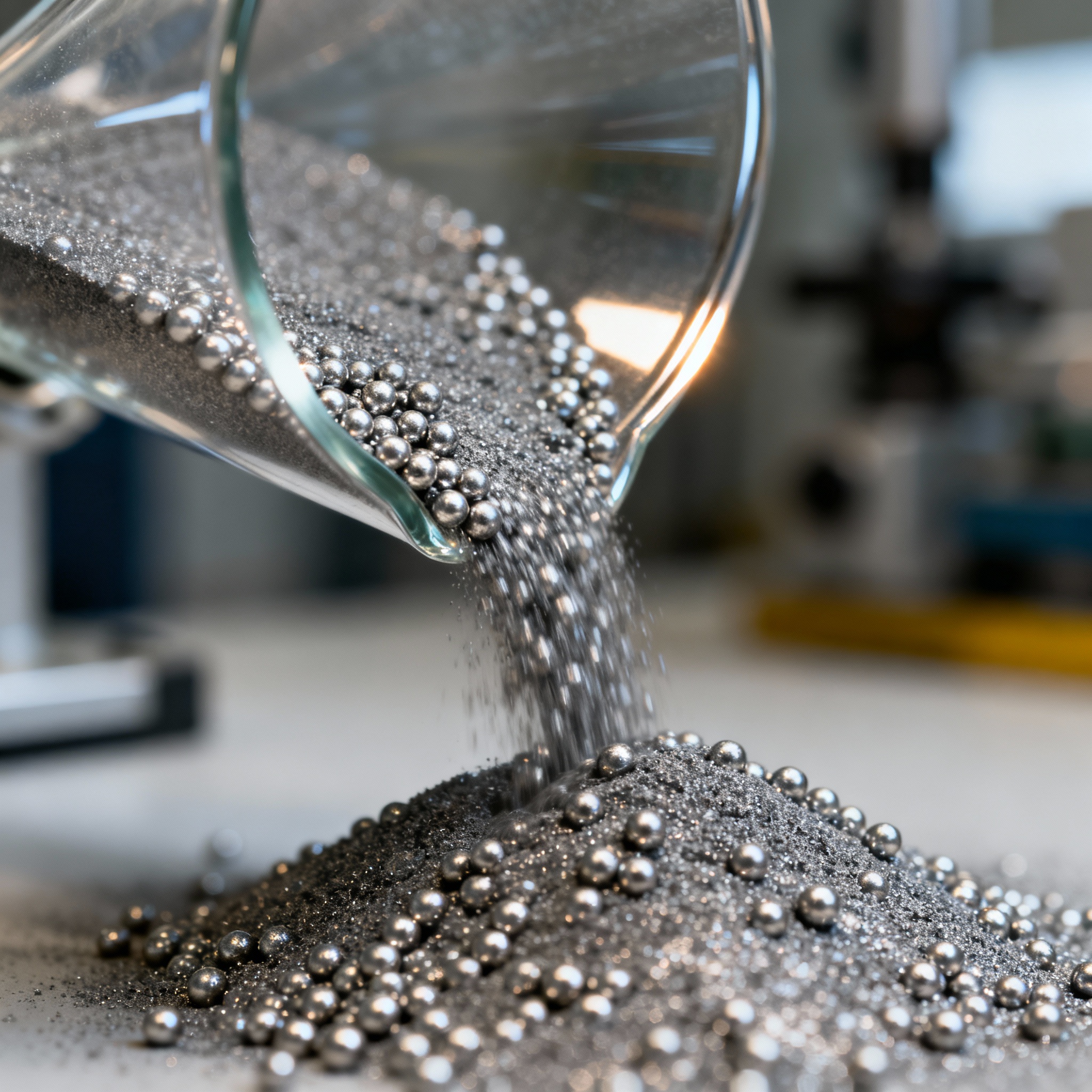
Metal powder management represents one of the critical factors for the success of industrial additive manufacturing. Traditional systems based on powder bed fusion require complex infrastructures and rigorous safety protocols, while alternative technologies are emerging to simplify this operational aspect.
Markforged's Metal X system completely eliminates the need for direct powder management, using metal-polymer composite filaments that require minimal personal protective equipment (PPE). This approach significantly reduces the risks associated with handling fine metal powders, which can be explosive and harmful to health. The process involves three phases: printing the “green” component, washing with debinding fluids to remove the plastic binder, and final sintering in a furnace.
An even more innovative solution is represented by the Gauss MT90, which replaces traditional powders with proprietary “metal ink” cartridges, with prices starting at $150. This system, awarded at CES 2026, brings desktop metal printing to an unprecedented level of accessibility, completely eliminating the handling of powdery materials and making the technology suitable for office environments.
Infrastructure Requirements for 3D Printing in an Industrial Environment
Infrastructure requirements vary drastically depending on the metal additive manufacturing technology adopted. Metal FFF systems have moderate requirements: the metal 3D printer does not need special preparations, while the washing and sintering stations require extraction systems. This configuration is significantly more accessible than traditional powder bed fusion systems.
For large-scale industrial implementations, automation of powder transfer becomes essential. Volkmann's PowTReX system, introduced in 2018 and recently updated with a “next-generation” version, automates the entire cycle: transfer of powder from containers or feed hoppers, extraction and sieving of the used material after each build to remove oversized particles, and collection of the screened powder for reuse in the printing process.
PowTReX is a closed, explosion-proof system designed to protect the material from contamination and operators from direct contact, eliminating manual handling. Compatible with printers from all manufacturers, it supports tungsten, cobalt, silver, iron, stainless steel, alumina, nickel-chromium, copper, titanium, carbide powder, and corundum. With over 100 installations in the additive manufacturing sector worldwide, it represents a consolidated solution for high-volume production.
Metal Powder Recycling and Regeneration Technologies
The circular economy is becoming a fundamental pillar in metal additive manufacturing. The strategic partnership between CNPC Powder and Brose demonstrates how production waste can be transformed into high-value-added materials. CNPC Powder converts steel scrap from Brose's Chinese production lines into iron-based powders for additive manufacturing, using advanced technologies such as AMP and PS spheroidisation.
These technologies produce metal powders with high sphericity, flowability, stable particle size distribution, low oxygen content, and compliance with international standards such as IATF 16949. The closed-loop process reduces dependence on virgin raw materials and minimizes industrial waste, supporting Brose's ESG objectives.
CNPC Powder has established experience in recycling programs, producing materials such as 100% recycled Ti6Al4V Grade 23 powders with SCS certification and high-sphericity AlSi10Mg powders. The “Green Steel” produced entirely from stamping scrap maintains the chemical composition and mechanical properties of conventional sheet metal components, ensuring compatibility with machinery and supporting circular economy initiatives.
In the defense sector, 6K Additive has been selected as the preferred supplier of metal powders for AGF Defcom. Using the proprietary microwave UniMelt system, 6K Additive transforms AGF Defcom's solid and powdery production waste into high-performance metal powders for 3D printing of suppressors, significantly reducing production costs and material waste.
Environmental Control and Safety in Powder Bed Fusion Processes
Operational safety in metal additive manufacturing processes requires rigorous protocols and sophisticated environmental control systems. Traditional powder bed fusion systems require airtight chambers, controlled inert atmospheres, and dedicated ventilation systems to prevent contamination and explosion risks.
Markforged's Metal X system drastically reduces these requirements. It does not require a dedicated powder management system and requires minimal PPE for the printer operator, with greater requirements only for the washing and sintering phases. The Wash-1 station uses solvents such as Opteon SF-79, Opteon SF-80, or Tergo Metal Cleaning Fluid for the debinding process, requiring adequate extraction systems.
Automated systems such as Volkmann's PowTReX are designed with explosion-proof and fully enclosed features, eliminating operators' exposure to metal powders. These systems include powder buffers, ultrasonic screeners for removing agglomerates, and vacuum pneumatic transfer that keeps the material isolated from the external environment.
The inert gas option available for the PowTReX allows working with particularly reactive materials such as titanium and aluminum, preventing oxidation and combustion risks. This configuration is essential for aerospace and medical applications where material purity is critical.
Automation and Integration of Powder Management Systems
Automation represents the enabling factor for the scalability of metal additive manufacturing. The PowTReX system is specifically designed to support high-volume production using multiple 3D printers simultaneously. Its portability and universal compatibility with machines from all manufacturers make it ideal for flexible production environments.
Software integration plays a crucial role in optimizing workflows. The Metal X system operates on Markforged's Digital Forge platform, using the Eiger software common to the company's desktop and industrial printers. This uniformity simplifies operator training and integration into existing workflows. Users design the component, upload the file to Eiger, select the metal, and start printing, followed by automated washing and sintering phases.
The Q5D CY10L system represents a different approach to automation, using five-axis robotic cells for laser-assisted selective metallization. With a 100-watt 1064nm laser, the system creates metallic traces directly on complex 3D substrates of polymers, ceramics, and specialized aerospace dielectrics, enabling applications such as sensors, wireless antennas, and selective RF shielding.
Automation of the sintering process is equally important. The “brown” parts (after washing) are placed in furnaces where they are heated to remove residual binder material and solidify the metal powder. Optimizing this process requires precise control of temperature, atmosphere, and cycle times to ensure optimal density and mechanical properties.
Case Studies: Implementation of Scalable Infrastructures for Series Production
The practical implementation of infrastructure for metal additive manufacturing varies significantly by application sector. In the automotive sector, Brose uses AM to accelerate product development, ensuring that prototypes match series production materials. With approximately 31,000 employees at 68 locations in 24 countries, Brose produces vehicle systems including doors, tailgates, seats, and electric motors from 200 watts to 14 kilowatts.
The partnership with CNPC Powder for Green Steel demonstrates how large organizations are integrating the circular economy into their AM operations. The material, produced entirely from stamping scrap from Brose's pressing shops, is still under evaluation for volume production, but represents a significant step toward sustainability.
In the defense sector, AGF Defcom is scaling suppressor production using metal AM, with analysts predicting AM penetration in the suppressor market of more than 70% within five years. The closed-loop upcycling program with 6K Additive reduces production costs and material waste while ensuring a secure domestic supply chain.
In the semiconductor sector, Alumina Systems used the Lithoz S320 system to produce a 15-inch gas distribution ring for atomic layer deposition applications. Metal materials did not provide the required chemical resistance, and subtractive techniques struggled with the ring shape and nozzle resolution. LCM (Lithography-based Ceramic Manufacturing) technology solved both challenges, demonstrating how ceramic AM can complement metal applications.
Plasway, the end customer, found in AM the solution when polymers and metals did not meet the requirements and conventional production methods could not achieve the necessary geometries. This case highlights how AM is often considered when traditional technologies reach their limits.
Future Prospects and Regulatory Developments in the Sector
The metal additive manufacturing sector is rapidly evolving toward greater accessibility, sustainability, and production integration. The emergence of technologies such as Metal FFF and systems based on “metal ink” is democratizing access to metal production, reducing cost barriers and operational complexity.
The standardization of materials and processes represents a growing priority. Compliance with international standards such as IATF 16949 for recycled materials demonstrates the sector's growing maturity. Future regulatory developments will have to address aspects of safety, material traceability, and component qualification, particularly critical for regulated sectors such as aerospace, medical, and defense.
The circular economy will become increasingly central, with powder recycling and regeneration programs moving from pilot initiatives to standard practices. The ability to convert production waste into high-performance materials not only reduces environmental impact but also improves supply chain resilience, a strategic aspect highlighted by the 6K Additive-AGF Defcom partnership in the context of national security.
Automation will continue to evolve, with increasingly integrated systems that manage the entire workflow from powder preparation to post-processing. The goal is to achieve productivity and repeatability levels comparable to traditional manufacturing processes, enabling the transition from additive manufacturing as a prototyping technology to a solution for series production.
article written with the help of artificial intelligence systems
Q&A
How does Markforged’s Metal X system reduce risks related to metal powder handling?
Metal X uses metal-polymer composite filaments instead of loose powders, eliminating direct handling of potentially explosive or harmful powders. The operator only needs minimal personal protective equipment during printing; additional precautions are required only in the subsequent washing and sintering stages.
What are the three stages of the Metal X process and what additional infrastructure do they require?
The stages are: printing the “green” part, solvent washing to remove binder, and furnace sintering. The printer needs no special provisions, while the washing and sintering stations must be equipped with extraction systems for solvent vapors.
What role does Volkmann’s PowTReX system play in large-scale powder bed fusion production?
PowTReX automates the entire powder handling cycle: pneumatic transfer, sieving to remove oversized particles, and collection of recyclable powder. It is a closed, explosion-proof system compatible with any printer and supports reactive materials like titanium and aluminum with an inert atmosphere.
How does CNPC Powder turn Brose scrap into additive manufacturing powders?
CNPC uses AMP and PS spheroidisation technologies to convert steel scrap into high-sphericity ferrous powders with low oxygen and controlled particle size, compliant with IATF 16949. The closed-loop process reduces virgin material use and produces fully recycled and certified Ti6Al4V and AlSi10Mg.
Why is environmental control less burdensome with the Gauss MT90 than with traditional powder bed fusion systems?
The Gauss MT90 uses $150 “metal ink” cartridges, completely eliminating loose powders and making the technology suitable for ordinary offices. No sealed chamber, inert atmosphere, or dedicated ventilation is required, drastically reducing infrastructure costs and complexity.
What advantage does Markforged’s Digital Forge platform offer for integrating the Metal X workflow?
Digital Forge provides the unified Eiger software: the user uploads the file, selects the metal, and starts printing; washing and sintering stages are then automated. The consistent interface reduces training time and simplifies integration with existing enterprise systems.