Low-cost precision? Here are the real trade-offs
In the 3D printing landscape, choosing the right system means balancing precision, throughput, and cost, especially when transitioning from maker to industrial use. The difference between a desktop system and a production solution lies not only in price but in the operational compromises each choice imposes.
Workbench-to-production precision
High-end desktop systems maintain precision comparable to industrial solutions, but with scale and speed limits that emerge when moving to production.
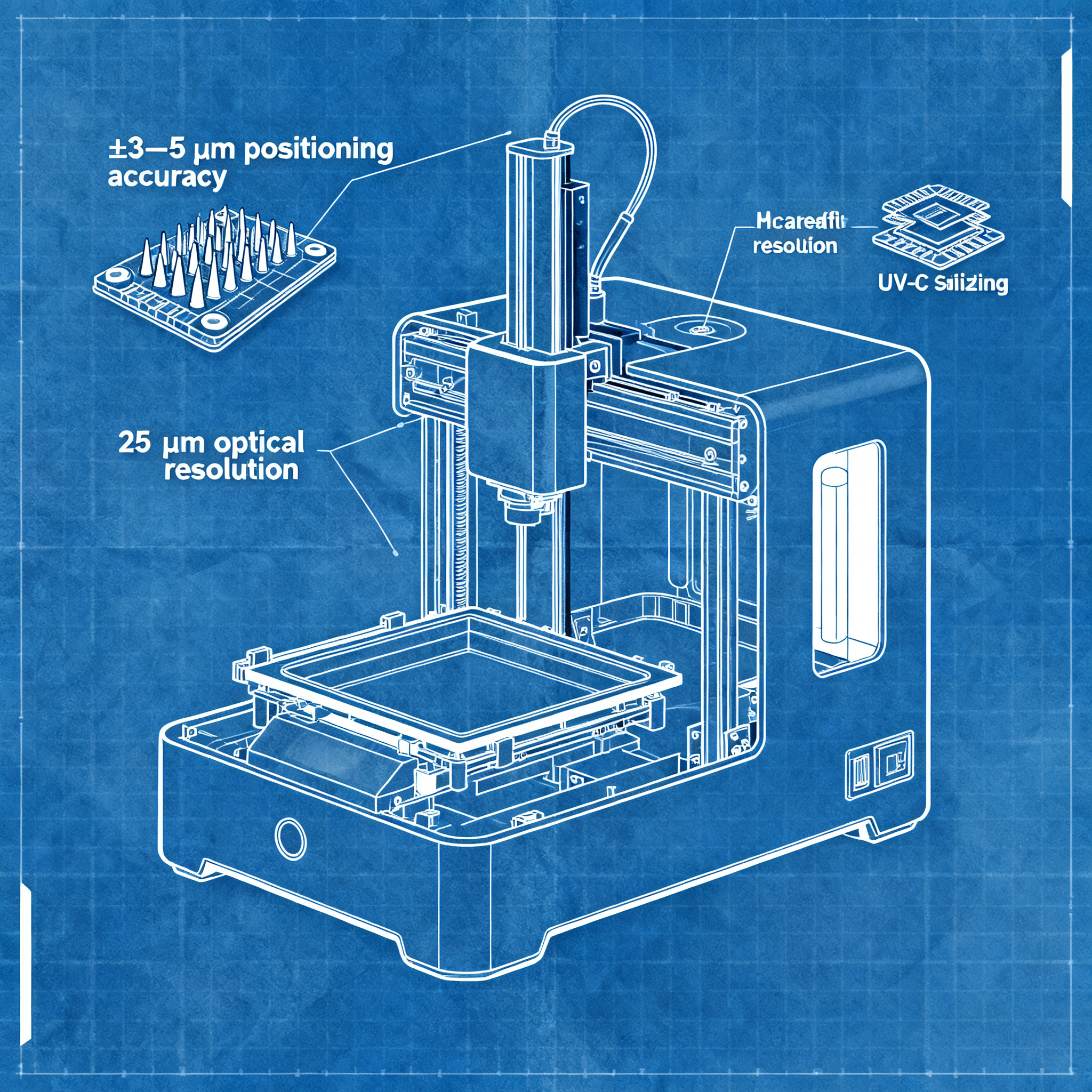
The microArch S150 represents a concrete example of how precision is no longer exclusive to industrial machines. With a positioning accuracy of ±3–5 µm and an optical XY resolution of 25 µm, this desktop system offers adequate performance for R&D and prototyping in critical sectors such as biomedical and electronics.
- PµSL technology with ±3–5 µm precision
- Heated resin tank for high-viscosity materials
- HEPA13 filtration and integrated UV-C sanitization
- Automatic calibration and pre-set material profiles
Precision remains constant, but the desktop format limits the print volume to tens of millimeters per side. This constraint defines the boundary between prototyping and production: components such as microneedles, microfluidic chips, or micro-gears fall perfectly within the scope, while larger parts require different solutions.
Speed vs control: the dilemma of small batches
The transition from prototyping to pilot production requires an increase in throughput that often conflicts with the need to maintain quality control.
The microArch S150 Ultra was created to meet this need. It maintains the same optical resolution (25 µm) but improves positioning accuracy to ±3 µm and optimizes throughput for fast small batches.
| Parameter | microArch S150 | microArch S150 Ultra |
|---|---|---|
| Main focus | Precision and flexibility | Speed and throughput |
| Positioning accuracy | ±3–5 µm | ±3 µm |
| Destination of use | R&D, laboratory | Pilot production |
| Layer thickness | 10–100 µm | 10–100 µm |
The trade-off becomes evident in production flow management. Increasing throughput means coordinating material feed, real-time monitoring, and automatic exposure compensation. Without these elements, the nominal speed translates to machine downtime and scrap.
Simplified post-production without compromising quality
New entry-level post-processors make industrial finishing accessible, but impose size and capacity limits that must be evaluated against production volume.
The AM Solutions M4 Basic represents an attempt to democratize industrial post-processing. This compact vibratory finishing system combines a 20-liter rotary vibratory bowl with a 25-liter process water tank in a closed-loop architecture.
The system handles parts up to 70 × 70 × 25 mm, compatible with SLA, SLS, MJF, and SLM. This maximum size excludes larger components, making it necessary to evaluate the production mix in advance.
The system offers smoothing, deburring, polishing, and cleaning for both polymers and metals. The closed-loop approach reduces water and energy consumption, extending the life of the process water and reducing downtime.
Colin Spellacy of AM Solutions emphasizes that «even smaller AM users are under pressure to provide consistently productive surface quality.» The M4 Basic replaces improvised manual steps with a controlled and repeatable process, but still requires attention to batch planning and cycle time management.
Conscious choice between precision, speed, and cost
The choice of the ideal system depends on the continuous balancing of precision, speed, and operational context. High-end desktop systems offer excellent precision for R&D and prototyping, but moving to pilot production requires investments in throughput and workflow management.
Entry-level post-processors bridge the gap between flexibility and final quality, but impose dimensional constraints that must be verified against the actual production mix. Every trade-off has an operational impact: speed without control generates waste, precision without throughput limits scale, automation without integration creates bottlenecks.
Evaluate your use case before investing: every trade-off has a hidden cost. The difference between an adequate system and an oversized (or undersized) one is measured in operational efficiency, not just technical specifications.
article written with the help of artificial intelligence systems
Q&A
What is the positioning accuracy of the microArch S150?
The microArch S150 offers a positioning accuracy of ±3–5 µm and an XY optical resolution of 25 µm, making it suitable for R&D and prototyping applications in critical sectors such as biomedical and electronics.
What are the main differences between the microArch S150 and the microArch S150 Ultra?
Both maintain an optical resolution of 25 µm, but the S150 Ultra improves accuracy to ±3 µm and increases throughput, making it more suitable for pilot production compared to the standard model dedicated to R&D and laboratory use.
What technologies and features distinguish the microArch S150?
The microArch S150 uses PµSL technology, features a heated resin tank for high-viscosity materials, integrated HEPA13 filtration, UV-C sanitization, automatic calibration, and preset material profiles.
What limitations does the M4 Basic have in the post-processing stage?
The M4 Basic can handle parts up to 70 × 70 × 25 mm, so it is limited in terms of maximum size. It is compatible with various additive technologies such as SLA, SLS, MJF, and SLM, but requires careful planning of production batches.
How do trade-offs between accuracy, speed, and cost influence the choice of a 3D printing system?
Choosing a system means balancing accuracy, throughput, and cost. High accuracy alone is insufficient if there is no throughput for production, just as greater speed without quality control can generate waste. Every choice has an operational and hidden impact on the final cost.