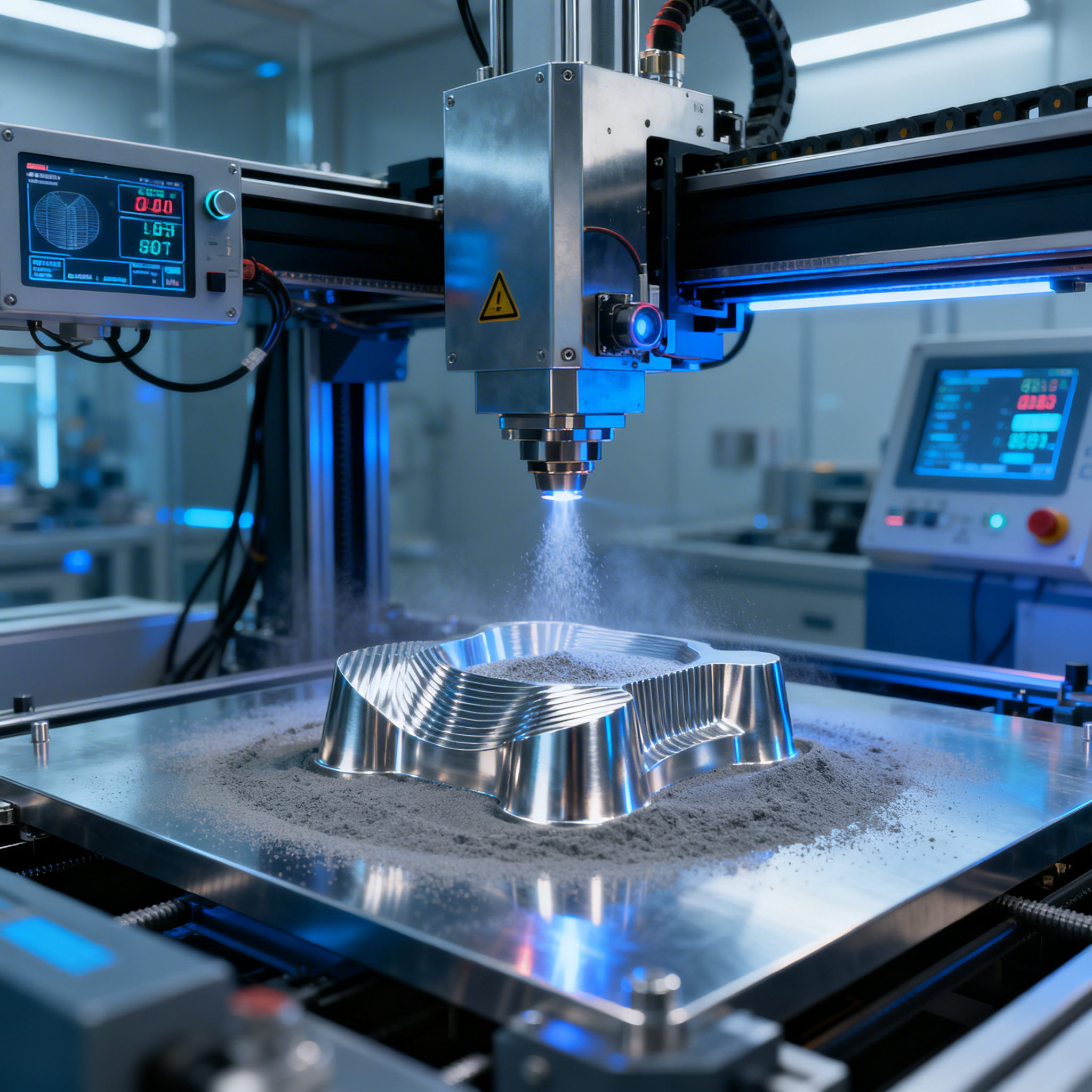
Dust under control: how patents are redefining precision in additive manufacturing
At the heart of new technologies for additive manufacturing, there is a silent revolution: intelligent powder control, which promises to make every layer more precise and predictable.
Cited patents
- POWDER MONITORING FOR ADDITIVE MANUFACTURING SYSTEMS — 2025-09-04
- POWDER MONITORING FOR ADDITIVE MANUFACTURING SYSTEMS — 2025-09-04
What problem does it solve
Variability in powder properties can compromise the quality of the final product, causing defects that are difficult to predict or correct afterwards.
In metal 3D printing, every layer depends on the quality and consistency of the deposited powder. When particle characteristics vary – size, morphology, flowability – the result can be an unstable melt pool, unwanted porosity, or structural defects that only emerge after costly post-printing processing. The first patent describes a system that receives data from sensors and determines particle characteristics, generating signals that allow for the real-time adjustment of deposition parameters. The second patent focuses on powder flow characteristics: the system receives data from sensors, determines flow properties, and generates signals to control both the energy delivery device and the powder feeding device.
The challenge is not only technical: it is economic. Every part scrapped due to powder-related defects represents wasted machine hours, material, and post-processing. In sectors like aerospace, where components must pass rigorous qualifications, feedstock variability can halt entire productions.
The idea in 60 seconds
Two recent patents propose active powder monitoring systems during 3D printing, with the goal of dynamically adapting process parameters based on the real conditions of the material.
Both patents describe additive manufacturing systems that include an energy delivery device (to form the melt pool on the build surface), a powder feeding device (which directs a flow of powder towards the melt pool), at least one sensor, and a computing unit. The difference lies in the focus: the first system analyzes particle characteristics – size, shape, distribution – and adapts the laser energy or deposition speed to maintain optimal melting conditions. The second system monitors powder flow characteristics – flow rate, uniformity, direction – and regulates parameters to ensure that every layer receives the right amount of material, in the right place, at the right time.
In both cases, the computing unit receives data from sensors, processes it, and controls the energy and powder devices to deposit a plurality of layers according to a set of deposition parameters. The approach is closed-loop: the system “sees” what is happening and reacts, instead of relying on predefined parameters that do not account for real material variations.
What really changes (tangible improvements)
Thanks to real-time monitoring, waste is reduced, consistency between layers is improved, and post-printing corrections are minimized.
The first system, focused on particle characteristics, allows for the detection of when the dust presents irregularities – for example, particles that are too large or agglomerates – and compensates by modifying the energy supplied or the deposition parameters. This results in an improvement in layer quality and a reduction in waste due to irregularities in the dust. If the dust changes during printing (for example, due to contamination, humidity, or degradation from reuse), the system adapts the process instead of producing a defective part.
The second system, focused on flow, addresses a different but equally critical problem: the variability in the amount of dust that reaches the melt pool. Even with excellent quality dust, if the flow is irregular – too much or too little material – the result is a non-uniform layer. Continuous flow monitoring allows for greater uniformity between layers and reduces the need for corrective post-processing, such as mechanical reworking or heat treatments to correct dimensional or structural defects.
Both systems aim for more repeatable production: less variability means fewer surprises, fewer trials, less waste. For those who produce in series, this translates to more predictable costs per part and a wider process window, facilitating the adoption of new alloys or recycled powders.
Example in company / on the market
In advanced contexts such as aerospace, prototypes are already in use that regulate laser energy or distributor speed based on collected data.
Imagine an aeronautical production department that prints nickel alloy components. During printing, the particle monitoring system detects that a portion of the dust has a slightly different size distribution from the previous batch – perhaps due to a change in supplier or degradation from reuse. The system automatically adapts the laser energy to maintain optimal fusion, avoiding porosity or defects in bonding between layers.
In another scenario, an automotive manufacturer prints a complex component with variable geometries. The flow monitoring system detects a variation in the dust flow rate – perhaps due to partial clogging or a fluctuation in the transport gas pressure. The system immediately corrects the speed of the dust distributor, ensuring that each zone of the layer receives the correct amount of material.
These examples are not yet market standards, but they represent the type of application that patents make possible. The technology is based on sensors already integrable into existing systems and feedback loops already used in other automated industrial sectors, which makes adoption plausible in the coming years.
Trade-offs and limits
Implementation requires structural modifications to existing machinery and raises questions about the reliability of sensors in thermally aggressive environments.
The first limitation is integration: both systems require sensors, computing units, and control software that are not standard on all AM machines. For manufacturers with legacy machine fleets, adoption could mean costly retrofits or replacement of plants. The complexity of integration with existing machinery is a real obstacle, especially for companies that have already invested in process qualifications based on fixed parameters.
The second limitation concerns the long-term reliability of sensors in a high-temperature environment: the melt pool can exceed 1,500 °C, and the surrounding environment is often saturated with fine dust, inert gases, and radiation. Optical or thermal sensors must withstand these conditions without degrading or requiring continuous calibration. The need for continuous calibration for different types of dust is another critical point: each alloy, each supplier, each batch may have different characteristics, and the system must be “trained” or configured to recognize and manage these variations.
Finally, there is the risk of possible interference with other optical measurements in the working field: many AM machines already use melt pool or layer surface monitoring systems. Adding further sensors for the powder could create conflicts or redundancies, requiring a more complex system architecture.
Reality check: what is needed to reach production
For real diffusion, prolonged testing cycles, common standards for integration and specific training for operators will be needed.
The patents describe working systems, but moving from paper to production requires validation. Prolonged testing cycles are needed on different alloys, different machines, different operating conditions. AM machine manufacturers will have to collaborate with sensor and software providers to define standardized system architectures, avoiding proprietary solutions that fragment the market.
Another critical element is training: operators will have to understand how to interpret the system signals, how to intervene in case of anomalies, how to configure the parameters for new
article written with the help of artificial intelligence systems
Q&A
- What main problems can variations in powder properties cause during metal 3D printing?
- Variations in powder properties, such as size, morphology and flowability, can cause an unstable melt pool, unwanted porosity and structural defects. These problems can compromise the quality of the final product and require costly post-printing processing.
- What do the two patents mentioned in the article consist of?
- The first patent describes a system that monitors the characteristics of the powder particles and adapts the deposition parameters in real time. The second patent focuses on monitoring the powder flow, regulating the energy delivery and powder feeding devices to ensure uniformity and precision in the layers.
- How do these systems contribute to improving additive manufacturing?
- Both systems reduce waste, improve consistency between layers and minimize post-printing corrections. By monitoring the characteristics of the powder and its flow in real time, the systems are able to compensate for any irregularities, increasing process repeatability and reducing costs per part.
- What are the main limitations and challenges related to the implementation of these systems?
- The main limitations include the need for structural modifications to existing machinery, the reliability of sensors in thermally aggressive environments, and the complexity of integration with already installed systems. In addition, frequent calibrations and specific training for operators may be required.
- Which sectors could benefit most from this technology?
- Sectors such as aerospace and automotive, where the quality and precision of components are critical, can greatly benefit from this technology. In particular, monitoring systems make it possible to avoid structural defects and obtain components that comply with rigorous specifications without resorting to repeated post-production checks.