300 km of cables in 48h? How infrastructure projects are redefining production and logistics
Major infrastructure projects are radically changing the way industrial-scale works are designed and built. From data centers to semiconductor factories, the demand for AI and high-energy-intensity computing is driving massive investments that require specific materials, integrated logistics, and advanced production technologies.
New infrastructures are not just large: they are hyper-specialized. Every sector requires tailored solutions that integrate technological choices, materials, and operational processes in a coordinated way.
AI-driven infrastructures
New computing hubs are designed around the energy and thermal requirements of AI, redefining materials and construction layouts.
The expansion of data centers is creating pressure on the entire infrastructure chain. More computing power means greater electricity demand, which in turn requires network upgrades, new generation projects, and transmission infrastructures.
Semiconductor production is growing again. Companies and governments no longer want to depend so heavily on foreign production after the shortages of recent years. This push is redefining where and how factories are built.
- Data centers are driving massive investments in energy infrastructure
- Chip production is being relocated to reduce foreign dependence
- Every project requires coordinated upgrades of the power grid and transmission systems.
Tailored materials for critical sectors.
From composite structures for wind farms to copper alloy conductors for power systems, every sector requires custom solutions.
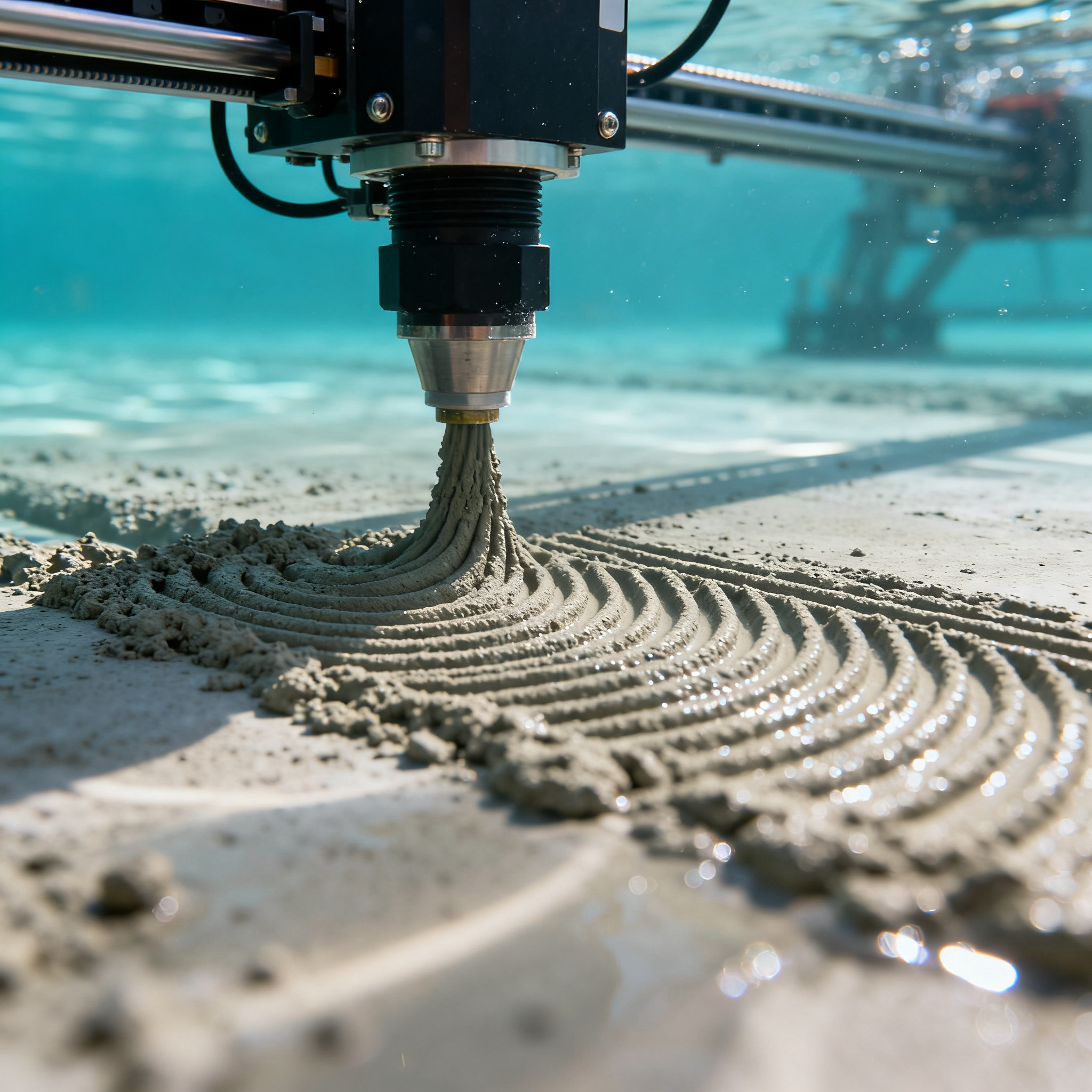
Additive manufacturing is finding concrete applications in underwater infrastructure. LUYTEN 3D has developed with the University of Wollongong the first accelerator-free concrete mixture specifically designed for underwater printing.
This formula simplifies the printing process and eliminates the need for chemical accelerator, typically used to prevent concrete from dissolving underwater. Laboratory tests used saltwater and seabed sand to simulate real conditions.
Target applications include coastal resilience, offshore wind energy, and defense. The ability to print directly underwater radically changes the way critical infrastructure is built, repaired, and reinforced in marine environments.
Underwater printing process
- Mixture preparation: accelerator-free concrete with seabed sand.
- Printing in saline environment: Direct underwater deposition without risk of dissolution.
- Natural hardening: The material stabilizes without chemical additives.
For terrestrial projects, construction speed becomes crucial. At Milan Bergamo Airport, WASP printed a service structure in 3D in 19 days, 7 of which dedicated to printing. The WASP Crane system has a construction volume of 8,200 x 3,200 mm and prints up to 200 mm/s.
Lime-based mortar has replaced traditional cement to reduce emissions. In contexts such as airports or energy plants, reducing construction times means saving much more than just the cost of the structure: safety checks, monitoring, access management, and operational risk are drastically reduced.
Logistics and supply: the bottleneck
The logistical complexity of infrastructure projects requires integrated and resilient supply chains.
The partnership between ICON and PALFINGER demonstrates how the integration of printing technology and industrial lifting systems is essential for scalability. ICON's Titan system can print structures up to 8 meters in height, with costs of about 20 dollars per square meter for wall systems.
PALFINGER contributes with lifting and stabilization technologies to position and support these systems in the field. This collaboration marks a shift from pilot projects to repeatable industrial implementations.
Cost reduction of up to 40% compared to traditional methods depends on the ability to operate continuously and manage large-scale projects, not just on printing technology.
Data management becomes critical. Additive manufacturing generates large volumes of data relevant to the process: software versions, parameter files, preparation tools, and monitoring systems all influence the final result.
Organizations with established digital production practices integrate additive manufacturing more effectively. Those without this foundation encounter bottlenecks not directly related to the printing process.
Specialization and integration: the keys to success
Modern infrastructure projects win only when they know how to integrate technology, materials, and logistics in a coordinated way. It is not enough to have powerful machines or innovative materials: a mature digital ecosystem is needed to connect design, production, quality control, and IT.
Supply chain resilience has become a priority. Geopolitical tensions and disruptions have pushed towards localized production and reduced dependence on foreign suppliers. Additive manufacturing meets this need when supported by adequate digital infrastructures.
Explore how your sector can adopt a targeted and scalable infrastructure approach, integrating advanced production technologies with data management and resilient logistics systems.
article written with the help of artificial intelligence systems
Q&A
How is the expansion of AI data centers affecting energy infrastructures?
The increase in computing power for AI requires greater electricity demand, which in turn imposes upgrades to the electrical grid, new generation projects, and transmission infrastructure. Consequently, new computing hubs are designed around the energy and thermal requirements of artificial intelligence, redefining materials and construction layouts.
Why is semiconductor production growing locally again in many countries?
Companies and governments want to reduce dependence on foreign production after the shortages of recent years. This push is redefining where and how semiconductor factories are built, shifting investments toward greater production autonomy and supply chain security.
What is the innovation of the concrete developed by LUYTEN 3D for underwater printing?
It is the first concrete mixture without chemical accelerator specifically designed for underwater printing. The formula uses saltwater and seabed sand to simulate real conditions, eliminating the risk of material dissolution without chemical additives. This technology radically changes the way critical infrastructures are built, repaired, and reinforced in marine environments.
What benefits did the 3D construction by WASP at Milan Bergamo airport bring?
The service structure was completed in just 19 days, of which 7 were dedicated to actual printing, with a system that prints up to 200 mm/s. Lime-based mortar was used instead of traditional cement to reduce emissions. The drastic reduction in construction times results in significant savings on indirect costs related to safety, monitoring, and access management.
Why is data management considered critical for the scalability of additive manufacturing in infrastructures?
Additive production generates large volumes of relevant data, such as software versions, parameter files, and monitoring systems, which directly influence the final result. Organizations with established digital production practices integrate additive manufacturing more effectively, while those without it encounter bottlenecks not directly tied to the printing process. Furthermore, supply chain resilience requires a mature digital ecosystem that connects design, production, and quality control.