Functional 3D fidget toys? Here's how to make them well
Creating effective fidget toys requires precise choices in design and materials: here’s how to do it best with ready-to-use models.
3D-printed fidget toys really work only if designed correctly. The difference between an object that ends up in a drawer and one you use every day lies in construction techniques, material choice, and post-printing optimization.
Ready and tested 3D models
Finding already validated models saves you hours of testing and failed prints. Here’s where to look and what to evaluate.
Platforms like MakerWorld offer hundreds of community-tested models. The most reliable designs include the Thor’s Hammer Fidget Spinner by araymbox, which combines a spinner and clicker in a single object, and the 5 Finger Fidget Clicker by CV3DP, one of the most downloaded for its immediate functionality.
The Walkman 4-in-1 Snap-Fit by Dimension W integrates four different mechanisms without the need for assembly. These models have already passed hundreds of prints and positive reviews.
- Clicking Orb by 3Dnetic: spherical print-in-place clicker mechanism
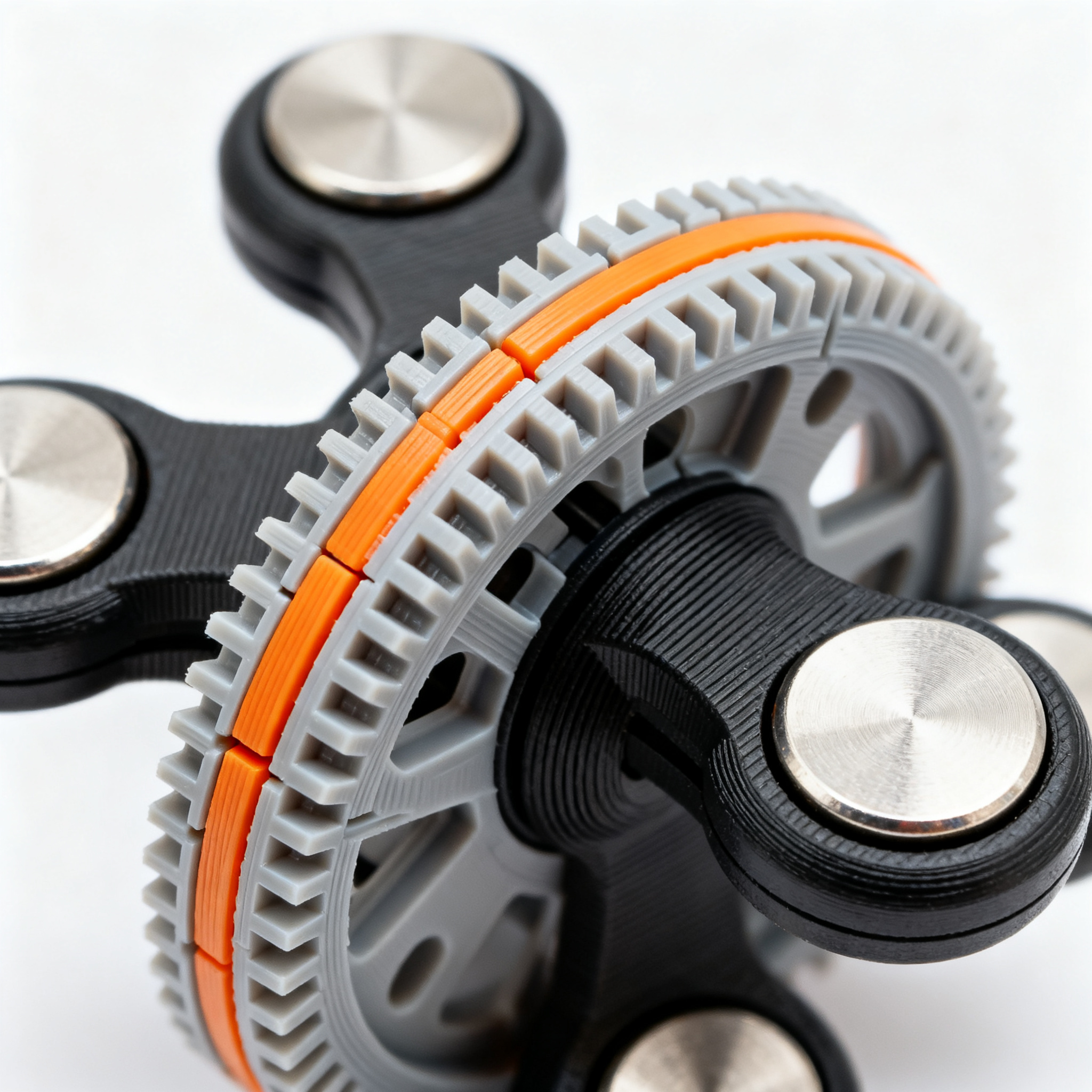
- Blade Heavy Duty Planetary Gears: spinner with sturdy planetary gears
- Overengineered Gear Slide Clicker: combination of gears and sliding mechanism
- Minimal Clicker by JamesThePrinter: essential design for quick prints
For more complex fidgets, the Fidget-Fuse Grenade 5-in-1 offers five different snap-fit mechanisms. The C4 Detonator by Rexi Labs reproduces a realistic click sound thanks to specially designed geometries.
Construction techniques for movement
Snap-fit, print-in-place and moving joints: the techniques that ensure functionality without complex assembly.
The print-in-place is the most effective technique for fidget toys. It allows printing moving parts already assembled, as in the Crazy Marble Fidget Toy V2 by Binrux3D. It requires precise tolerances between 0.2mm and 0.3mm between moving parts.
The mechanisms snap-fit use elastic snap fits that are assembled with manual pressure. The Passthrough Button v4 by Plaid Platypus uses this technique to create a button that passes completely through the body of the fidget.
Tolerance verification
- Calibration: Print a test cube to verify the actual dimensions of your printer.
- Tolerance test: Use a model with variable gaps (0.1-0.5mm) to find the optimal value.
- Adjustment: Scale the model or modify the slicing parameters based on the results.
The planetary gears, as in the Blade Spinner, they distribute the weight and create smooth rotations. The Compliant Mechanism Spherical Flexure Joint uses the flexibility of the material itself to create movement without separate parts.
The Limau Link by YY the panjang uses chains printed together, tested to withstand repeated drops. This technique requires correct layer orientation to maximize strength.
The right materials for lasting results
PLA, PETG or TPU: each material completely changes the behavior of your fidget toy.
The PLA remains the main choice for rigid clickers and spinners. It offers dimensional precision and a crisp click sound. PLA+ improves impact resistance by 30-40% compared to standard PLA.
The PETG It is ideal for fidgets that undergo repeated stress. It has greater flexibility than PLA and resists wear better at contact points. It is perfect for snap-fit mechanisms that are frequently assembled and disassembled.
| Material | Ideal application | Main feature |
|---|---|---|
| PLA/PLA+ | Clickers, rigid spinners | Crisp click, high precision |
| PETG | Snap-fit, parts under stress | Flexibility and durability |
| TPU (95A) | Grip, tactile surfaces | Softness and quietness |
The TPU 95A it is used for soft inserts that improve grip. Rossero's TriFlex leverages this characteristic to create printed flexible fabrics. For silent fidgets, TPU drastically reduces the noise of mechanisms.
I special filaments such as wood- or metal-filled PLA add weight and a premium feel to spinners. The extra weight improves inertia and spin duration.
Optimization and post-processing
Post-print finishing turns a working prototype into an object you actually want to use.
The smoothing of the contact points reduces friction in rotating mechanisms. 400-800 grit sandpaper followed by 1000-2000 grit creates smooth surfaces. For optimal results, use consistent circular motions.
The Virus Fidget Toy by Lins benefits from light lubrication. Use silicone spray lubricants, never oils that attract dust. One drop in the rotation points is enough for months.
Print-in-place fidget toys can melt if exposed to temperatures above 50°C. Do not leave them in a car in summer or near heat sources.
The painting requires a specific primer for plastic. The Hexagon Twist Illusion by MeasureOnce creates optical effects that are amplified with contrasting colors. Use acrylic spray paints for even finishes.
For mechanisms that seize, the heat treatment can help. Briefly immerse the parts in hot water (60-70°C for PLA) and move them gently. This relaxes internal stresses and improves smoothness.
Conclusion
With the right construction techniques and appropriate materials, you can create custom fidget toys that last over time and work perfectly. Community-tested models give you a solid foundation, while post-print optimization makes the difference between a mediocre object and an excellent one.
Try one of the recommended models right away and share your results with the community! Start with simple designs like the Minimal Clicker to get familiar with tolerances, then move on to more complex projects like multi-function mechanisms.
article written with the help of artificial intelligence systems
Q&A
Where can I find 3D models of fidget toys that are already tested and reliable?
Platforms like MakerWorld offer hundreds of community-validated models. Among the most reliable designs are the Thor's Hammer Fidget Spinner, the 5 Finger Fidget Clicker, and the Walkman 4-in-1 Snap-Fit. These models have already passed numerous prints and gathered positive reviews, reducing the risk of failed prints.
Which construction techniques ensure functionality without complex assembly?
The print-in-place technique allows printing moving parts already assembled, requiring tolerances between 0.2 mm and 0.3 mm. Snap-fit mechanisms use elastic interlocks that assemble with simple manual pressure. Furthermore, planetary gears and flexible joints exploit geometry or material deformation to create smooth movements.
How do you calibrate tolerances to correctly print moving parts?
It is necessary to print a test cube to verify the actual dimensions of the printer and use a model with variable gaps between 0.1 mm and 0.5 mm to find the optimal value. Based on the results, you can scale the model or modify the slicing parameters. This process ensures that moving parts are neither too tight nor too loose.
Which materials are most suitable for the different types of fidget toys and why?
PLA and PLA+ are ideal for rigid clickers and spinners thanks to dimensional precision and crisp click sound. PETG is preferable for snap-fit and parts subjected to repeated stress because it offers greater flexibility and wear resistance. TPU 95A, on the other hand, is perfect for soft inserts, grips, and silent fidgets.
Which models are recommended for those approaching fidget toy printing for the first time?
To get started, the Clicking Orb with spherical print-in-place mechanism, the Blade Heavy Duty Planetary Gears, and the Minimal Clicker for quick prints are recommended. For more complex solutions, one can choose the Fidget-Fuse Grenade 5-in-1 and the C4 Detonator, which offer multiple mechanisms and realistic click sounds.