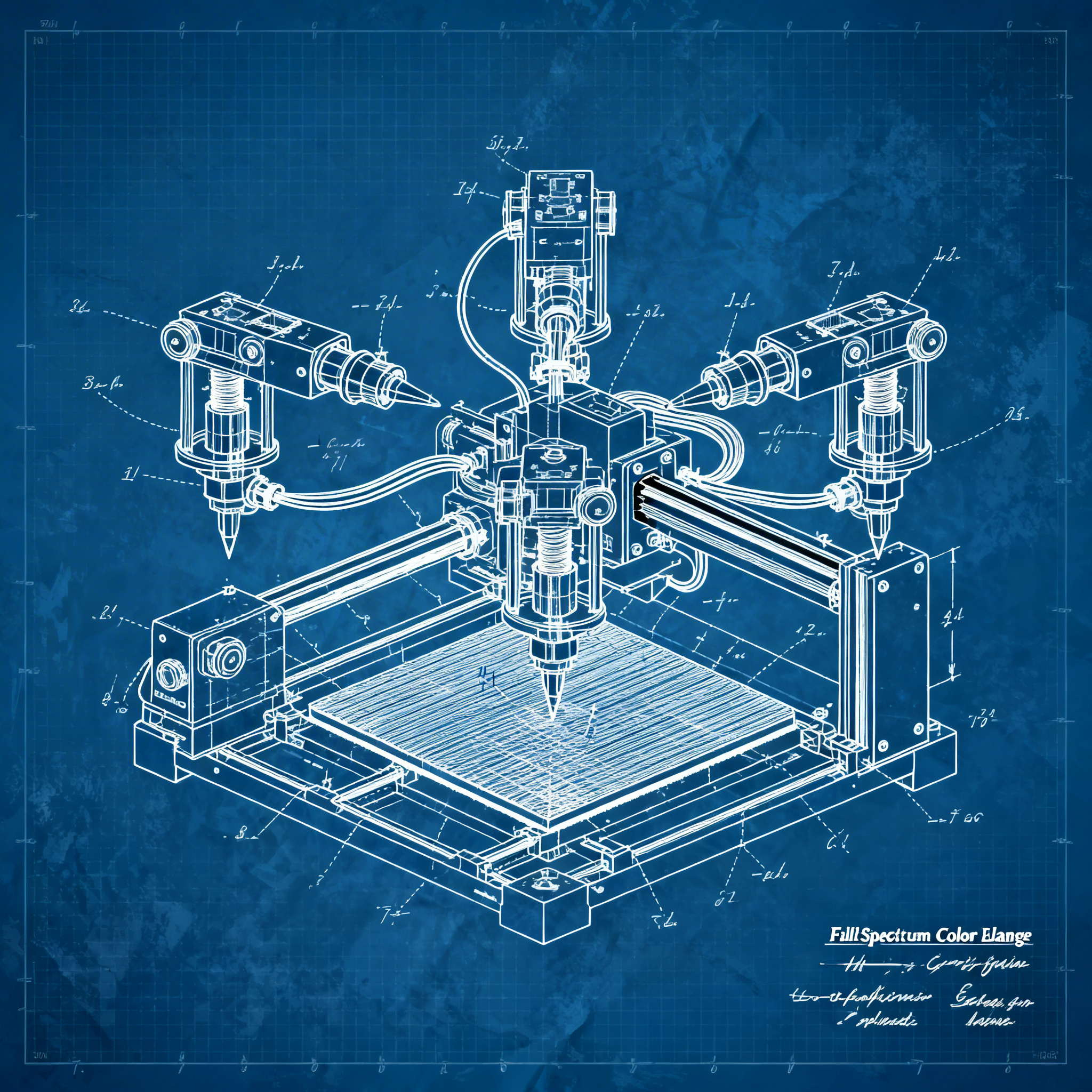
FullSpectrum and Toolchanger: How Advanced Color 3D Printing Really Works
Color 3D printing is evolving thanks to solutions like FullSpectrum and intelligent toolchanger systems, which together are redrawing the possibilities of color in FFF. While traditional multicolor systems are limited to combining a few physical filaments with sharp changes and bulky purge towers, the integration between controlled optical mixing and rapid tool changing opens up completely new technical scenarios for desktop and industrial production.
The FullSpectrum Principle: Precise Mixing for an Extended Gamut
FullSpectrum exploits the controlled stacking of thin, translucent layers to generate intermediate colors through light transmission, overcoming the limit of the four physical filaments typical of multicolor systems.
The FullSpectrum system, implemented in the “Snapmaker Orca Full Spectrum” fork of Orca Slicer developed by Ratdoux, introduces the concept of “virtual colors” in FFF printing. Unlike traditional mixing systems that fuse materials inside the nozzle, FullSpectrum alternates very thin layers of different filaments along the Z-axis: when the materials are sufficiently translucent and the layers fine enough, light passes through multiple levels before reflecting, and the human eye optically integrates the chromatic contributions perceiving a uniform intermediate hue.
The principle is based on the “transmission distance” – the distance of material traversed by light – combined with the opacity and color of the base filaments. This approach allows for simulating an extended color gamut starting from a few well-chosen filaments, bringing FFF printing closer to a chromatic language typical of digital graphics. In the artistic and product design fields, the system enables continuous gradients and realistic shading without resorting to complex inkjet processes or post-print coating.
Mechanical Toolchangers: Reducing Dead Times in Color Changes
Modern toolchangers with dedicated print heads eliminate the long purging phases typical of filament changes, reducing dead times and waste to a few seconds per chromatic transition.
The SnapSwap system patented by Snapmaker represents the evolution of color changing from filament change to tool change. Instead of pushing new material through a single nozzle to eliminate residues of the previous color – a process that generates long times and much wasted plastic – the toolchanger uses up to four dedicated hotend modules, each with its own filament ready for use.
The print carriage engages the required module in a few seconds, performing the exchange with a contained impact on total time even in jobs rich in color changes. The central element is the use of spherical kinematic couplings to align each hotend module with high repeatability, without screws, magnets, or specific motors for locking. This approach drastically reduces waste during chromatic transitions, making multicolor printing much closer, in terms of productivity, to fast single-color printing.
On machines with CoreXY kinematics, high accelerations, and speeds in the order of hundreds of millimeters per second, the speed of tool changes becomes even more critical: minimizing the time lost with each color change contributes significantly to reducing total print time. Independent analyses indicate that configurations with a toolchanger can complete multicolor jobs in significantly shorter times compared to filament change solutions or systems based on long purges.
Software Integration: Coordinated Control between Mixing and Tool Changing
The firmware and slicer manage in real-time the coordination between the toolchanger and FullSpectrum layer sequences, ensuring color consistency and surface quality through responsive motion planning algorithms.
Hardware-software integration is crucial for maintaining consistent results. The Orca Full Spectrum fork introduces a dedicated module for defining and managing virtual colors directly within the slicing flow, calculating optimal layer sequences to achieve the desired tones. The system may require material changes at every single layer in areas with virtual colors, a feature that makes the technique particularly suitable for multi-nozzle toolchanger machines where each material is always ready without long retractions.
The development roadmap includes local Z-dithering, a function that will allow locally varying the layer height in mixed zones to obtain more precise material proportions vertically, ensuring more accurate control of the perceived color and reducing the gap between preview and actual result.
Integration with high-speed systems leverages input shaping and pressure advance techniques to optimize dynamics and extrusion, containing vibrations and surface defects even during frequent tool transitions. The coordination between the responsive motion planner and color management creates space for additional services such as predictive maintenance and remote tuning, crucial elements when 3D printing is integrated into production lines.
Industrial vs Hobbyist Applications: Where It Makes the Difference
The FullSpectrum-toolchanger combination finds optimal application in aesthetic prototyping, signage, and professional product design, while hobbyist use benefits from operational simplification in advanced desktop systems.
On the industrial side, the greatest interest focuses on aesthetic prototyping and signage, where the possibility of rendering gradients and shades with standard materials—rather than resorting to complex processes—opens up interesting scenarios for those seeking chromatic precision and production flexibility. The reduction of waste and downtime becomes particularly relevant on complex multicolor jobs, where the volume of wasted material could otherwise become very significant.
In the desktop segment, the integration between RFID material recognition, simplified profile management, quick tool changing, and the availability of optimized filaments aims to reduce the typical operational complexity of multi-extruder systems. This approach caters to users seeking advanced solutions without having to intervene deeply on slicing and daily calibrations, making multicolor and multimaterial printing more accessible.
The difference for the end user translates into fewer printing accidents, fewer manual interventions for filament changes, and greater reliability in long multimaterial jobs, often used for functional prototypes, parts with flexible inserts, or complex multicolor objects.
Conclusion
FullSpectrum and toolchangers represent a technical breakthrough for those seeking color precision and production flexibility in FFF 3D printing. The integration between controlled optical mixing and rapid tool changing transforms multicolor from a simple “color selector” into a tool capable of creating extended palettes with a few well-chosen filaments, bringing FFF technology closer to a richer color language while maintaining the cost and accessibility advantages of desktop 3D printing.
Explore the available configurations for your printing ecosystem and discover how to implement advanced color solutions evaluating hardware compatibility, software requirements, and specific use cases for your application.
article written with the help of artificial intelligence systems
Q&A
- What is the principle behind FullSpectrum technology?
- FullSpectrum exploits the controlled stratification of thin, translucent layers to generate intermediate colors through light transmission. When materials are sufficiently transparent and layers are thin enough, light passes through multiple levels and the human eye perceives a uniform intermediate hue.
- How does the patented Snapmaker toolchanger system work?
- The SnapSwap system uses up to four dedicated hotend modules, each with ready-to-use filament. The print carriage engages the required module in a few seconds, eliminating long purges and reducing downtime to a few seconds per color transition.
- What benefits does the software integration between FullSpectrum and toolchanger offer?
- The firmware and slicer coordinate the toolchanger with FullSpectrum layer sequences in real-time, ensuring color consistency and surface quality. The system calculates optimal layer sequences to achieve the desired tones and may require material changes at every single layer in areas with virtual colors.
- In which industrial sectors does the FullSpectrum-toolchanger combination find optimal application?
- The optimal application is found in aesthetic prototyping, signage, and professional product design, where chromatic precision and production flexibility are required. The technology allows for gradients and shades with standard materials, avoiding complex and costly processes.
- What are the main benefits of the FullSpectrum system compared to traditional methods?
- FullSpectrum overcomes the typical limit of four physical filaments, simulating an extended chromatic range with a few well-chosen filaments. It allows for continuous gradients and realistic shades without complex inkjet processes or post-print varnishing, bringing FFF printing closer to a richer chromatic language.