Two nozzles, a real advantage? Here's how the Bambu X2D works
The new Bambu Lab X2D introduces a dual nozzle system with mechanical switching to improve precision and ease of support removal. Presented on April 14, 2026, the machine replaces the X1 series and brings some features already seen in the H family into a compact format.
Dual Nozzle System: how it really works
The dual nozzle system separates extrusion functions: one prints the model, the other handles supports with dedicated material. The change occurs via a gear mechanism, without additional motors on the toolhead.
The main nozzle of the X2D prints the finished part. The auxiliary nozzle handles supports with a different material, making removal easier without heavy post-processing interventions.
The transition between the two nozzles occurs through a combination of gears and activation mechanisms. Bambu Lab chose not to add a dedicated motor on the toolhead: this solution reduces inertia and vibrations, improving stability and precision.
- Over a million nozzle changes in durability tests
- No loss of operational smoothness
- Mechanical system without additional electrical components on the toolhead
With multicolor PLA or PETG, the nozzle change allows for faster transitions and less purging compared to systems that change filament on the same hotend. The print volume is 256 × 256 × 260 mm with a single nozzle, reduced to 235.5 × 256 × 256 mm in dual nozzle configuration.
Dedicated extruders: Direct Drive vs Bowden
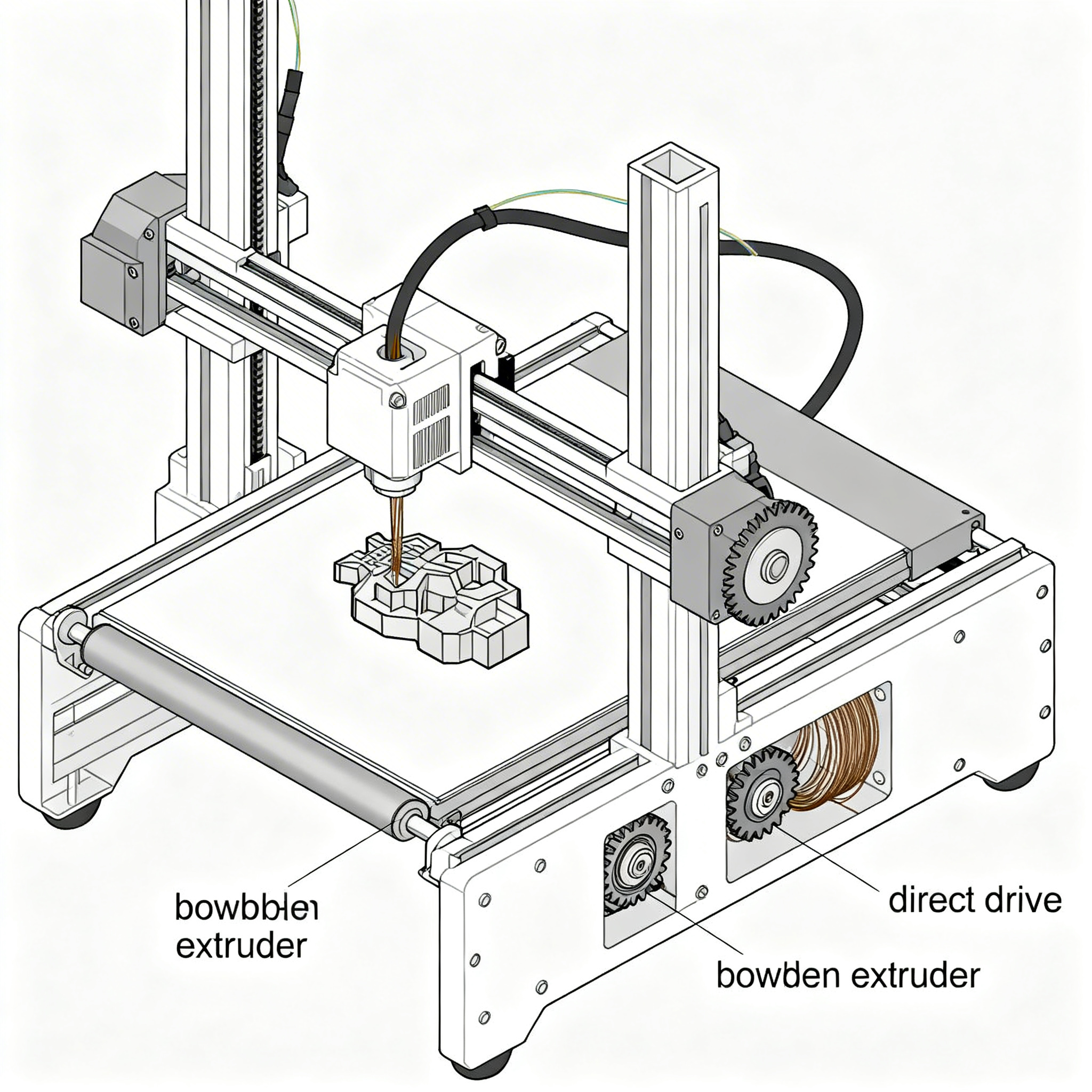
The X2D combines a main direct drive extruder for printing the part and an auxiliary Bowden extruder for supports and multimaterial processing. This architecture separates tasks to maximize efficiency and quality.
The main direct drive extruder ensures precision and control over the model material. The auxiliary Bowden extruder is positioned at the rear of the machine and is used for support material.
This separation has a clear objective: the main nozzle remains the most suitable for printing the part, while the second is oriented toward specific multimaterial processing and dedicated supports. In Tom's Hardware tests, the Bowden nature of the auxiliary nozzle also emerges as a limitation: the second channel is useful for supports and material savings, but less suitable for being interpreted as a second “symmetrical” extruder compared to the main one.
| Feature | Main nozzle | Auxiliary nozzle |
|---|---|---|
| Extruder type | Direct drive | Bowden |
| Main function | Model printing | Supports and multimaterial |
| Precision | High | Standard |
| Standard TPU | Recommended | Not recommended |
Standard TPU is not recommended on the auxiliary nozzle precisely due to the Bowden setup. The machine reaches a maximum nozzle temperature of 300 °C and features an actively heated chamber up to 65 °C.
Mechanical switching: uncompromised reliability
The nozzle change occurs without additional motors, increasing longevity and precision over time. Choosing a pure mechanical system reduces failure points and maintains operational consistency.
Bambu Lab designed the switching system to last over a million cycles without performance loss. The choice to eliminate additional motors on the toolhead is not just a matter of weight: it reduces vibrations, simplifies maintenance, and increases overall reliability.
The machine integrates 31 sensors that monitor filament path, thermal environment, and safety status. The three-stage air filtration system includes a G3 pre-filter, an H12 HEPA filter, and coconut shell activated carbon.
The X2D offers two operating modes: cooling for PLA and active heating for technical materials. This reduces warping with ABS, ASA, and Nylon thanks to the controlled chamber.
Bed leveling is fully automatic. The machine features a filament runout sensor, USB, Wi-Fi and Bluetooth connectivity, and a 5-inch touchscreen display. The declared noise level remains under 50 dB.
Positioning and price: accessibility to the technical range
The Bambu Lab X2D starts at 629 euros including VAT in Europe for the base version. The X2D Combo rises to 849 euros. The comparison with the H2D, which starts at 1,749 euros, clarifies the positioning: the X2D brings a part of the advanced functions of the H line into a more accessible range.
The machine does not seek to distinguish itself only on speed. Bambu Lab presents it as a platform designed to reduce the manual work related to supports, make multimaterial printing more orderly, and maintain operational consistency over time.
Do you want to know if the dual nozzle is right for you? Evaluate your printing needs: if you often work with complex media or multi-material projects, the dual nozzle system reduces post-processing and waste. If you mainly print simple single-color models, the configuration might be overkill.
article written with the help of artificial intelligence systems
Q&A
- What is the main advantage of the Bambu X2D's dual nozzle system?
- The system separates the printing of the model from that of the supports, using a main nozzle for the part and an auxiliary one for the supports. This facilitates the removal of supports and improves print precision.
- How does the switching between the two nozzles occur in the Bambu X2D?
- The switching occurs via a mechanical switching mechanism based on gears, without the use of additional motors on the print head. This reduces vibrations and increases reliability.
- What are the differences between the main nozzle and the auxiliary one?
- The main nozzle is direct drive and is dedicated to printing the model, ensuring high precision. The auxiliary nozzle, on the other hand, is of the Bowden type and is used for supports and some multi-material applications.
- How durable is the switching system of the X2D?
- According to tests conducted by Bambu Lab, the mechanical system can withstand over a million switching cycles without loss of performance or reliability issues.
- What materials are recommended for each nozzle?
- The main nozzle supports materials like PLA, PETG, and TPU well, while the auxiliary nozzle, being Bowden, is not recommended for standard TPU. It is ideal for supports with dedicated material.