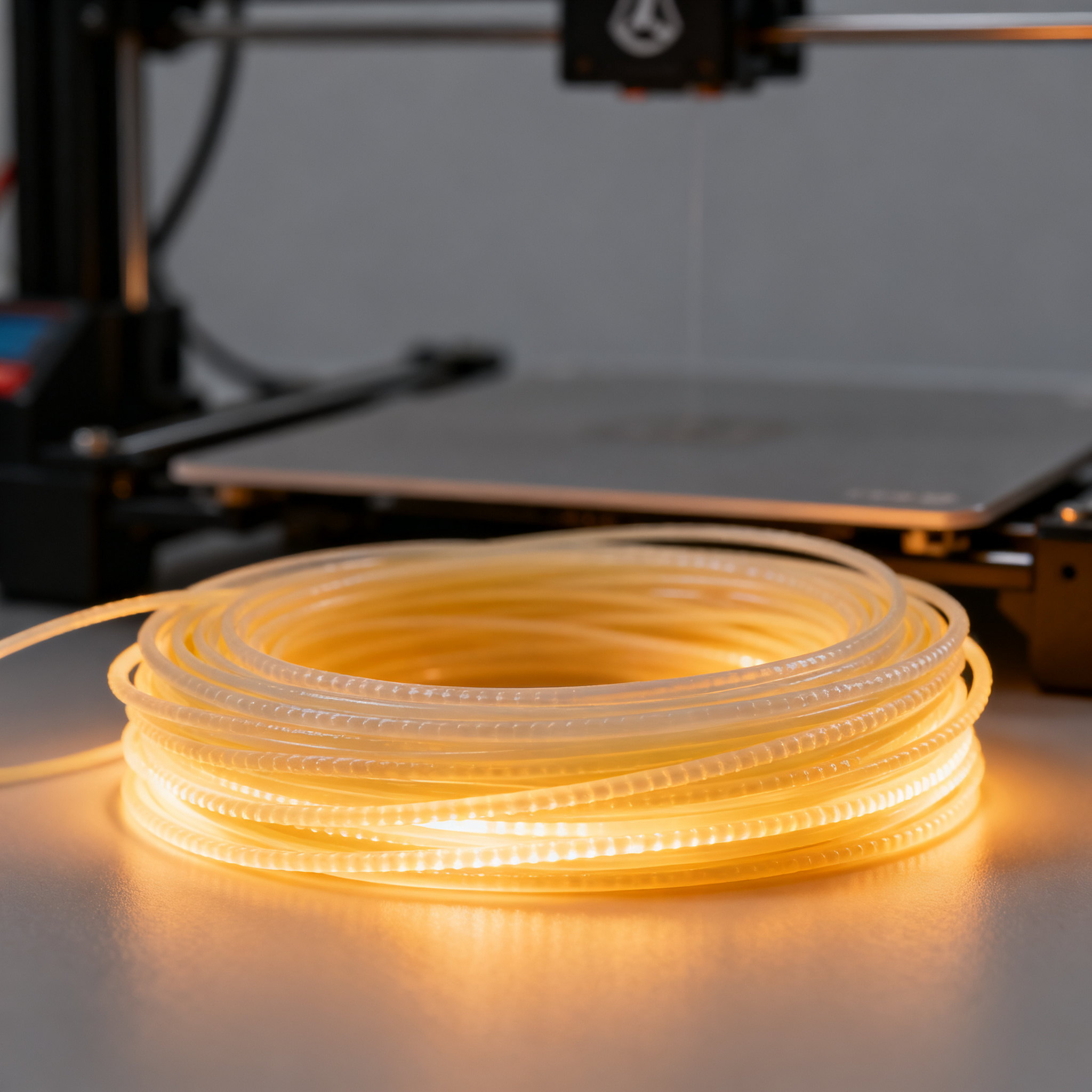
New consumer 3D printing technologies: innovations and market trends 2026
The consumer 3D printing market is undergoing a profound transformation, characterized by the integration of artificial intelligence, new accessible materials, and increasing attention to sustainability. The innovations presented in the first months of 2026 demonstrate that technology is increasingly usable in a domestic setting, breaking down the technical barriers that had limited its mass diffusion.
Revolutionary materials for home 3D printers
One of the most significant news concerns the management and recycling of materials. ExtrudeX, developed by the start-up Creative3DP led by Priyank Pal, transforms plastic waste into reusable filament directly at home. The machine, just 65 cm long, is placed next to a common FDM printer and is designed in a do-it-yourselfstyle: the frame and the extrusion system can be 3D printed, reducing production costs and simplifying repairs.
The process requires six steps: cutting the plastic waste, heating the machine based on the polymer, inserting the material into the hopper, starting the motor, passing the filament through the extrusion mechanism, and waiting for cooling. Creative3DP recommends mixing 40% of crushed scraps with 60% of virgin pellets, always using the same polymer. ExtrudeX is compatible with PLA, ABS, and PETG and costs $249.
In the resin printing segment, HeyGears has perfected the Reflex series, particularly the Reflex 2 Pro model. The build volume increases to 230 × 144 × 350 mm, and the more precise light projection optimizes polymerization, improving surface quality and reducing waste. The “Resin Capsule” system automatically manages filling and emptying of the tank, eliminating manual spills and contact with sticky gloves.
Integrated artificial intelligence in consumer 3D printers
Artificial intelligence is making 3D printing accessible even to those without technical skills. Meshy has developed a system that automates the most complex phases: mesh repair, geometric adaptation, material selection, finishes, colors, and slicing parameters. The user types a prompt and gets a finished object, without going through CAD software. The workflow is completed with real-time quotes and shipping managed by Meshy's network of production partners.
Ethan Hu, founder and CEO of Meshy, explains: «We have automated the most difficult parts of the process, from mesh repair to color production. Now anyone who can type a prompt can hold a professional-level collectible object in their hands. It is the simplest way to bridge the gap between digital imagination and physical reality.»
In the FDM segment, artificial intelligence increases reliability. The Centauri Carbon V2 by Elegoo, expected for the first quarter of 2026, integrates an AI camera that stops printing in case of error. It maintains the 500 mm/s of the previous version, the Klipper firmware and the CoreXY frame, but adds a reinforced frame, hardened steel nozzle, heated bed up to 110 °C and extended compatibility with materials. The price remains under $400.
Market expansion: new players and penetration strategies
The sector enters a phase of maturity and consolidation. In 2025, applications diversified, focusing on concrete industrial needs. Caracol, an Italian company specialized in large-scale robotic additive production, has raised 40 million dollars to expand in the United States, the European Union and the Middle East, a sign of a market oriented towards complete and customized solutions.
Construction remains a growing application: recycled materials and low-impact formulations support the transition to the circular economy. While food 3D printing has slowed down, other sectors are accelerating. 2025 was a year of adjustment and consolidation, with the repositioning of major players and the affirmation of concrete use cases.
Sustainability and recycling in consumer 3D printing processes
Sustainability has become a pillar of innovation. Although depositing material only where needed, 3D printing generates waste: failed prints, filament scraps, supports. ExtrudeX addresses the problem by promoting short supply chains and local autonomy. The approach do-it-yourself lowers costs, simplifies repairs and favors the understanding of how it works, while components such as motors and electronics are available locally, reducing the impact from transportation.
In the resin sector, HeyGears“ ”Auto-Peel“ technology and the ”Resin Capsule" system reduce waste and contamination, eliminating manual handling. Even in the construction sector, recycled mixes and lower-impact formulations are spreading, supporting the circular economy.
Future perspectives of the consumer 3D printing sector
2026 outlines a rapidly evolving market where smart materials, AI, and sustainability make consumer 3D printing accessible, reliable, and responsible. The reduction of technical barriers, the closing of the material cycle, and the entry of new players are transforming the technology from niche to mainstream. The resulting ecosystem promises to change the way we design, produce, and consume everyday objects.
article written with the help of artificial intelligence systems
Q&A
- What is ExtrudeX and what is its main advantage for the domestic user?
- ExtrudeX is a 65 cm micro-extruder that turns household plastic waste into printable filament. Its main advantage is closing the material cycle: it recycles PLA, ABS, or PETG and produces new low-cost filaments, reducing waste and expenses.
- How does the Meshy system work and who is it for?
- Meshy is an AI platform that, starting from a simple text prompt, repairs the mesh, chooses materials, colors, and slicing parameters, and ships the finished object. It is aimed at those who do not know how to use CAD but want to obtain professional parts without technical skills.
- What improvements does the Centauri Carbon V2 by Elegoo introduce compared to the previous version?
- It maintains the 500 mm/s speed and Klipper firmware, but adds an AI camera that stops printing in case of error, a reinforced frame, a hardened steel nozzle, a 110 °C heated bed, and compatibility with more materials, remaining under 400 dollars.
- Why is 2025 considered a year of consolidation for consumer 3D printing?
- In 2025, applications focused on concrete and sustainable use cases, slowing down the hype and attracting capital (e.g., 40 million to Caracol) for tailored industrial solutions, signaling a market moving from exploration to maturity.
- How does HeyGears reduce waste and contact with toxic resines in its new devices?
- The “Resin Capsule” system automatically manages filling and emptying of the tank, eliminating manual pouring and sticky gloves, while the “Auto-Peel” technology further reduces residues and contamination at the end of printing.