3D-printed lattices become distributed sensors: the University of Glasgow maps damage in real time with electrical tomography
A team from the University of Glasgow, in collaboration with the University of Sydney, has developed a system that turns 3D-printed lattice structures into distributed sensors capable of detecting and locating damage as it propagates. The technology eliminates the need to apply point sensors in every critical area of the structure.
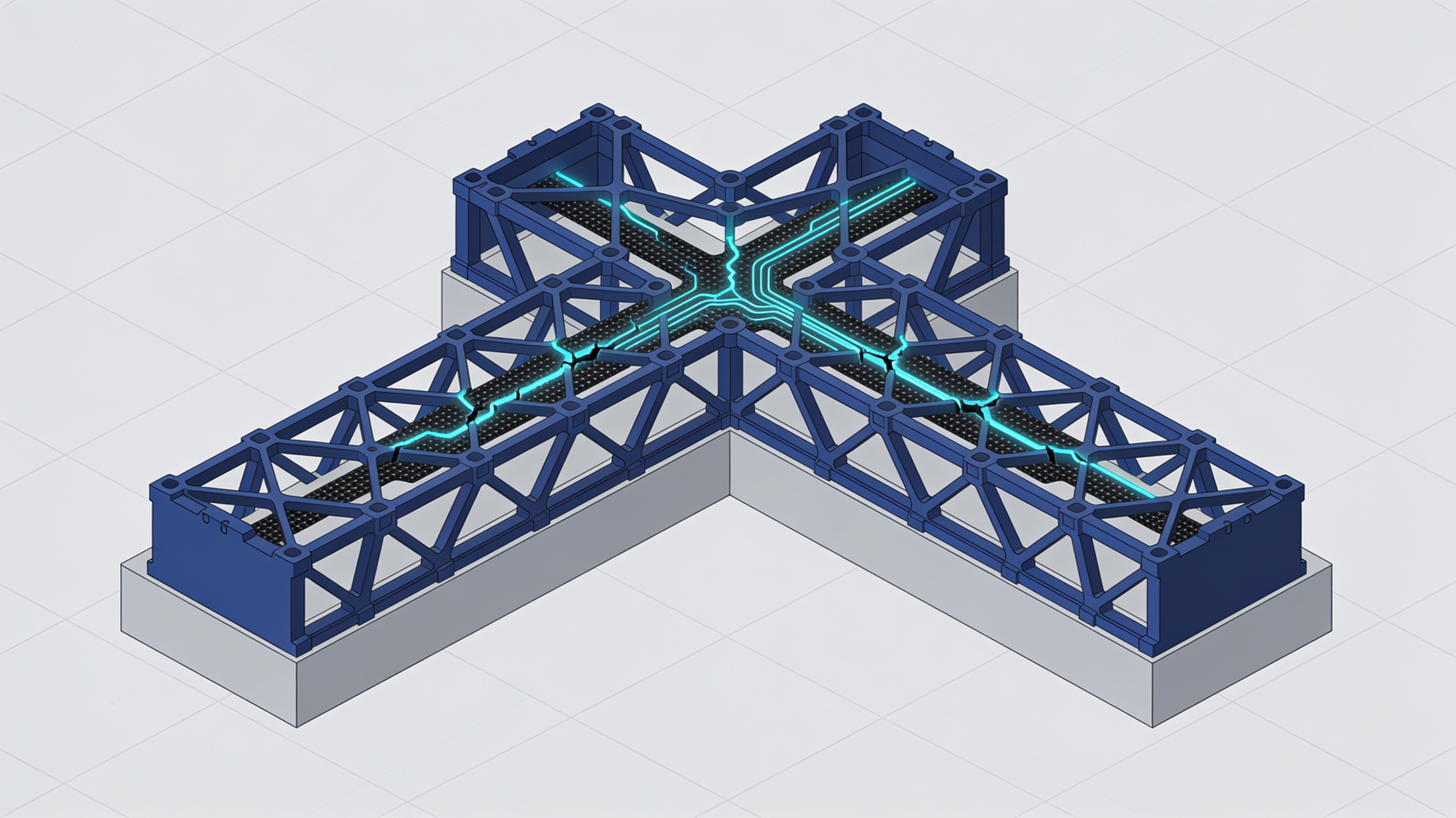
The principle is based on a photopolymer resin loaded with carbon nanotubes that makes the entire architecture electrically conductive. When an element of the lattice is damaged, the local electrical path changes and the system reconstructs a spatial map of the damage through Electrical Impedance Tomography (EIT).
- Conductive resin with carbon nanotubes turns the lattice into a distributed sensor
- EIT reconstructs the damage map in real time without point sensors
- First in situ application of electrical tomography to architected structures
- Study published in Advanced Functional Materials on September 28, 2026
The structure becomes the sensor
The geometry and material of the entire lattice become an integral part of the measurement system, not a support on which to apply external sensors.
The study, authored by Akash Deep, Andrea Samore, Alistair McEwan, Andrew McBride, and Shanmugam Kumar, represents the first in situ application of EIT to architected lattices designed specifically to integrate mechanical response and sensing capability.
The result is not a lattice with strain gauges applied. The entire structure functions as a distributed sensor that detects changes in electrical conductivity while it is mechanically loaded.
The problem of invisible internal fractures
Lattice structures can undergo significant internal damage without showing obvious signs on the external surface, making monitoring with conventional methods difficult.
3D-printed lattices combine low mass, high specific stiffness, energy absorption, and programmable behavior. But precisely this complex architecture makes it difficult to identify where the damage begins.
A lattice can contain hundreds of ligaments, nodes, and alternative load paths. A single internal fracture may not produce obvious changes on the external surface.
The problem is amplified when the lattice is enclosed in a skin, integrated into a sandwich, or hidden inside a component. Observing only the outside is not enough.
The limitations of conventional sensors
Traditional sensors measure specific points: one must know in advance where to place them, otherwise the damage can go undetected.
A strain gauge measures strain where it is applied. An accelerometer detects dynamic response at a specific position. An optical fiber can monitor a line.
These technologies can be very accurate but share a limitation: they require knowing the critical position in advance. If damage originates elsewhere, it may not be detected.
Electrical imaging technique that reconstructs the conductivity distribution inside a volume by measuring currents and voltages on the surface. When the structure is damaged, the local conductivity changes and EIT transforms this variation into a spatial map.
How the system works
Continuous monitoring of electrical conductivity makes it possible to track the onset and propagation of damage without interruption.
Photopolymer resin loaded with carbon nanotubes is used to print the lattice through vat photopolymerization processes. The entire structure becomes electrically conductive.
During mechanical loading, the system applies electrical currents and measures the resulting voltages. The EIT algorithm continuously reconstructs the conductivity distribution.
When a ligament is damaged or breaks, the local electrical path changes. The system detects this variation and transforms it into a spatial map that shows where the damage is located.
Implications for structural monitoring
The technology opens up possibilities for distributed monitoring of complex components in sectors where structural safety is critical.
The system developed in Glasgow can find applications in structural health monitoring in sectors such as aerospace, automotive, biomedical, energy, and protective structures.
The ability to detect damage in real time without point sensors makes it possible to monitor components where visual inspection is impossible or insufficient. The lattice itself becomes an integrated diagnostic system.
The publication in Advanced Functional Materials on September 28, 2026 marks a step forward in the integration between structural design and distributed sensing capability.
article written with the help of artificial intelligence systems
Q&A
How does the 3D lattice sensing system developed by the University of Glasgow work?
The system is based on a photopolymer resin loaded with carbon nanotubes that makes the entire lattice architecture electrically conductive. When an element is damaged, the local electrical path changes and the system reconstructs a spatial map of the damage via Electrical Impedance Tomography (EIT).
Why are conventional sensors not enough to monitor lattice structures?
Strain gauges measure only specific points and require knowing in advance where to place them. In a lattice with hundreds of ligaments and alternative load paths, a single internal fracture may not produce evident variations on the outer surface, escaping point monitoring.
What is the main novelty of the study published in Advanced Functional Materials?
The study represents the first in situ application of electrical tomography (EIT) to architected lattices designed specifically to integrate mechanical response and sensing capability. It is not a lattice with applied sensors, but the entire structure functioning as a distributed sensor.
What problems does distributed damage monitoring solve in 3D-printed lattices?
Lattices can undergo significant internal damage without visible signs on the outside, especially if enclosed in a skin, integrated into a sandwich, or hidden in a component. The EIT system makes it possible to detect and locate the damage as it propagates, without point sensors in every critical zone.
Who authored the study and when was it published?
The study is authored by Akash Deep, Andrea Samore, Alistair McEwan, Andrew McBride, and Shanmugam Kumar, the result of a collaboration between the University of Glasgow and the University of Sydney. It was published in Advanced Functional Materials on September 28, 2026.