
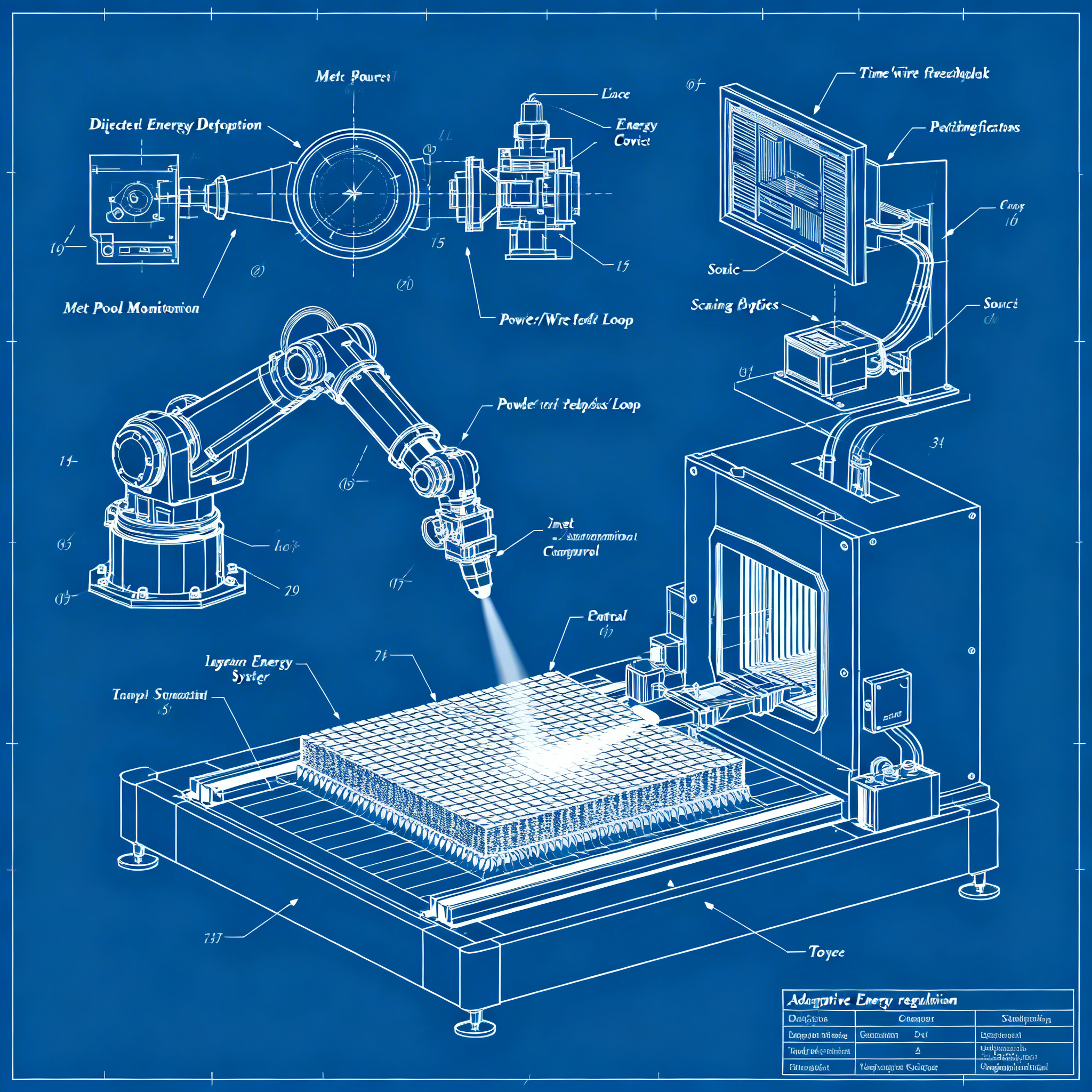
How Large-Scale Directed Energy Deposition Works: Advanced Melt Pool Control and Precision in Deposition
The most advanced Directed Energy Deposition systems today integrate real-time feedback to control material fusion, redefining what high-precision 3D printing means. Thanks to continuous melt pool monitoring, targeted deposition via multi-angle actuators, and dynamic process modeling, large-scale DED overcomes the traditional limits of additive manufacturing, enabling the production and repair of large metal components with unprecedented control over geometry, metallurgical quality, and mechanical properties.
Fundamentals of Directed Energy Deposition
The DED process uses a concentrated energy source to melt metal material deposited on a substrate, with machine architectures designed to operate on build volumes exceeding one meter in size.
Directed Energy Deposition technology is based on well-defined physical principles: a high-power energy source – 12 kW laser, electron beam, plasma, or electric arc – is used to create a melt pool on the work surface, into which feedstock material is introduced in the form of metal powder or wire. Unlike powder bed systems, the deposition head is not constrained to a rigid closed volume, but can move in three-dimensional space, often mounted on anthropomorphic six-axis robots or large gantry systems.
Key components of an advanced DED system include the material deposition nozzle, the energy source with its beam focusing and scanning system, multi-axis positioning actuators, and real-time monitoring systems. Platforms like LAMAR (Large Additive Manufacturing Articulating Robot) developed by Penn State and US Army Research Laboratory integrate a six-axis robot synchronized with a two-axis rotary positioner, achieving working volumes of 2 m × 3 m × 3.5 m. This kinematic architecture allows for tackling complex geometries, managing multi-angle approaches, and optimizing deposition trajectories on large components.
For oxidation-sensitive alloys, the most advanced systems operate in controlled chambers with an argon atmosphere, maintaining low oxygen levels to ensure repeatability and certified mechanical properties. Material feeding can occur in single mode, dual-wire for composition gradient deposits, or hot-wire to improve thermal efficiency by preheating the wire before interaction with the melt pool.
Real-Time Melt Pool Control
Melt pool monitoring technologies and adaptive energy control allow for the dynamic adjustment of process parameters to achieve precise melt volume dimensions and ensure constant deposit quality.
The core of innovation in advanced DED systems is represented by the melt pool monitor, an observation device that collects real-time data on the characteristics of the melt pool during deposition. These systems detect critical parameters such as melt pool size, surface temperature, shape, and stability of the melt volume, transmitting the information to a computing unit that processes the data and intervenes instantaneously on the process parameters.
An advanced additive manufacturing system receives data from a melt pool monitor indicative of one or more melt pool parameters and determines, based on this data, the current position of the melt pool. The computing unit then establishes the desired melt pool size based on the current position and controls the energy delivery device to form a melt pool of the desired size on the component's build surface. This closed feedback loop allows for the compensation of thermal variations, substrate geometric irregularities, or fluctuations in the material flow, maintaining constant deposit quality even over long and complex paths.
Adaptive energy regulation occurs by modifying in real-time the power of the laser or energy source, the beam scanning speed, or the spatial distribution of energy via two-axis beam scanning systems. This capability to “program” the energy distribution allows for controlling the bead shape, preventing melt pool instabilities, and optimizing the penetration and dilution of the deposited material, which are fundamental elements for achieving controlled metallurgical properties and reducing the need for rework.
Targeted Deposition with Multi-Angle Actuators
Advanced kinematic solutions with actuators positionable at multiple angles allow for precise deposition even on complex surfaces, deep cavities, and non-planar geometries, without unwanted remelting of already deposited zones.
A DED system can include a nozzle that deposits metal powder on a plurality of positions of a repair area, with a first energy source configured to emit a first energy beam from a discharge end positionable via one or more actuators. These actuators direct the energy beam onto the repair area at a first angle or a second angle relative to the cavity axis, to fuse metal powder deposits localized in a first set or a second set of the plurality of positions. This capability to vary the energy beam angle is crucial for complex repairs, where access to the treatment zone may be limited by surrounding geometries or deep cavity walls.
The in-situ automatic toolpath generation technology developed by FormAlloy represents a significant evolution: through real-time scanning and coordinate recording, the system establishes the accurate spatial alignment of the part geometry relative to the machine coordinate system, without manual intervention. Once alignment is established, deposition paths are generated in-situ to conform to the measured surface geometry, allowing for deposition closely coupled to the actual condition of the part rather than an idealized model.
This automated approach reduces excess material, minimizes post-process machining, and improves dimensional control, proving particularly effective when components exhibit dimensional variability introduced during machining, casting, forging, or in-service wear. The closed-loop nature of this workflow supports consistent results even when parts show variability from lot to lot or from part to part, making DED feasible on an industrial scale.
Dynamic Process Modeling
Real-time simulation systems integrated into advanced DED platforms continuously optimize process parameters based on data collected during deposition, predicting thermal behavior, residual stresses, and final microstructure.
The convergent approach to large-scale DED integrates numerical process modeling with closed-loop control, creating an ecosystem in which materials, hardware, software, and control converge toward the capability to deposit material in a repeatable manner. Thermal and mechanical models predict deposition, dilution, and residual stresses, while optimization algorithms suggest suitable parameters in advance to combine high deposition speeds with acceptable microstructures.
These computational systems dynamically model the process based on parameters observed by the melt pool monitor and other integrated sensors, adapting preheating strategies, thermal control, and deposition sequences to reduce temperature gradients on very large components. Predictive modeling allows for defining toolpath strategies suitable for large-format complex surfaces, limiting oversizing and rework, and developing materials dedicated to the thermal dynamics of DED with attention to segregation, grain size, and microstructure stability across multiple passes.
The integration of non-destructive testing (NDT) in-process or post-process, to detect porosity, cracks, or lack of fusion, completes the framework of an intelligent system capable of ensuring that mechanical properties and metallurgical quality are aligned with design requirements. This convergence between simulation, adaptive control, and real-time verification represents the qualitative leap that makes large-scale DED an industrially mature technology, capable of competing with traditional fabrication and repair methods in terms of both cost and time.
Conclusion
Large-scale DED represents a frontier of additive manufacturing where precision and advanced control merge to overcome traditional limits. The integration of continuous monitoring
article written with the help of artificial intelligence systems
Q&A
- What are the main components of an advanced Directed Energy Deposition system?
- Key components include the material deposition nozzle, the energy source with beam focusing and scanning system, multi-axis positioning actuators, and real-time monitoring systems. These elements work together to ensure precision and control during the deposition process.
- How does real-time melt pool control work in advanced DED systems?
- The melt pool monitor collects real-time data on the characteristics of the melt pool, such as size, temperature, and stability. This information is processed by a computing unit that dynamically regulates process parameters, such as power and beam speed, to maintain constant deposit quality.
- What advantages do solutions with multi-angle actuators offer in deposition?
- Multi-angle actuators allow for depositing material on complex surfaces, deep cavities, and non-planar geometries without remelting already deposited zones. This flexibility is particularly useful for complex repairs with limited access to the areas to be treated.
- What is the role of dynamic process modeling in large-scale DED systems?
- Dynamic modeling integrates real-time simulations with sensor data to predict thermal behavior, residual stresses, and final microstructure. This approach enables continuous optimization of process parameters, improving the quality of the final component and reducing necessary rework.
- How does large-scale DED overcome the limits of traditional additive manufacturing?
- Large-scale DED allows for the production and repair of large metal components with advanced control over geometry, metallurgical quality, and mechanical properties. It utilizes real-time feedback, targeted deposition, and dynamic modeling to achieve superior precision and repeatability compared to traditional methods.


