How Chemical Vapor is Revolutionizing the Post-Processing of 3D Parts
Discover how chemical vapor is transforming the surface finish of 3D printed parts, bringing them to quality levels never seen before. Automated chemical smoothing technologies are eliminating production bottlenecks, allowing companies to scale additive manufacturing with controlled and repeatable finishes, without compromising dimensional tolerances or mechanical properties.
Fundamentals of Chemical Post-Processing for Additive Manufacturing
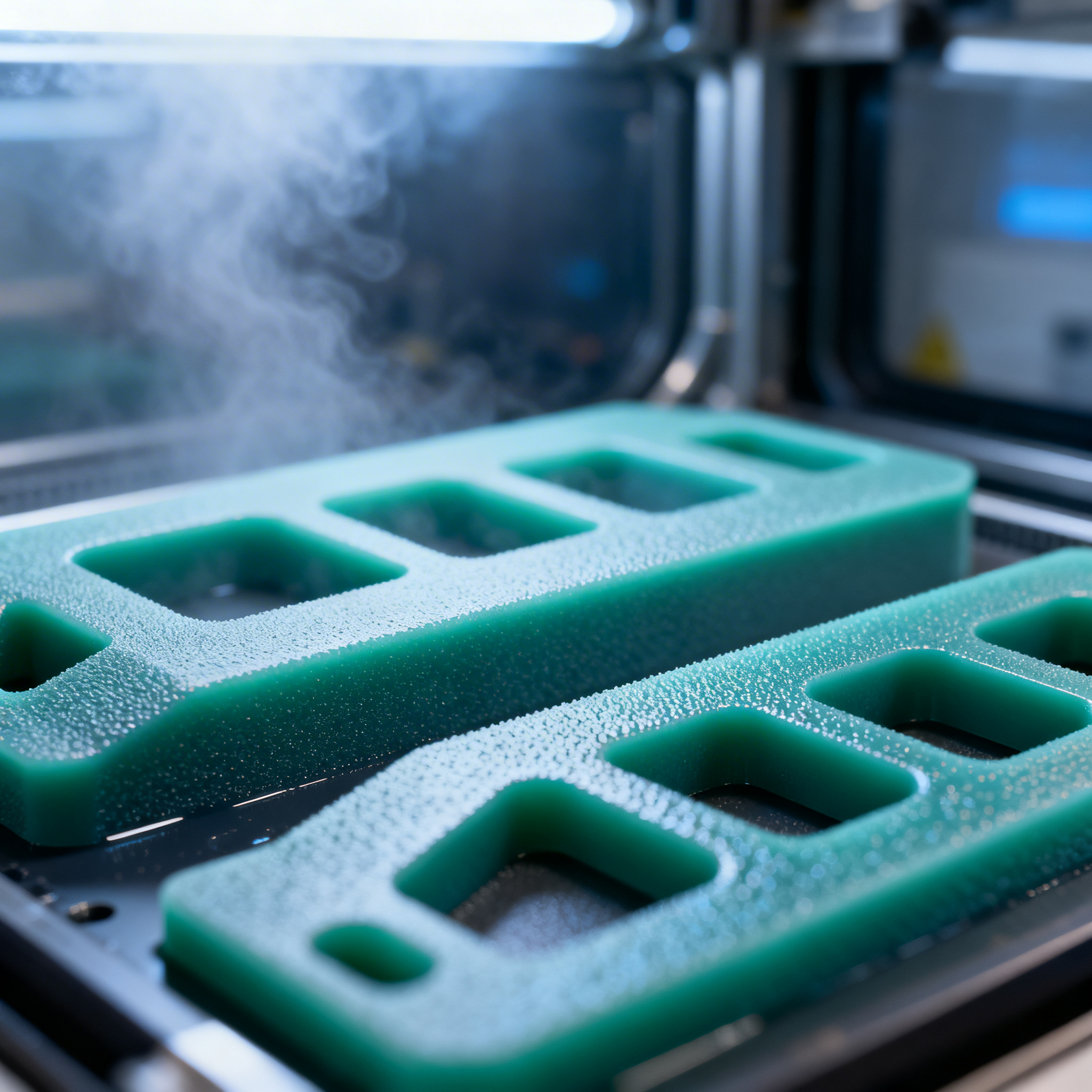
Chemical vapor treatment acts at the molecular level on the surface of printed parts, modifying the surface morphology through a controlled process that preserves the dimensional integrity of the component.
Post-processing represents up to 60% of the total cost of a 3D printed part when performed with traditional manual methods. Chemical vapor solves this criticality through a precise physicochemical mechanism: the specific solvent vapor is distributed uniformly on the surface of the thermoplastic component, causing a controlled remelting of the surface layer. This process eliminates the roughness typical of additive manufacturing without material removal, maintaining dimensional variations below 0.4%.
Chemical vapor smoothing technology not only improves aesthetics but seals the external surface, making components impermeable to air and water. This aspect is fundamental for applications that require sealing, ease of cleaning, or preparation for painting and dyeing. The process also increases elongation at break (EAB) without compromising tensile strength, effectively improving the overall mechanical properties of the component.
Automation and Scalability: The AMT PostPro Case
AMT PostPro solutions represent the industrial evolution of chemical post-processing, offering fully automated platforms that guarantee repeatability and high throughput for serial production.
The AMT PostPro range includes systems designed for different production needs. The PostPro SFX, the world's first benchtop system for chemical smoothing, offers an 11.5-liter chamber ideal for small batches and prototyping. The PostPro SF50, with a 48-liter chamber (400 × 300 × 400 mm), and the PostPro SF100, with a 96-liter chamber (400 × 600 × 400 mm), are fully automated solutions for increasing production volumes.
These systems are compatible with multiple printing technologies (SLS, MJF, CFR, FFF/FDM, FGF, HSE, HSS) and a wide range of thermoplastic materials: PA6, PA11, PA12, ABS, PC, PP, TPU, TPE, SBC, PEBA, as well as composites filled with glass, carbon, or mineral fibers. The HMI touchscreen interface allows programming specific recipes, saving optimal parameters, and replicating them with absolute precision, eliminating the variability typical of manual processes.
The full automation offered by AMT PostPro transforms post-processing from a bottleneck into a scalable production phase. The proprietary software manages the entire treatment cycle, ensuring consistent results regardless of the operator, an essential requirement for industrial process certification and the production of end-use parts.
Material and Performance Effects of Chemical Treatment
The interaction between chemical vapor and various thermoplastic materials produces specific effects on surface roughness, mechanical strength, and aesthetic characteristics, requiring optimized process parameters for each polymer family.
Standard materials such as PA12, ABS, and PC respond excellently to chemical vapor treatment, achieving smooth and uniform surface finishes. The process improves color consistency and vibrancy, a critical aspect for consumer and medical applications. For composites filled with glass, carbon, or mineral fibers, chemical vapor acts selectively on the polymer matrix, reducing roughness without excessively exposing the reinforcing fibers.
Chemical post-processing not only improves aesthetic appearance but also opens up new application possibilities. Sealed surfaces facilitate sterilization in the medical field, reduce contaminant accumulation in food and aerospace applications, and improve tribological properties for moving components. The ability to obtain waterproof surfaces is particularly relevant for manifolds, conduits, and fluidic components produced with additive manufacturing.
For elastomeric materials such as TPU and TPE, precise control of process parameters is essential to avoid deformation. AMT's automated platforms allow these critical variables to be managed through validated recipes, ensuring repeatable results even on complex geometries and thin walls.
Comparison Between Traditional Methods and Innovative Solutions
Traditional manual finishing techniques such as sandblasting, sanding, and polishing present significant limitations in terms of repeatability, labor costs, and the ability to handle complex geometries, while solutions based on automated chemical vapor offer decisive advantages for industrial production.
Sandblasting and shot blasting, while effective for removing residual powder and initial cleaning, produce limited surface finishes and can damage fine details or thin walls. Systems like AMT PostPro DP Max combine automated depowdering and shot blasting with capacities up to 30 kg, but represent a preparatory phase rather than a complete solution for high-quality finishes.
Manual sanding and traditional polishing require qualified operators, long times, and produce variable results. For internal geometries, cavities, or inaccessible surfaces, these methods are impractical. Chemical vapor penetrates uniformly into all exposed surfaces, ensuring homogeneous finishes regardless of geometric complexity.
From an economic point of view, post-processing automation drastically reduces operational costs. While manual methods can represent up to 60% of the total cost of a part, automated AMT PostPro solutions reduce this impact by allowing complete batches to be processed without continuous supervision. Industrial repeatability eliminates waste due to process variability, a critical aspect for certified production and regulated applications.
Vibratory finishing systems such as AM Solutions M1, which combine smoothing, grinding, polishing and deburring in a single platform, represent a complementary alternative for metals and polymers, but operate on mechanical rather than chemical principles, with limitations on complex geometries and ultra-smooth finishes.
Conclusion
The adoption of advanced chemical post-processing methods represents a decisive turning point for the additive manufacturing industry, opening up new application possibilities thanks to controlled and scalable finishes. Automated technologies such as AMT PostPro eliminate the main production bottleneck, transforming post-processing from a critical phase into a repeatable and certifiable industrial process.
The ability to obtain sealed, impermeable surfaces with controlled roughness significantly expands the application field of additive manufacturing, making it competitive for end-use parts in demanding sectors such as aerospace, medical, automotive and consumer. Compatibility with standard materials and advanced composites guarantees design flexibility without compromising final quality.
Explore the potential of chemical post-processing for your productive sector and evaluate the integration of automated solutions to elevate the quality of your 3D parts. Investing in technologies such as AMT PostPro can transform your productive capacity, reducing operational costs and delivery times while constantly improving the quality and repeatability of your 3D printed components.
article written with the help of artificial intelligence systems
Q&A
- How does chemical vapor post-processing work on 3D printed parts?
- Chemical vapor acts at the molecular level by modifying the surface morphology through controlled remelting of the surface layer. This process eliminates the roughness typical of 3D printing without material removal and maintains dimensional variations below 0.4%.
- What are the main advantages of chemical vapor smoothing compared to traditional methods?
- Advantages include smooth and uniform surface finishes, surface waterproofing, improved mechanical properties such as elongation at break, and reduced operational costs by up to 60%. In addition, the process is repeatable and suitable for serial production.
- Which materials are compatible with AMT PostPro solutions?
- AMT PostPro solutions support various printing technologies and a wide range of thermoplastic materials such as PA6, PA11, PA12, ABS, PC, PP, TPU, TPE, SBC, PEBA. They are also compatible with composites filled with glass, carbon, or mineral fibers.
- How does automation improve chemical post-processing?
- Automation ensures repeatability of results, eliminating variability related to the operator and enabling the processing of complete batches without continuous supervision. Through HMI touchscreen interfaces, it is possible to program and replicate specific recipes with precision.
- Which industries can benefit most from this technology?
- Industries such as aerospace, medical, automotive, and consumer goods benefit from this technology thanks to the ability to obtain sealed, waterproof surfaces with controlled finishes. This enables applications that require tightness, sterilization, and high mechanical properties.