
From Agricultural Waste to Construction Materials: How the Industrial Process Works
Discover how straw, fruit peels, and other agricultural waste are finding new life as innovative materials in the construction sector.
The construction sector is responsible for 32% of global energy consumption and 34% of CO₂ emissions, according to UNEP's Global Status Report for Buildings and Construction 2024/2025. In this context, the transformation of agricultural waste into building materials represents one of the most promising frontiers for reducing the environmental impact of construction. Through specific industrial processes that combine pre-treatment, extrusion, and additive technologies, residues such as corn straw, peels, and plant waste are converted into panels, bricks, and insulation with performance comparable to traditional materials.
Types of Agricultural Waste That Can Be Used
The agricultural residues most suitable for transformation into building materials include biomasses rich in cellulosic fibers and by-products of food processing, selected for their chemical composition and local availability.
The CORNCRETL project developed by the Mexican collective Manufactura demonstrates how corn cultivation residues can become raw material for construction. The system uses nejayote, a calcium-rich liquid produced during nixtamalization (a traditional Mesoamerican corn treatment process), which instead of being discarded becomes a key ingredient of the printable composite. To this are added dried corn stalks and leaves, which provide fibrous reinforcement to the mixture.
The choice to use corn residues is strategic for Mexico, where corn is a daily food and generates significant volumes of organic waste. This approach valorizes local and culturally rooted waste streams, transforming them into construction resources available near building sites. The decentralized model proposed by CORNCRETL makes it possible to process agricultural waste directly on site, reducing transport costs and the overall carbon footprint.
Preliminary Phases: Collection, Pre-Treatment, and Selection
Before industrial processing, agricultural waste requires drying, shredding, and size control operations to ensure uniformity and compatibility with subsequent processing processes.
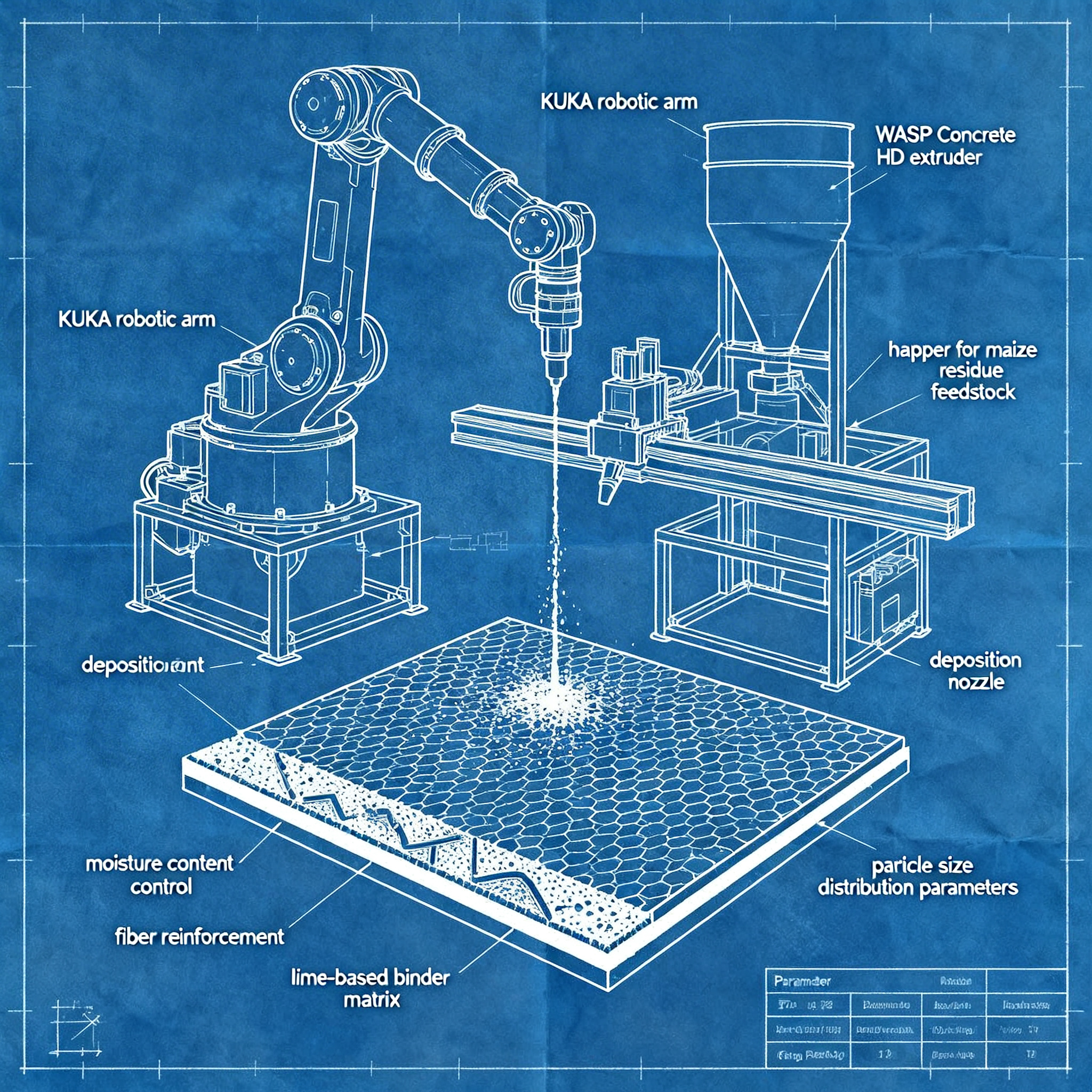
In the case of CORNCRETL, corn residues are first dried to reduce the moisture content, then shredded and ground until a controlled particle size is obtained. This phase is crucial because irregularly sized particles would compromise the quality of extrusion and the strength of the final material. The grinding process produces a fine powder that is subsequently mixed with natural binders.
Preliminary selection removes contaminants and unsuitable materials, ensuring that only fractions with the desired chemical-physical characteristics enter the production process. In the context of biocomposites for 3D printing, the presence of residual moisture or impurities can cause deposition defects, air bubbles, or variations in the mechanical properties of the finished component.
Similarly, in large-format additive manufacturing systems such as those developed by CEAD for reinforced thermoplastic materials, production waste is shredded into uniform flakes with calibrated dimensions to prevent clogging in extruders. This principle of dimensional control also applies to agricultural waste intended for industrial extrusion or pressing processes.
Technological Transformation Processes
The key industrial technologies for converting agricultural biomass into building materials include robotic extrusion, high-temperature pressing, and polymerization with natural or synthetic binders.
CORNCRETL uses a KUKA robotic arm combined with a WASP Concrete HD continuous feeding system to deposit the corn-based composite layer by layer. The ground residues are mixed with natural hydraulic lime (NHL 3.5) as a binder and aggregates suitable for robotic extrusion. The mixture is extruded through a nozzle that deposits beads of material following programmed trajectories, eliminating the need for traditional formwork and reducing construction site waste by 90%.
The robot's freedom of movement makes it possible to create curved surfaces and geometric textures inspired by terrazzo, impossible to obtain with conventional methods. After printing, the lime-based material hardens at room temperature within days, without requiring high-energy curing processes like Portland concrete.
In the case of pellet-based LFAM (Large Format Additive Manufacturing) systems, such as those from CEAD, screw extruders process short-fiber-reinforced thermoplastic pellets, achieving high throughputs suitable for the production of full-scale structural components. These systems can integrate cellulose fiber-based biocomposites, offering alternatives to glass or carbon fibers with lower environmental impact.
Physical and Performance Properties of Final Materials
Materials derived from agricultural waste show structural, thermal, and durability characteristics comparable to conventional products, with specific advantages in terms of sustainability and behavior over time.
CORNCRETL can reduce carbon emissions by up to 70% compared to Portland cement, thanks to lime-based chemistry and the low-temperature hardening process. The material also exhibits a self-healing behavior: when moisture penetrates into microcracks, unreacted lime particles recrystallize and partially seal the fracture, a known property of lime-based binders that improves durability over time.
The modular wall prototypes were successfully printed up to 80 cm in height and tested at full scale at the Shamballa outdoor laboratory in Italy, demonstrating the structural feasibility of the system. The tests validated the material's ability to bear loads compatible with non-load-bearing and partition building applications.
In the context of recycled reinforced thermoplastic composites, the first tests conducted by CEAD indicate that regenerated materials maintain adequate properties for non-critical structural applications and for molds or production equipment. The presence of short fibers in recycled granules helps preserve mechanical strength and stiffness, although each recycling cycle entails some degradation of the polymer chains.
Industrial Case Studies and Scalability
Pilot plants and funded research projects demonstrate that the conversion of agricultural waste into building materials can be implemented on an industrial scale, with decentralized and circular production models.
The project AddMamBa of RWTH Aachen University, funded by the German Federal Ministry for Economic Affairs and Energy, explores the transformation of steel scrap into brackets for 3D-printed facades, but the applied circular economy model is also relevant for bio-based materials. The consortium includes demolition companies (Paul Kamrath Ingenieurrückbau GmbH), construction system manufacturers (RSB Rudolstädter Systembau GmbH), and additive manufacturing specialists (Laser Melting Innovations GmbH), demonstrating how the complete supply chain – from the collection of waste material to the production of the certified component – can be integrated industrially.
In the case of CORNCRETL, the proposed model envisages local micro-factories near agricultural areas, where residues are collected, processed, and transformed into building elements. This decentralized approach reduces logistics costs and makes the material accessible even in areas lacking conventional construction materials. The modularity of printed components facilitates transport with smaller vehicles compared to traditional loads of timber or heavy prefabricated components.
CEAD has integrated into its production ecosystem solutions for shredding and regranulation that transform printing waste into new pellets, closing the loop of reinforced thermoplastic materials. This closed-loop workflow has been successfully applied in sectors such as marine, automotive, and energy, where design iterations generate significant volumes of prototypes and decommissioned molds.
Conclusion
The conversion of agricultural waste into construction materials represents a concrete opportunity for an advanced circular economy. The industrial processes available today – from robotic extrusion to high-temperature pressing – make it possible to transform waste biomass into building components with verified technical performance and reduced environmental impact. Projects such as CORNCRETL and CEAD's LFAM solutions demonstrate that industrial scalability can be achieved through integrated supply chains, rigorous process control, and decentralized production models.
Explore the industrial solutions available today and evaluate the integration of these materials into your sustainable building projects. The adoption of bio-based and circular materials is no longer a futuristic vision, but an accessible technical and economic reality for designers, builders, and component manufacturers.
article written with the help of artificial intelligence systems
Q&A
What is the environmental impact of the construction sector and how can agricultural waste help?
The construction sector is responsible for 32% of global energy consumption and 34% of CO₂ emissions. Agricultural waste, such as straw and peels, can be transformed into alternative building materials, reducing the use of non-renewable resources and lowering emissions.
How does the CORNCRETL project work in Mexico?
CORNCRETL uses residues from corn processing, such as nejayote and dried stalks, to create a printable composite. This material is extruded by robots to build architectural elements without formwork, reducing waste and emissions.
What preliminary steps are needed to prepare agricultural waste?
Waste is dried, chopped, and sifted to achieve uniform particle size. This step is essential to ensure the quality of the final material and prevent defects during industrial processing.
What technologies are used to transform agricultural waste into construction materials?
Technologies such as robotic extrusion, pressing, and polymerization with natural binders are used. For example, CORNCRETL employs a KUKA robotic arm and an extrusion system to print elements made of lime and plant residues.
What advantages do materials obtained from agricultural waste offer compared to traditional materials?
These materials reduce CO₂ emissions by up to 70%, have self-healing capabilities, and are suitable for non-load-bearing applications. Moreover, their production process is less energy-intensive than traditional concrete.


