
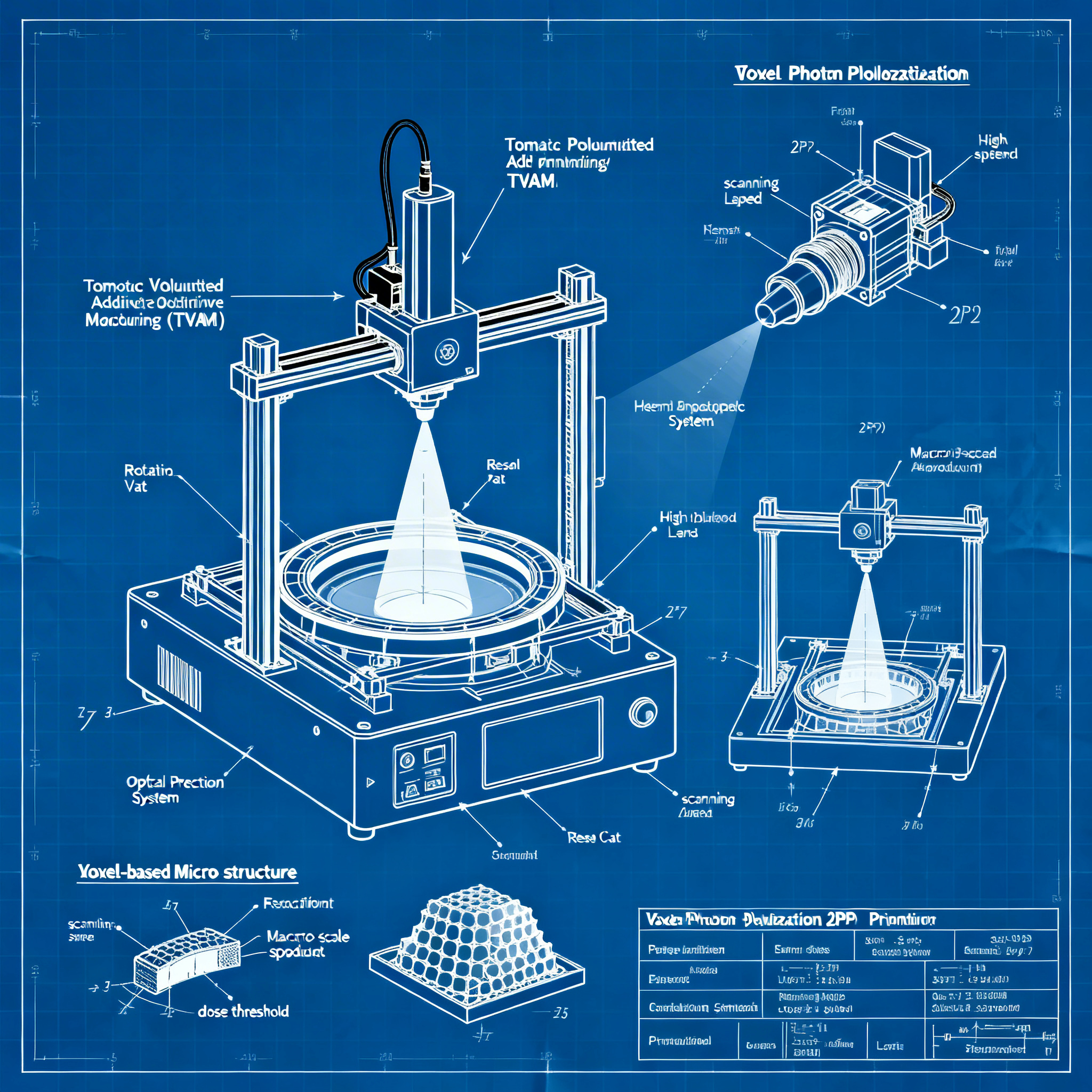
Advanced Photopolymerization: When Speed Meets Precision
In the world of photopolymer 3D printing, the choice between speed and resolution can determine the success or failure of a project. Emerging technologies such as Tomographic Volumetric Additive Manufacturing (TVAM) and Two-Photon Polymerization (2PP/TPP) represent two opposite extremes: the former prioritizes production speed on significant volumes, the latter guarantees sub-micrometric details at the cost of prolonged times. Understanding the trade-offs between these technologies is fundamental for those operating in industrial and high-precision contexts, where every decision directly impacts costs, times, and final quality.
Introduction to Advanced Photopolymerization
Advanced photopolymer technologies are redefining the boundaries of additive manufacturing, offering differentiated solutions for industrial applications that require both speed and extreme precision.
Photopolymer 3D printing today faces an intrinsic compromise: faster processes, suitable for consistent volumes, struggle to achieve micrometric details, while techniques capable of sub-micrometric resolutions require long times because they “write” the part point by point. This dichotomy has pushed research toward solutions that integrate complementary mechanisms, allowing the advantages of each technology to be exploited in the appropriate context. For the manufacturing industry, the choice is no longer between one technology or another, but in understanding which approach maximizes value according to the specific requirements of the project.
TVAM: High Productivity at the Expense of Resolution
TVAM solidifies 3D geometries through calculated light projections, offering exceptional speed for consistent volumes but with limitations in fine resolution.
Tomographic Volumetric Additive Manufacturing (TVAM), often described as “tomographic” volumetric printing, represents a paradigm shift compared to traditional layer-by-layer approaches. This technology solidifies a three-dimensional geometry through light projections calculated from the CAD model, while the resin is rotated or optically scanned: energy accumulates in space and polymerizes where a critical dose threshold is exceeded.
The strength of TVAM is its extraordinary speed: entire volumes can be produced in seconds or minutes, with the possibility of creating complex geometries without supports. On the industrial front, several companies such as Readily3D and xolo are commercializing variants of volumetric printing, demonstrating the growing maturity of the technology.
However, the typical limit remains resolution, often on the order of tens of micrometers for fine details. This limitation derives from optical and material constraints related to absorption, scattering, and polymerization kinetics. For applications where macro geometry is a priority over micro-details, TVAM represents the ideal solution, enabling rapid production of scaffolds for bioengineering or complex structural components.
Two-Photon Polymerization: The Frontier of Microfabrication
2PP exploits nonlinear absorption to create microstructures with sub-micrometric resolutions, but the voxel-by-voxel process drastically limits productivity on extended volumes.
Two-Photon Polymerization uses a laser, typically a near-infrared femtosecond laser, focused with a high numerical aperture. Nonlinear absorption occurs in an extremely small volume near the focus, making it possible to “write” microstructures with resolutions that can fall below one micrometer. This capability has made commercial systems such as those from Nanoscribe market benchmarks for microfabrication, micro-optics, and highly precise complex structures.
The disadvantage is intrinsic to the nature of the process: since it is voxel-by-voxel writing, productivity drops drastically as volume increases. Producing the entire part in 2PP becomes impractical when the “macro” part reaches significant dimensions. 2PP excels in applications where microchannels, lattices, textures, and micro-interfaces are critical functional elements that justify extended production times.
Recent developments in photoinitiator chemistry are seeking to overcome some limitations of 2PP. Research on curcumin-based formulations, for example, is demonstrating how it is possible to combine photoinitiation and scaffold bioactivity in a single material system, balancing nonlinear absorption efficiency with cytocompatibility.
Technological Comparison: TVAM vs TPP
The direct comparison highlights clear operational trade-offs: TVAM prioritizes throughput and volumes, while 2PP focuses on precision and functional micro-features.
From the standpoint of mechanisms, TVAM operates through single-photon absorption with cumulative dose from multiple projections, while 2PP exploits nonlinear absorption localized at the laser focus. This fundamental difference translates into distinct operating scales: TVAM is efficient on millimeter-to-centimeter volumes with “meso” details, while 2PP excels at sub-millimeter scales with micro- and sub-micrometric details.
Productivity is the main differentiator: TVAM offers high productivity for substantial volumes, while 2PP shows low productivity as total volume increases. The critical points differ significantly: for TVAM, scattering, absorption, dose threshold, and reconstruction algorithms are central; for 2PP, scan time, high-numerical-aperture optics, and system stability are decisive.
Typical outputs reflect these differences: TVAM produces support-free resin volumes suitable for structural components, while 2PP generates microchannels, lattices, textures, and micro-optics for specialized functional applications.
Hybrid Solutions: Integrating Speed and Precision
Unified platforms that combine TVAM and 2PP in the same system promise to maximize overall productivity, using each technology only where it brings added value.
The most promising approach to overcoming the trade-off between speed and precision consists in integrating both technologies into a single platform. Recent research developments describe unified printers that combine single-photon TVAM and 2PP in the same reference system, enabling workflows where TVAM generates a millimetric structure (the “pre-volume”) and 2PP creates micro-structures inside or on the surface of the TVAM object, without changing resin and without mandatory intermediate steps.
This “two-resolution” logic aims to reduce total time: 2PP is used only where it provides functional value, avoiding using it to fill the entire volume. Integration into a single platform reduces errors typical of transfer between different machines, such as re-clamping, repositioning, drift, and reference differences. Internal registration between the two subsystems ensures that 2PP micro-features fall exactly where intended relative to the TVAM geometry.
Target applications include bio-scaffolds where most of the volume requires details on the order of tens of micrometers, while localized portions benefit from sub-micrometric details for microchannels or micropatterns. In micro-optics and optoelectronics, regions printed with different strategies can have different optical properties, paving the way for hybrid components where the macro part provides shape and support while the microstructure performs the optical function.
Innovative Materials and Photoinitiators
Chemical compatibility between different exposure regimes represents a critical challenge: innovative formulations must balance single-photon photoinitiators and two-photon response in the same resin.
One of the most concrete difficulties in combining different photopolymerization processes is materials chemistry. TVAM normally uses photoinitiators activatable with visible or UV light through single-photon absorption, while 2PP requires formulations suited to a strong two-photon response in the infrared laser band.
Recent demonstrations have presented systems where the two processes operate without changing photoresin, leveraging a pre-polymerized volume that facilitates subsequent 2PP writing and, in some areas, also rapid volumetric polymerization. The sector literature highlights how formulation—including initiators, oxygen inhibition, absorption, and scattering—profoundly conditions the quality and the “process window” of volumetric printing.
Photoinitiator chemistry remains a bottleneck in two-photon biomanufacturing. Photoinitiators must balance nonlinear absorption efficiency with cytocompatibility, avoiding thermal damage and competitive photochemical pathways. Innovative formulations based on natural compounds such as curcumin are demonstrating the possibility of combining photoinitiation and scaffold bioactivity in a single material system, opening new perspectives for biomedical applications.
Conclusion
Choosing the appropriate photopolymerization technology requires careful evaluation of the specific project requirements, balancing often conflicting objectives such as production time, operating cost, and final quality. TVAM excels when the priority is productivity on substantial volumes with complex geometries, accepting resolutions on the order of tens of micrometers. 2PP is the mandatory choice when sub-micrometric micro-features are functionally critical, justifying prolonged production times. Emerging hybrid solutions promise to overcome this trade-off, allowing each technology to be used in its optimal regime.
Carefully evaluate your project requirements before choosing between speed and precision: both can be winning if applied in the right context. The key metrics to consider include registration accuracy between geometries at different resolutions, the fraction of time dedicated to each process, compatibility between mechanical properties in the different modes, and the software workflow for segmenting CAD into volumetric and micro-functional regions. The future of advanced photopolymerization lies in the ability to intelligently orchestrate complementary technologies, maximizing the overall value of the production process.
article written with the help of artificial intelligence systems
Q&A
What is the main trade-off between TVAM and Two-Photon Polymerization (2PP)?
The main trade-off concerns speed versus resolution: TVAM enables rapid production over significant volumes but with limited resolution, while 2PP offers sub-micrometer details at the expense of productivity.
What does the tomographic volumetric photopolymerization (TVAM) process involve?
TVAM solidifies 3D geometries through calculated light projections while the resin is rotated or optically scanned. It polymerizes only where a critical dose threshold is exceeded, allowing rapid printing of complex objects without supports.
For which applications is Two-Photon Polymerization (2PP) particularly suitable?
2PP is ideal for micro-fabrication, micro-optics, and structures with micro-channels or critical textures, thanks to its ability to produce sub-micrometer details, albeit with long production times.
How do hybrid solutions combining TVAM and 2PP work?
These platforms use TVAM to create the macro structure (pre-volume) and 2PP to add microstructures only where needed, improving overall efficiency and reducing transfer errors between different systems.
What are the material-related challenges in integrating TVAM and 2PP?
The main challenge is finding formulations compatible with both processes: photoinitiators effective for both single-photon absorption (TVAM) and two-photon absorption (2PP), while maintaining properties such as cytocompatibility.


