Additive Manufacturing in Semiconductor Packaging: The Operational Plan of XTPL and Manz Asia
The integration of additive manufacturing into advanced packaging processes is no longer a future bet, but an industrial reality driven by targeted partnerships such as that between XTPL and Manz Asia. XTPL's Ultra-Precise Dispensing (UPD) technology is entering the production flows of semiconductor industry leaders, marking a paradigm shift towards more flexible and high-performance processes. The strategic collaboration with Manz Asia allows the Polish company to scale the adoption of its technology without direct infrastructure investments, transforming a machinery sale into a technology demonstrator in the world's most important market for semiconductors.
Definition and Functionality of Advanced Packaging
Advanced packaging evolves from a simple protective enclosure to an active component in integrated circuits, enabling 3D configurations and superior performance through functional integration.
Chip packaging includes all components of a semiconductor device excluding the die (the actual “chip”). As IBM explains, “packaging provides the mechanical environment in which a chip operates.” Advanced packaging is distinguished because the components that house the chip do not only provide protection, but become an integral part of the device's functionality itself.
Advances in this field stem from the 3D design revolution in semiconductors over the last twenty years. Manufacturers have begun to explore the benefits of vertical chip stacking instead of traditional side-by-side placement. This evolution has made the integration of additive manufacturing in conversations about advanced packaging increasingly common, supporting the business models of companies like the Polish XTPL.
The transition from 2D to 3D has completely transformed the way semiconductor devices are designed. System in a Package (SiP) architectures, which combine multiple smaller dies in the same device with advanced packaging, are becoming strategic in global semiconductor competition, so much so that China has developed significant capabilities in this area to compensate for restrictions on equipment imports.
The Role of Additive Manufacturing in Electronics
Additive techniques allow for micrometric precision and rapid customization, ideal for complex substrates and advanced interconnections that traditional packaging struggles to achieve.
Additive manufacturing for electronics (AME) covers a wide range of applications, from RF antennas to rapidly iterated PCB prototypes. Among these, advanced chip packaging represents probably the most significant growth opportunity for the AME segment. The ability to move from 2D to 2.5D and 3D design has revolutionized chiplets, semiconductor devices composed of small chip systems instead of integrating all functions into a single die.
The additive approach allows for the direct realization of conductive structures, three-dimensional interconnections, and sensor integrations on the package, reducing dependence on conventional substrates and high-complexity traditional packaging lines. This translates into greater geometric flexibility and the possibility of reducing the number of dedicated masks and photolithographies.
AME platforms allow working on rigid and flexible substrates, with geometries not limited to standard packages. This approach enables the direct integration of signal lines, power planes, and three-dimensional interconnections into the body of the package or module, reducing the number of steps compared to solutions based on multilayer PCBs and conventional organic substrates.
XTPL and Ultra-Precise Dispensing Technology
XTPL's UPD solution enables controlled sub-micron level deposition, essential for high-density applications in advanced electronics and complex packages.
XTPL has developed a micro-scale 3D printing technology that allows depositing conductive materials in the form of lines and structures with widths on the order of a few micrometers. Unlike conventional inkjet or screen printing, the solution combines accurate ink flow control with extremely precise positioning, achieving narrow, uniform, and high-aspect-ratio traces.
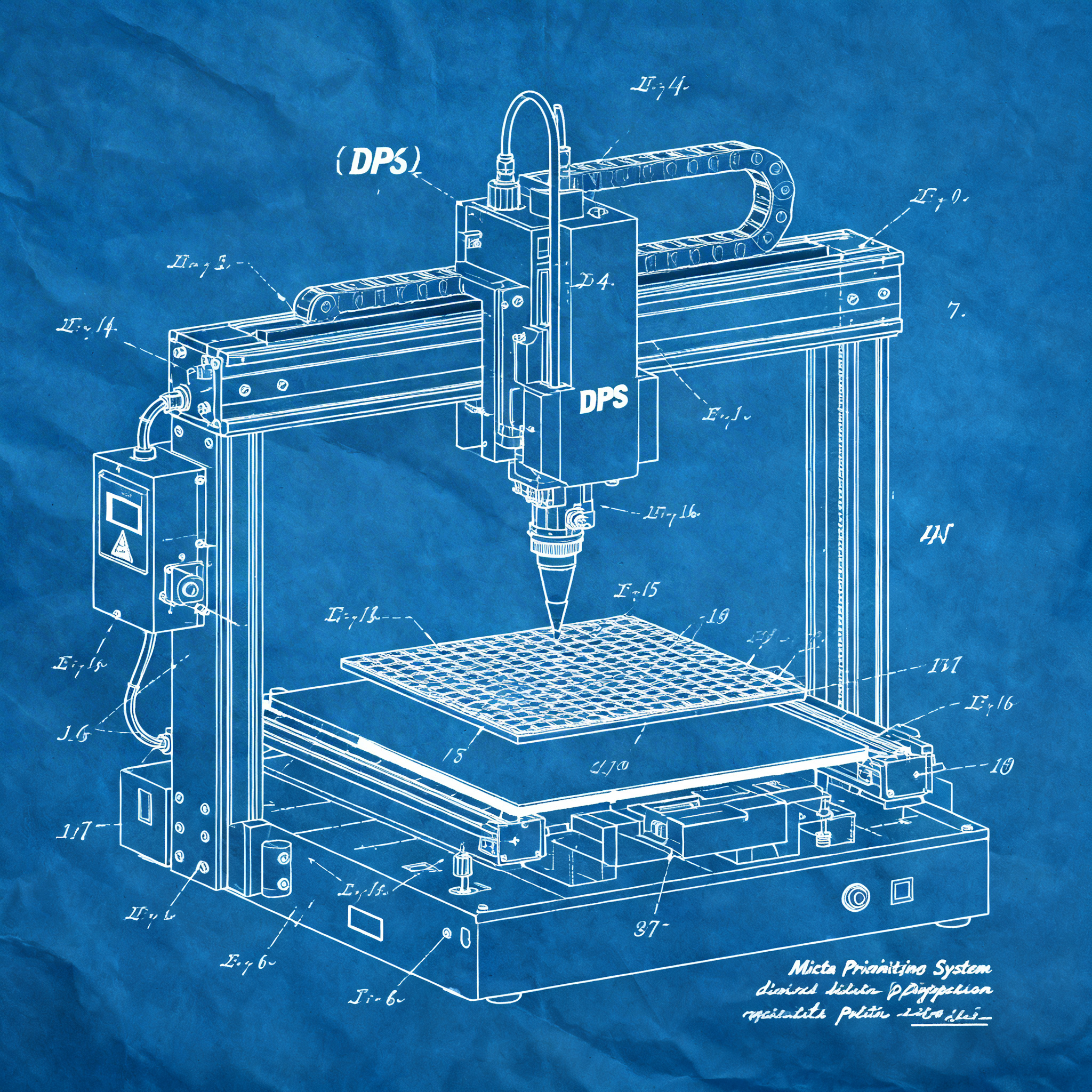
This type of deposition is particularly relevant for advanced electronics, where miniaturization requires very dense interconnections with stringent requirements on electrical resistance, substrate adhesion, and compatibility with subsequent packaging stages. XTPL's Delta Printing System (DPS) leverages UPD technology for applications ranging from advanced packaging to high-density interconnections.
With the increase in the number of I/O and bandwidth in modern devices, thermal management and signal routing over extremely short distances become critical. Traditional techniques based on bumps, wire bonding, or micro-vias encounter density and cost limits in some configurations, opening up opportunities for additive deposition processes that allow creating custom bridges, lines, and vertical connections directly on the package.
Partnership Strategy with Manz Asia
Collaborating with Manz Asia allows XTPL to integrate its technology into existing production flows without having to build dedicated plants, accelerating access to the Taiwanese market.
XTPL has announced a strategic partnership with Manz Asia, a semiconductor equipment manufacturer specializing in advanced packaging technologies that maximize chip performance. The starting point of the collaboration is the acquisition by Manz Asia of a Delta Printing System (DPS) unit from XTPL, which leverages Ultra-Precise Dispensing technology.
The acquisition will be installed in the first half of the year at the Manz Semiconductor Innovation R&D Center in Taiwan, allowing XTPL to reach a completely new audience while Manz Asia acquires a new process capability. Since the print head is the key to the UPD technique, XTPL emphasizes that the strategic partnership provides a potential path to definitively integrate XTPL's print head into Manz Asia's machines.
By collaborating with Manz Asia, XTPL has achieved the goal of expanding its physical sales positions in key markets without having to commit the capital necessary to expand that presence independently, transforming a machine sale into a technological demonstrator in the world's most important semiconductor market.
Robert Lin, CEO of Manz Asia, stated: “This strategic partnership with XTPL expands our printing capabilities in the ultra-precise deposition of materials, enabling a wide range of advanced semiconductor applications. The technology supports conductive and non-conductive materials on 2D, 2.5D, and 3D substrates in various production scenarios.”
Operational Cases and Industrial Scalability
Pilot projects demonstrate the large-scale applicability of UPD technology in complex and certified production environments, with a roadmap towards volume production.
XTPL also announced a strategic partnership with a major semiconductor OEM for an advanced packaging solution based on its 3D printing technology. The agreement provides for joint validation phases, integration of the XTPL module into the manufacturer's lines, and a roadmap towards large-scale production once performance and reliability objectives are met.
In the initial phase, teams define use cases with pitch, thickness, and electrical resistance requirements compatible with the OEM's product roadmaps, including reliability tests such as thermal cycles, humidity, and accelerated aging. Once the solution is validated, the goal is to achieve in-line integration, where XTPL modules interface with existing equipment coordinating with other process steps.
For XTPL, this means entering the supply chain of a major player in a stable manner, with the prospect of recurring revenues related to systems, maintenance, and consumables. Filip Granek, CEO of XTPL, commented: “I am excited to start the partnership with Manz Asia, a company with a strong position and deep experience in the semiconductor industry in Taiwan and Asia. The synergy between XTPL's ultra-precise dispensing technology and Manz Asia's expertise in advanced semiconductor packaging is a natural combination.”
Expansion in Taiwan could precisely be what gives the company an advan
article written with the help of artificial intelligence systems
Q&A
- What is the main objective of the partnership between XTPL and Manz Asia in the semiconductor sector?
- The main objective is to integrate XTPL's Ultra-Precise Dispensing (UPD) technology into Manz Asia's advanced packaging processes, scaling the adoption of the technology without direct infrastructure investments. This allows XTPL to enter the Taiwanese semiconductor market through a technological demonstrator.
- What does XTPL's Ultra-Precise Dispensing (UPD) technology consist of?
- UPD technology enables sub-micron controlled depositions, essential for high-density applications in advanced electronics. Unlike traditional techniques, it allows for the creation of lines and conductive structures with micrometric precision, improving interconnections and direct integration in packages.
- How is the concept of packaging changing in the semiconductor industry?
- Advanced packaging is no longer just a protective enclosure but an active component that contributes to the functionality of the integrated circuit. Thanks to 3D design and functional integration, superior performance and more compact configurations can be achieved, such as in System in a Package (SiP) systems.
- What advantages does additive manufacturing offer compared to traditional methods in electronic packaging?
- Additive manufacturing allows for greater precision, geometric flexibility, and a reduction in the number of masks and photolithographies. It enables the creation of three-dimensional interconnections and integrated structures directly on the package, overcoming the limitations of traditional techniques such as bump or wire bonding.
- What is the role of the Delta Printing System (DPS) in XTPL's strategy?
- The DPS is the system that implements XTPL's UPD technology and represents the core of the collaboration with Manz Asia. It is installed in the partners' R&D centers to demonstrate its effectiveness and prepare for large-scale integration in existing industrial processes.