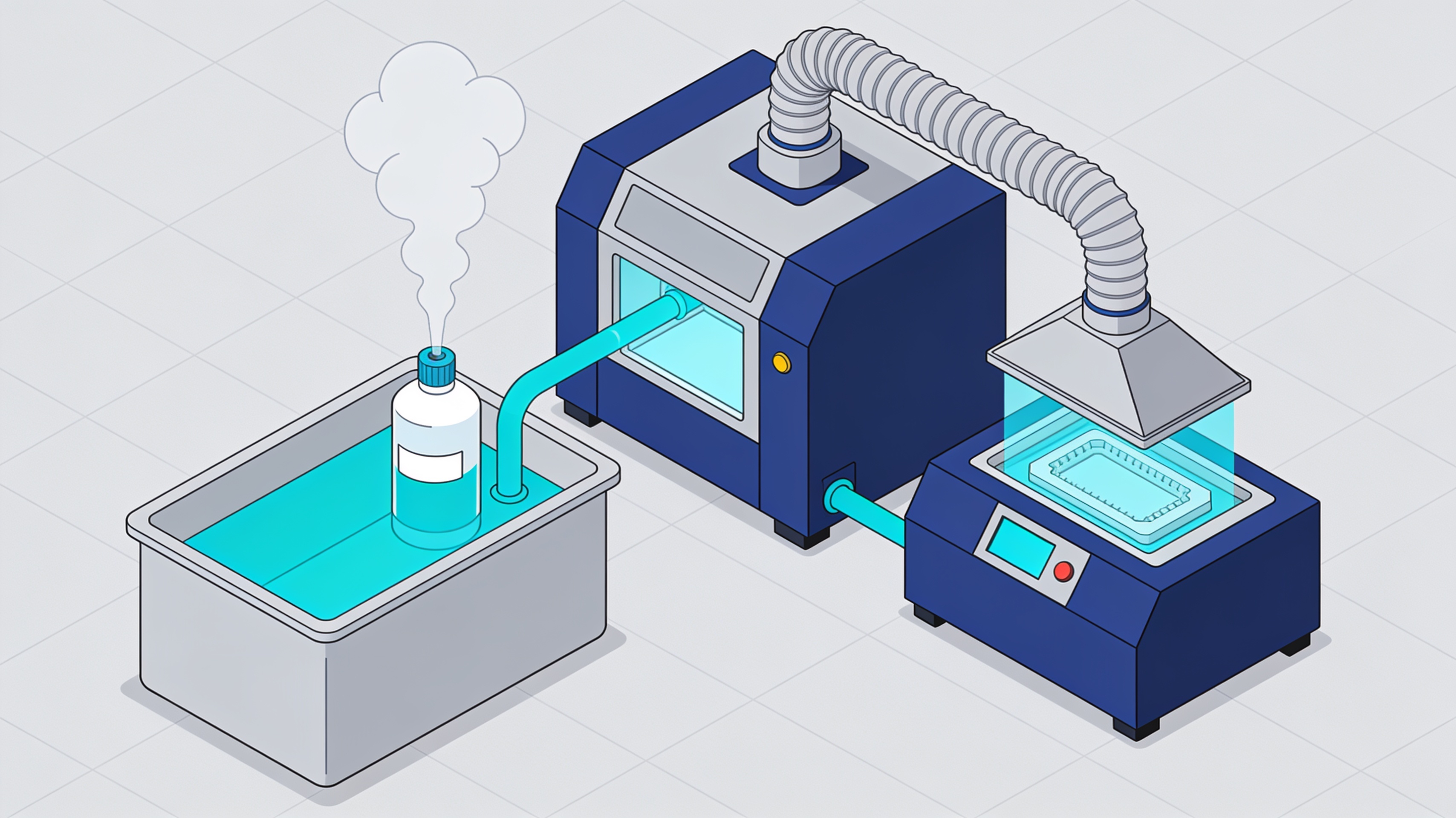
Resin 3D printing: VOCs come not only from the printer, but from washing and post-curing
Post-processing stages in resin 3D printing can generate concentrations of volatile organic compounds higher than those of printing itself. A scoping review draws attention to the entire workflow, not just the machine.
Safety in resin 3D printing does not end with purchasing a printer equipped with a closed cover. A new scoping review dedicated to occupational exposure in vat photopolymerization highlights that VOC peaks can occur during washing with isopropanol, opening the vat, or post-curing.
For dental labs, service bureaus, schools, and hospitals using SLA, DLP, or MSLA systems, the message is clear: safety design must cover the entire workstation, not just the printer enclosure.
The complete process: nine critical stages
Resin 3D printing involves multiple steps, each with potential emissions. The closed-cover printing stage is not necessarily the riskiest.
The review identifies nine distinct moments: resin preparation, printing, opening the machine, removing the build plate, washing, drying, post-curing, support removal, and cleaning.
Previous experimental studies have documented that some of the highest concentrations of volatile organic compounds occur during washing with isopropanol. Other peaks occur when the build plate emerges from the vat or during the curing stage.
- Washing with isopropanol: VOC concentrations higher than printing
- Opening the vat and removing the build platform: immediate release of vapors
- Post-curing: emissions from residual photochemical reactions
- Cleaning and maintenance: direct contact with chemical residues
What resins are: complex chemical formulations
Resins for vat photopolymerization are not simply “liquid plastic”, but proprietary mixtures of oligomers, monomers, and additives. The exact composition influences emissions.
Resins contain oligomers, acrylate or methacrylate monomers, photoinitiators, pigments, stabilizers, and additives. These components modify viscosity, flexibility, strength, transition temperature, and combustion behavior.
The exact formulation is often proprietary. This makes it difficult to predict emissions based only on the material's trade name.
Two resins with a similar name can have different chemical compositions and generate completely different emission profiles. The SDS safety data sheet is essential but not always complete.
Scoping review: mapping the problem, not solving it
A scoping review collects and compares existing studies to identify knowledge gaps. It does not establish definitive safety limits, but highlights where more data are needed.
The article published by Fabbaloo on September 16, 2026 reports the review “Occupational Exposure to Airborne Emissions from Resin Based Three Dimensional Printing: A Scoping Review”.
A scoping review does not certify specific machines nor define a single safety limit. It serves to collect measurements from the literature, compare experimental approaches, and identify areas with insufficient information.
In the field of resin 3D printing, this approach is particularly useful. Systems that ten years ago were confined to industrial laboratories today cost a few hundred euros and are used in environments not designed as chemical laboratories.
Practical implications for users
The spread of low-cost resin printers in non-industrial environments makes it urgent to rethink safety measures. Ventilation, filtration, and operating procedures must cover the entire workflow.
The operational consequence is direct: safety must be designed around the complete workstation, not just around the printer enclosure.
HEPA and activated carbon filters can mitigate emissions, but they must be sized for the entire work environment. Standards such as UL 2904 test particles and chemical emissions, but focus mainly on the printing phase.
Washing with isopropanol requires particular attention. It is a significant source of VOCs and typically occurs in open or semi-open containers, without the protections present on the printer.
Recommended approach to safety
- Comprehensive assessment: Map all stages of the process, not just printing.
- Adequate ventilation: Install local exhaust ventilation at washing and post-curing stations.
- Monitoring: Measure VOCs under real operating conditions, not only with the machine turned off.
- Training: Instruct operators on the risks of each stage, not only on using the printer.
Future perspectives
The review highlights that the available information is still insufficient for many aspects of the process. Studies are needed that measure emissions under realistic operating conditions, with standardized protocols and attention to post-processing stages.
For manufacturers, users, and regulators, the message is clear: safety in resin 3D printing requires a holistic approach. The risk does not end when printing ends.
article written with the help of artificial intelligence systems
Q&A
During which phase of resin 3D printing are the highest VOC peaks recorded?
Volatile organic compound concentration peaks occur mainly during isopropanol washing and vat opening, often exceeding those of the printing phase itself.
What are the nine critical phases of the resin printing process identified by the review?
The phases are: resin preparation, printing, machine opening, platform removal, washing, drying, post-curing, support removal, and cleaning. Each presents specific potential emissions.
Why is it difficult to predict resin emissions based solely on the trade name?
Resins are complex proprietary mixtures of oligomers, monomers, and additives; formulations with similar names may have different chemical compositions and generate completely different emission profiles.
Which specific operations involve an immediate release of hazardous vapors?
Opening the vat after printing and removing the platform cause an immediate release of accumulated vapors, representing high-risk moments for operator exposure.
Does a printer with a closed lid alone guarantee safety from VOC exposure?
No, safety does not end with the printer closed, as post-processing phases like washing and curing generate higher concentrations; the entire workstation must be designed for safety.