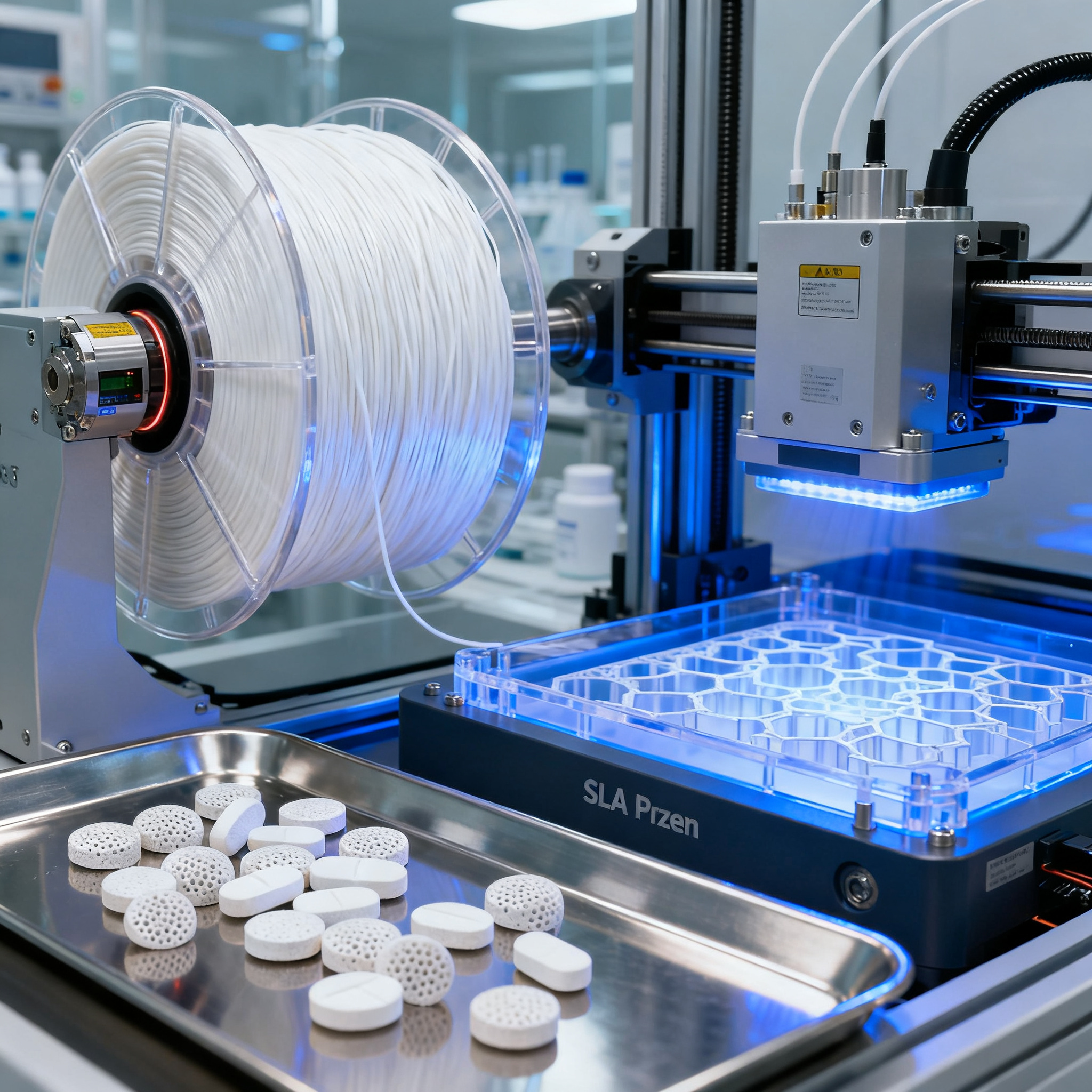
The 3D pharmacy that prints your medicine?
Personalized pharmaceutical production is no longer science fiction: here is how 3D printing technologies are truly entering pharmacies.
3D printing technologies for the pharmaceutical industry
Each technology presents specific advantages and limitations in terms of precision, compatible materials, and regulatory compliance.
The choice of the right technology determines the success of the implementation in the pharmacy. Five processes dominate the sector: FFF, SLS, SLA/DLP, binder jetting, and Semi Solid Extrusion (SSE).
The Fused Filament Fabrication (FFF) incorporates active ingredients into printable filaments via Hot Melt Extrusion. It does not use solvents and is accessible, but heat limits the range of usable active ingredients. The quality of the filament directly influences the uniformity of the dose.
| Technology | Main advantages | Critical limitations |
|---|---|---|
| FFF | Solvent-free, accessible | Heat sensitivity, filament quality |
| SLS | Porous orodispersible tablets | Thermal exposure, dust management |
| SLA/DLP | Complex geometries, smooth surfaces | Limited ingestible resins |
| Binder jetting | Fast, friable structures | Post-print drying necessary |
| SSE | Low temperatures, heat-sensitive actives | Modest throughput, critical rheology |
The Selective Laser Sintering (SLS) binder jetting
Semi Solid Extrusion (SSE) offer precise geometries and smooth surfaces, useful for complex release architectures. Ingestible photopolymerizable resins still represent a bottleneck.
The binder jetting, already FDA approved with Aprecia's Spritam, quickly prints fragile structures that rapidly disintegrate. The choice of binder systems and post-printing drying introduce additional steps.
The Semi Solid Extrusion (SSE) operates at low temperatures, ideal for heat-sensitive active ingredients. Limited throughput and the need to carefully control rheology can cause variability.
Operational workflow: from lab to production
L’integration of 3D printing requires a standardized process that ensures quality and repeatability in a GMP environment.
Customization is not just geometry: it is a complete digital thread. Dose calculators, patient data integration, print recipes, and label generation must connect to the clinical registry.
Pharmacy manufacturing process
- Digital prescription: the doctor enters dose, weight, and patient parameters into the system.
- Print recipe generation: the software calculates geometry, active ingredient quantity, and process parameters.
- Printing and control: the dose is produced with in-process controls (NIR, analytical weighing).
- Traceability and dispensing: Each batch is documented electronically and linked to the patient.
CurifyLabs states that a dose can be printed in 1-3 seconds, achieving approximately 1000 doses per hour with integrated quality control. The system includes analytical weighing and in-process NIR control to assess mass and uniformity.
Process Analytical Technology (PAT), such as near-infrared spectroscopy, becomes essential for validating each batch. Without automation and integrated controls, customization remains manual, slow, and difficult to scale.
Materials and safety: selection criteria
The choice of materials must meet pharmacological and biocompatibility requirements, with attention to traceability.
Basic excipients must be produced according to GMP standards. CurifyLabs provides certified Curablend bases for various forms: tablets, liquids, films, suppositories, and troches.
Compounded drugs are not pre-approved by the FDA like industrial medicines. Safety, efficacy, and quality are not verified before marketing through the same pathway as approved drugs. For this reason, standardization, traceability, and quality control are of central importance.
Chemical compatibility between active ingredients and printing materials is critical. Each formulation must ensure stability, controlled release, and absence of interactions. Complete traceability from raw material to the final patient is mandatory.
For thermosensitive active ingredients, technologies like SSE operate at lower temperatures. For complex release geometries, SLA/DLP offer greater precision. The choice depends on the physicochemical properties of the active ingredient and the therapeutic goals.
Real cases: hospital pharmacies and on-demand production
Some facilities are already testing integrated solutions for local production of personalized formulations.
AtrimusRx in Sweden has integrated 3D printing into the extemporaneous preparation process. The company works on drug shortages, locally unregistered medications, and distributes to hospitals and pharmacies.
The Atrimus Px system allows customization by age, weight, and prescribed dose. Dosages start from 2 mg, with adjustments down to 0.25 mg in the lowest ranges. This precision is crucial in pediatrics, where splitting standard tablets introduces unacceptable variability.
- Pete Pharma has signed an agreement with Atrium24 to bring M3DIMAKER to independent US pharmacies
- CurifyLabs is present in 21 US states with technology already operational in pharmacies
- Series A round of $14 million for US expansion, supply chain, and R&D
In the United States, Pete Pharma has signed an agreement with Atrium24 Technologies to distribute the FabRx M3DIMAKER platform through the GPO network of independent pharmacies. Pharmacies get preferential terms on hardware, software, and know-how.
CurifyLabs has closed a $14 million Series A round led by Sandwater and HealthCap. The capital will fund US expansion from Jacksonville, Florida, supply chain strengthening, and product development. The company states that pharmacies in 21 US states already use its technology for thousands of personalized doses per day.
Conclusion
Personalized pharmaceutical production is now a concrete application reality, no longer confined to research laboratories. 3D printing technologies offer different solutions for different needs: FFF for accessibility, binder jetting for speed, SSE for delicate active ingredients.
L’implementation requires targeted technological choices and complete digital workflows. Traceability, in-process controls and electronic documentation are essential to comply with regulatory standards. Pharmacies that adopt these platforms can respond to drug shortages, pediatric needs and complex therapies with greater precision.
Evaluate your production process: which 3D technology can truly scale in the pharmacy? The answer depends on the active ingredients treated, the volumes required, and the ability to integrate automated quality controls into the daily operational workflow.
article written with the help of artificial intelligence systems
Q&A
What are the main advantages and limitations of FFF technology in pharmaceutical 3D printing?
Fused Filament Fabrication (FFF) does not use solvents and is an accessible and relatively inexpensive technology for pharmacies. However, the use of heat during extrusion limits the range of usable active pharmaceutical ingredients, and filament quality directly affects the uniformity of the final dose.
Why is Semi Solid Extrusion (SSE) considered ideal for thermosensitive active ingredients?
SSE operates at low temperatures, which preserves the integrity of active ingredients that would degrade with heat. Its main limitations are modest throughput and the need to precisely control material rheology to avoid variability in production.
What is the role of Process Analytical Technology (PAT) in the pharmacy 3D printing workflow?
PAT, such as near-infrared (NIR) spectroscopy, enables in-process controls to evaluate mass and uniformity of each dose during printing. Without these integrated automated controls, customization would remain manual, slow, and difficult to scale in a GMP environment.
What regulatory challenges emerge for drugs produced in pharmacies via 3D printing?
Compounded drugs are not pre-approved by the FDA through the same pathway as industrial medicines, so safety and efficacy are not verified before commercialization. For this reason, standardization, complete traceability from raw material to patient, and rigorous quality controls are central elements of the process.
How is the manufacturing process structured from digital prescription to dispensing in a 3D pharmacy?
The physician enters dose, weight, and patient parameters into a digital system that automatically generates the printing recipe with geometry and active ingredient quantity. The dose is then produced with in-process controls and each batch is documented electronically, ensuring traceability and direct link to the final patient.
What real-world implementation examples of pharmaceutical 3D printing are cited in the article?
In Sweden, AtrimusRx has integrated 3D printing for personalized extemporaneous preparations through the Atrimus Px system, especially useful in pediatrics. In the United States, Pete Pharma distributes the M3DIMAKER platform and CurifyLabs already operates in 21 states producing thousands of personalized doses per day.