3D printing for defense: from the field container to mass production
3D printing for defense moves along two tracks. In the field, containerized systems reduce procurement times; at the industrial level, Divergent aims for high volumes with proprietary additive technology.
- An AML3D system in a 20-foot container was used by Marines in Okinawa to produce requested parts during an exercise.
- Divergent supports Raytheon in the development of the SLCM-N missile and has announced the Monolith One system.
- Divergent plans 64 new systems in a 430,000-square-foot facility in Long Beach.
3D printing in the operational theater
Field 3D printing serves to produce what is missing, where it is missing.
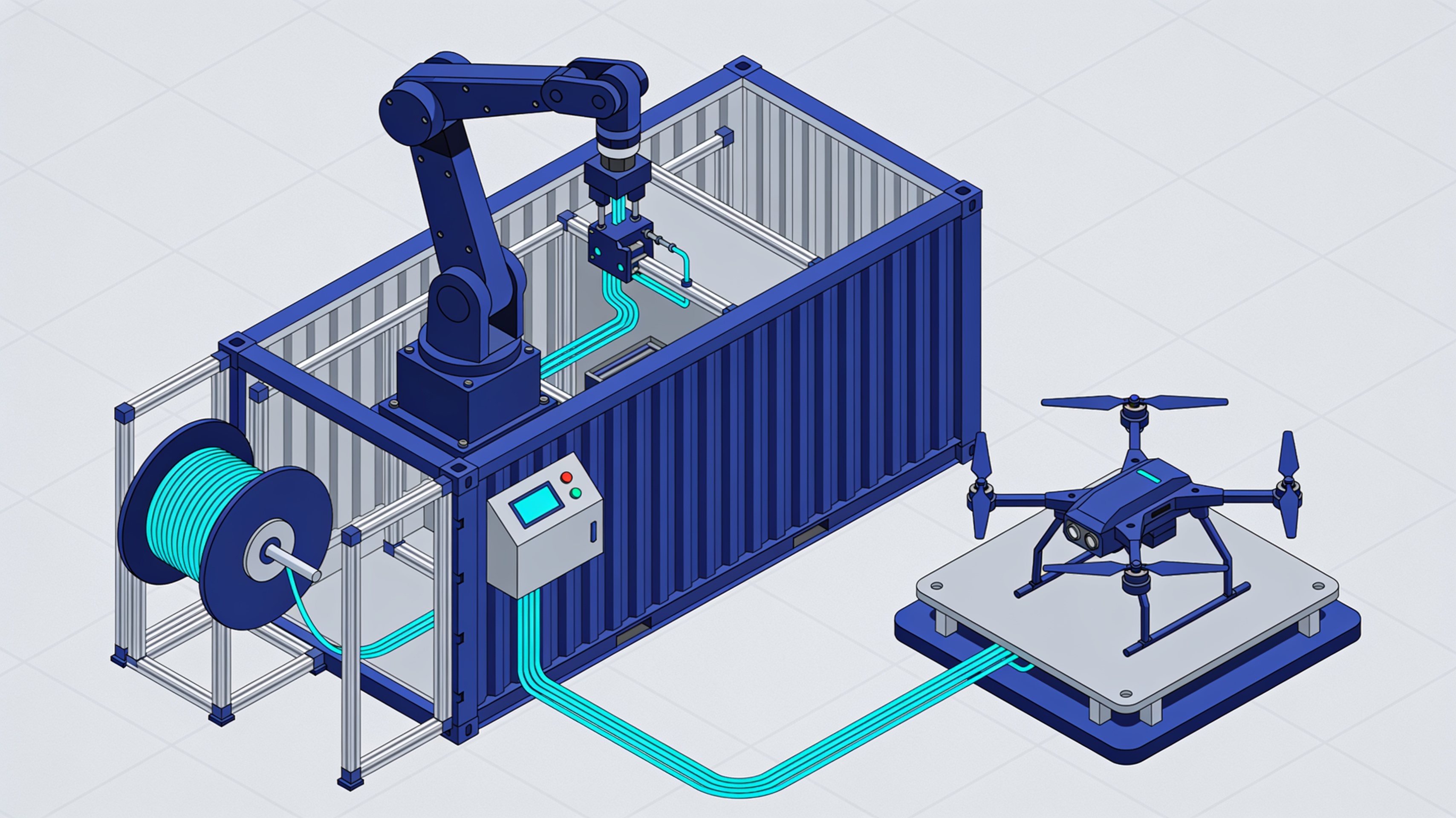
A portable AML3D system in a 20-foot container has entered the AM Center of Excellence environment. The goal is to make production, experimentation, and reorganization of capabilities more flexible.
The container is a practical choice. A standard module can be moved, reinstalled, and used for training or production in different contexts.
The team set up a production capability in a training area, working on parts requested by units engaged in the exercise.
Examples cited include bolts for a construction vehicle, 3D-printed adapters, and drone frames. A component that would have taken weeks was recreated using scanning, reverse engineering, and local manufacturing.
Divergent and industrial scale
Divergent connects 3D printing to defense on two fronts: systems development and production capability.
Raytheon received an OTA agreement from the U.S. Navy for the Nuclear-Armed Sea-Launched Cruise Missile (SLCM-N). Divergent will contribute to development alongside Anduril Rocket Motor Systems and Williams International.
The SLCM-N program has been in development since 2018. Raytheon wants to move from concept activities to a focused development phase, mature the design, and prepare prototype demonstrations.
The composable weapons approach uses mature modular building blocks. The goal is to reduce cycle times and accelerate missile development.
Divergent already has partnerships in the sector with General Atomics Aeronautical Systems, AEVEX, and Lockheed Martin.
Divergent also announced the Monolith One additive manufacturing system. In the coming months and years, production should shift entirely to proprietary AM technology.
CEO Lukas Czinger aims to scale with a 12-laser AM system.
From field production to mass production
Industrial scale is the second front: more systems, more space, more volumes.
Divergent and AEVEX are developing a new autonomous platform. Divergent plans 64 additional systems in a new factory of approximately 430,000 square feet in Long Beach, California.
The expansion is expected to increase annual production capacity approximately eightfold. The stated goal includes tens of thousands of airframes for munitions per year.
| Attribute | Field printing (AML3D/AIMMS) | Industrial production (Divergent) |
|---|---|---|
| Units | 20-foot container | 64 additional systems |
| Target | Flexibility and parts required in exercises | Tens of thousands of airframes for munitions per year |
| Technology | Portable AML3D system | Monolith One, 12-laser AM system |
Limits and open questions
The two trajectories are not alternatives: they respond to different needs.
Field printing prioritizes immediate availability. It reduces dependence on logistics and long waits for critical components.
Industrial production prioritizes volumes and repeatability. It requires large facilities and multiple systems, as in the Divergent plan.
Available sources do not quantify costs per part. They also do not indicate average printing times or qualified materials. These data remain to be verified.
3D printing in the field does not automatically replace industrial production. Sources show two complementary models: local emergency production and volume additive production.
article written with the help of artificial intelligence systems
Q&A
How is 3D printing used in the field by Marines in Okinawa?
A 20-foot containerized AML3D system was used to produce parts requested by units during an exercise. Examples include bolts for a construction vehicle, adapters and drone frames. A component that would have taken weeks was recreated with scanning, reverse engineering and local manufacturing.
What is Divergent's role in the U.S. Navy's SLCM-N program?
Raytheon received an OTA agreement from the U.S. Navy for the SLCM-N missile and Divergent will contribute to development together with Anduril Rocket Motor Systems and Williams International. The goal is to move from concept activities to a focused development phase, mature the design and prepare prototype demonstrations.
What does the composable weapons approach cited for the SLCM-N program consist of?
The composable weapons approach uses mature modular building blocks to reduce cycle times and accelerate missile development. This method aims to make the transition from concept phases to production faster.
What defense sector partnerships does Divergent already have?
Divergent has partnerships with General Atomics Aeronautical Systems, AEVEX and Lockheed Martin. These collaborations are part of the link between 3D printing and defense on systems development and production capacity.
What are Divergent's plans for the industrial scale of 3D printing?
Divergent announced the Monolith One additive manufacturing system and plans 64 new systems in a 430,000-square-foot facility in Long Beach. CEO Lukas Czinger aims to scale with a 12-laser AM system, with production expected to shift entirely to proprietary AM technology.