Custom footwear and apparel: 3D printing revolutionizes production
We analyze two recent patent applications, not established technologies. Innovations could enter production within 2-5 years, modifying design and manufacturing of shoes and wearable components.
Cited patents
– Topology Optimized 3D Printed Structures for Footwear — 11 February 2026
– Multi-Layer Extruded Uppers for Articles of Footwear and Other Foot-Receiving Devices — 14 January 2026
3D printing is no longer just experimental: two new patented technologies are about to enter footwear factories, promising lighter, higher-performing, and custom-made products. Soles with structures optimized via topology can weigh up to 30% less without sacrificing resistance, while multi-layer 3D-printed uppers combine comfort, support, and breathability in a single print. The innovations are made plausible by established technologies in other sectors and the interest of advanced sports companies.
What problem does it solve
Traditional footwear suffers from trade-offs between lightness, durability, and comfort. The new technologies aim to overcome them with computer-designed structures and precision manufacturing.
In conventional methods, every improvement in one direction tends to worsen another characteristic: a lighter sole may be less resistant; a more breathable upper may offer less support. The limits stem from material constraints and traditional processes: injection molding, cutting and sewing, assembly of separate components.
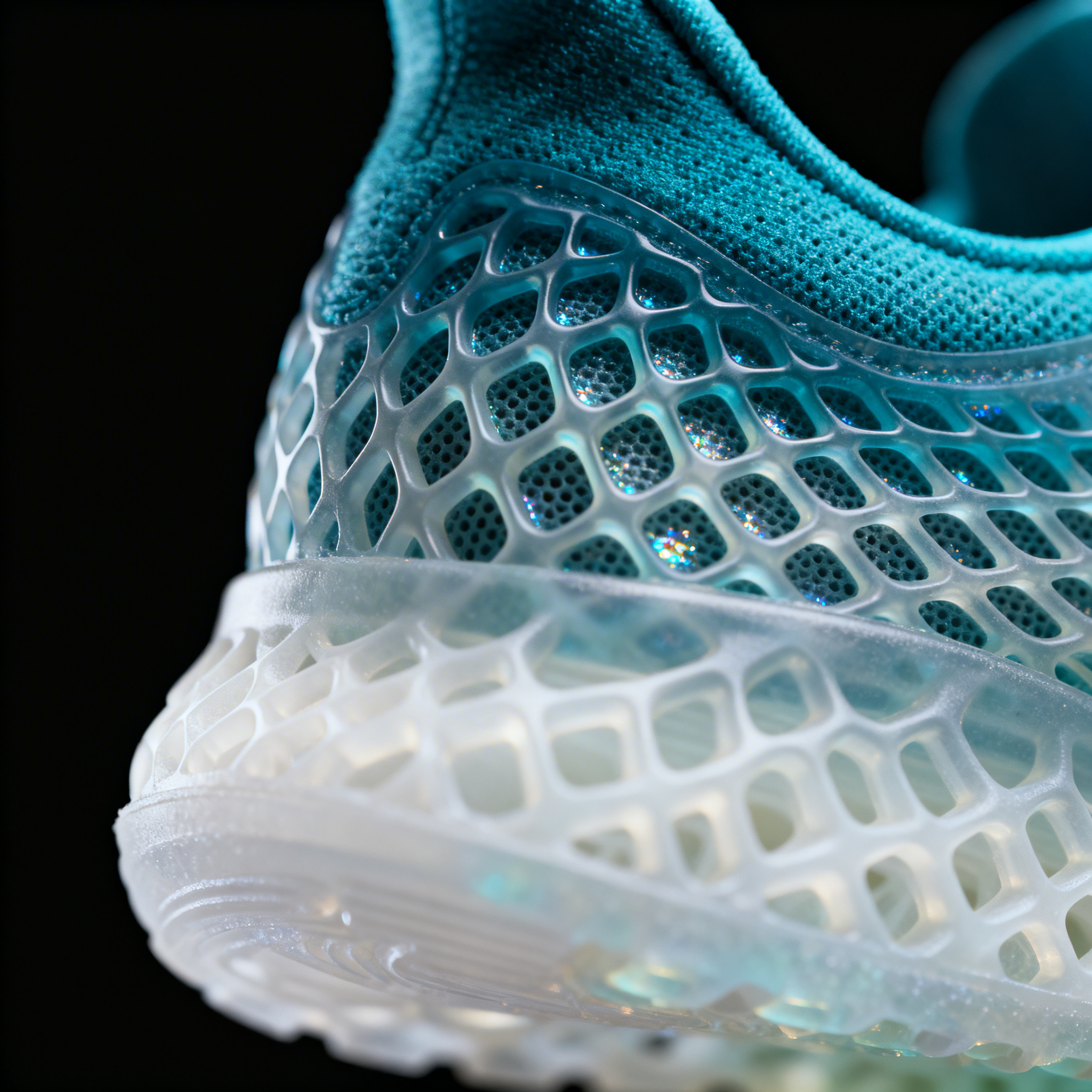
The patent on optimized structures notes that traditional soles contain structurally “unnecessary” material: areas that do not contribute to resistance but add weight and cost. Topology optimization calculates where material is needed and where it can be removed, creating internal lattice structures that maximize resistance and cushioning while reducing mass.
Traditional uppers require the assembly of fabrics, synthetic leather, or mesh, sewn or glued. Every seam is a potential failure point; every layer adds weight and complexity. The patent on multi-layer uppers proposes building the entire upper in a single additive process, depositing filaments of different materials along calculated paths to obtain differentiated mechanical properties—stiffness in the heel, elasticity in the forefoot, lateral breathability—without seams or joints.
The idea in 60 seconds
Two recent patents introduce optimized internal structure soles and multi-layer 3D printed uppers for lighter, more durable, and customized footwear.
The first patent describes a method for 3D printing footwear components—particularly soles—by populating the internal volume with a lattice of interconnected cells, whose arrangement is determined by topological optimization algorithms. The software calculates where reinforcements are needed and where material can be reduced, generates a three-dimensional lattice structure, and the printer deposits material only where necessary.
The second patent concerns the production of uppers through multi-layer extrusion: the printer deposits multiple filaments (with different properties: rigid, elastic, breathable) simultaneously or in sequence along designed paths to form the heel, midfoot, toe, and lateral zones. Each layer fuses with the underlying one, creating a seamless, one-piece component.
Both technologies are based on additive processes (FDM or similar), but the qualitative leap lies in the integration between advanced computational design and automated production: it is not just about “printing a shoe,” but generating geometries impossible with traditional molds and customizing them based on biomechanical data or individual preferences.
What really changes (tangible improvements)
Soles can weigh up to 30% less, while uppers offer differentiated mechanical properties without seams, improving comfort and durability.
Weight reduction without compromising strength
The Patent on topologically optimized structures indicates that the soles can weigh up to up to 30% less compared to traditional equivalents. The internal lattice structure maintains or improves cushioning and resistance because the material is distributed exactly where it is needed. For a runner, 30g less per shoe means less fatigue over long distances; for the manufacturer, less material means lower costs and less environmental impact.
Customizable cushioning and elastic response
The lattice structure can be designed with variable density: denser under the heel to absorb impact, more open in the forefoot to favor propulsion. This control is difficult to achieve with EVA foams or injection-molded polyurethanes, which have uniform properties. The patent does not provide quantitative cushioning values, but the principle is clear: variable geometry equates to tailored mechanical response.
Elimination of seams in uppers
The patent on multi-layer uppers describes a continuous process in which filaments fuse during deposition. This eliminates seams, which are traditionally weak points (they can tear, cause irritation, accumulate moisture). A seamless upper is more durable and comfortable and can be produced more quickly because it does not require manual assembly.
Differentiated mechanical properties zone by zone
By depositing filaments with different characteristics—rigid TPU for the heel counter, soft TPU for the tongue, breathable mesh for the sides—the process allows for calibrated support, elasticity, and ventilation in each zone, without adding separate layers. The patent documents do not provide quantitative data on breathability or rigidity, but the principle is solid and already applied in other sectors (multilayer packaging, technical textiles).
Example in company / on the market
Sports manufacturers are testing these technologies for premium lines, adapting sole geometry to users' biomechanical data.
A plausible use case, consistent with the patent on optimized structures, is that of a sports footwear manufacturer launching a premium line of customized running shoes. The customer performs a 3D foot scan (smartphone or dedicated scanner), provides data on their running style (stance, pronation), and the system generates a sole with an internal lattice optimized for that biomechanical profile. The shoe is printed on demand and shipped within a few days.
This model is in the experimental phase at companies like Zellerfeld, which has built a platform for on-demand production of 3D-printed footwear, and at established brands testing midsoles with similar technologies (Carbon collaborates with Adidas and New Balance). The adoption of topology optimization for soles is a natural extension.
For multi-layer uppers, a concrete example could be a factory producing footwear for specific sports (soccer, trekking, basketball), printing uppers with reinforcements and elastic zones calibrated for each discipline, without managing dozens of fabric variants and sewing operations. The <a
article written with the help of artificial intelligence systems
Q&A
- What is the main advantage of 3D-printed soles with topology optimization?
- Solescan weigh up to 30% less while maintaining or improving strength and cushioning, thanks to an internal lattice structure that distributes material only where needed.
- How does the multi-layer upper patent eliminate the problems of traditional stitching?
- It builds the entire upper in a single 3D extrusion process, fusing different filaments without seams; this eliminates weak points, irritation, and speeds up production.
- Why can the internal lattice geometry be customized?
- Because topological optimization calculates the cell layout based on the user's biomechanical data, allowing variable density to cushion or support specific areas of the foot.
- When could footwear with these technologies hit the market?
- The innovations, currently in the patent phase, could enter production within 2-5 years, as they are based on additive processes already proven in other sectors.
- What is a concrete example of a sports application cited in the article?
- A manufacturer can offer premium running shoes: after 3D scanning of the foot and analysis of the gait, the sole with the optimized lattice is printed on demand and shipped within a few days.