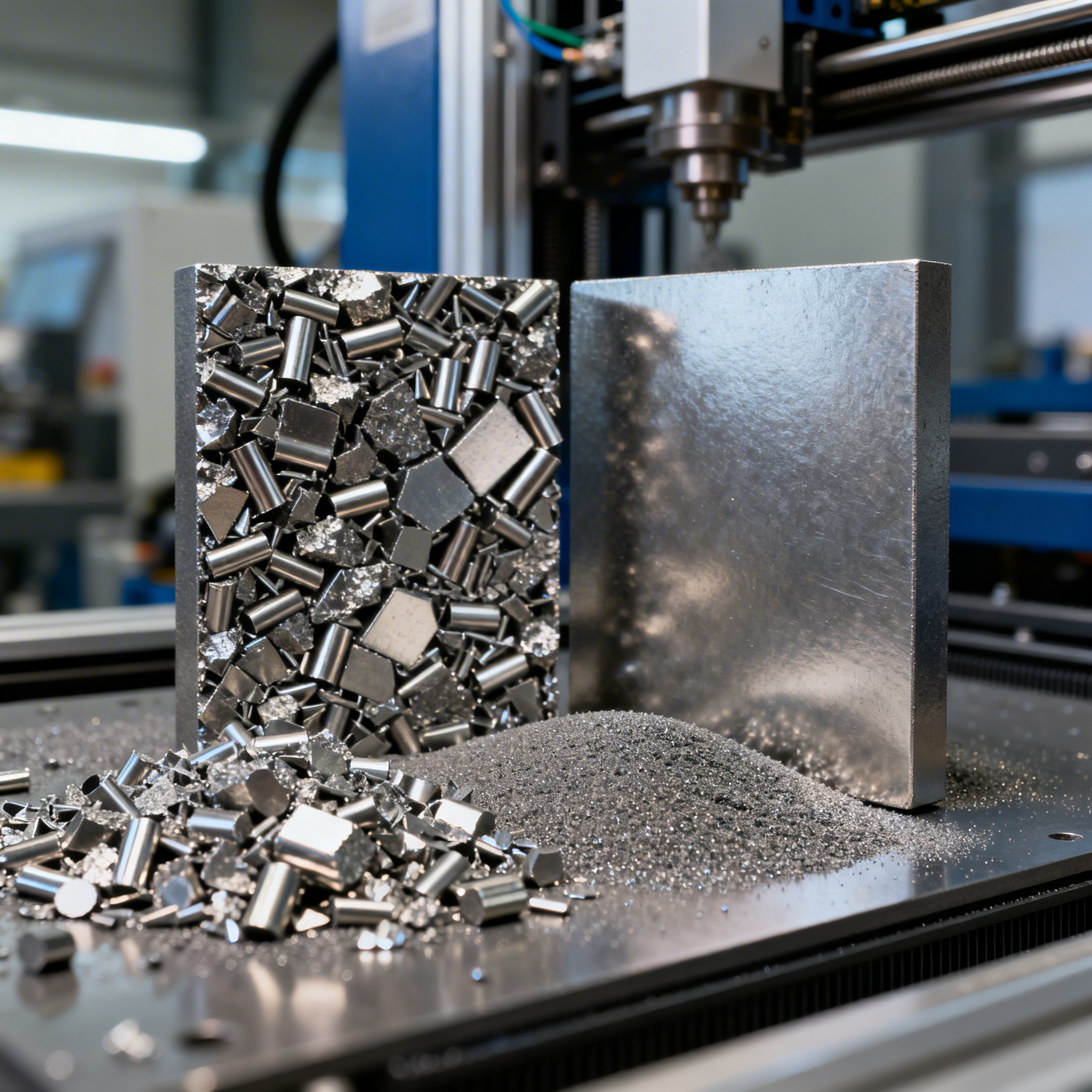
Sustainable 3D Printing: Quality vs. Environmental Impact in Recycled Materials
In the world of industrial 3D printing, the use of recycled powders offers concrete environmental benefits but poses real challenges on the quality of final components, requiring a careful balance between sustainability and performance.
The transition to recycled materials in additive manufacturing represents today one of the most concrete challenges for those operating in the industrial sector. Emerging data shows that the choice between new and recycled powder is not just a simple environmental issue, but implies operational compromises that directly affect mechanical resistance, process costs, and production efficiency. For companies that must meet high quality standards while maintaining decarbonization goals, understanding these trade-offs becomes essential.
Final Product Quality: New vs. Recycled
The ratio between virgin and recycled powder directly determines the final mechanical properties: finding the right balance is the result of an iterative process that balances sustainability and structural integrity.
JawsTec's practical experience with SLS systems demonstrates how the optimal ratio between new and recycled material is the result of careful experimentation. The company currently uses a mixture with approximately 80% virgin powder and 20% recycled material: this proportion guarantees high-quality components without compromising mechanical properties. As the company explains, using exclusively recycled powder without the addition of virgin material produces extremely fragile parts, similar to paper, that break easily. The process of identifying the optimal ratio required successive attempts, with the goal of maximizing recycled content while maintaining industrial quality standards.
In the case of metal powders, Life Cycle Assessment studies conducted by Oregon State University on recycled nickel show that the quality of the recovered material must remain “process-ready”: sphericity, flowability, oxygen content, and granulometric distribution affect density, defectology, and repeatability of the final component. The sustainability of the material becomes relevant only if the powder maintains characteristics suitable for industrial use.
Operational Costs and Environmental Impact
The integration of recycled materials can reduce procurement costs, but a complete analysis must consider energy, inert gases, and qualification processes that affect the total carbon footprint.
The study on recycled nickel conducted by Oregon State University quantifies a reduction in global warming potential (GWP) of 58.8% using recycled nickel compared to virgin material. When the process is combined with green electricity and argon from renewable sources, the reduction reaches 98.7%. These data highlight that, in recycling-based pathways, electricity and inert gases become the main contributors to the residual environmental impact, while in conventional production, virgin nickel represents approximately 62% of the total GWP.
The “cradle-to-gate” analysis – from raw material to manufacturer exit – provides quantitative metrics useful for comparing supply alternatives and documenting decarbonization goals, but does not replace metallurgical qualification activities. The challenge launched by Additive Manufacturing Austria in 2026 underscores precisely this need: to develop tools that allow calculating the CO₂ footprint considering all phases, from material choice to part orientation, from infill density to machine energy consumption.
Print System Efficiency and Material Adaptation
Systems with reduced build volumes and lower power lasers are particularly suitable for the use of recycled powders, optimizing cycle times and energy efficiency for prototyping and small batches.
The QLS 230 system used by JawsTec is a concrete example of a machine designed to exploit recycled materials. The reduced build volume compared to larger systems (such as the QLS 820 with 13.7 x 13.7 x 15.7 inches), combined with a relatively lower power laser, makes it ideal for prototyping and small production runs. The complete print cycle, including cooling, takes about 24 hours – significantly less than the several days required by many traditional SLS systems.
From a machine design perspective, Nexa3D highlights the importance of addressing sustainability not only on the material side but also on the systems side: printers like XiP and XiP Pro are built with recyclable materials such as aluminum to reduce consumables, and over 80% of the energy is used directly for component production, ensuring high energy efficiency.
Concrete Industrial Cases: Balancing Performance and Sustainability
High-tech industrial projects demonstrate that the integration of traceable recovery circuits allows material to be reintroduced into the supply chain while maintaining rigorous quality standards.
Siemens Energy sent tens of thousands of kilograms of nickel-based scrap to Continuum Powders for conversion into feedstock via Greyhound Melt-to-Powder (M2P) technology, with the goal of reintegrating material into the supply chain instead of sending it to lower-value disposal routes. This type of closed-loop circuit demonstrates that life cycle analysis is not a theoretical exercise, but a replicable procurement model when a qualifying recovery flow exists.
The availability of scrap flows with traceability and quality consistent with the needs of superalloys is an often-overlooked element: the sustainability of metal powders requires quality controls and replacement criteria to avoid compromising the process window for the sake of environmental goals.
Conclusion
The choice between new and recycled powder requires careful evaluation of operational and strategic trade-offs, not just environmental ones: sustainability and reliability must go hand in hand.
Available data show that the integration of recycled materials in industrial 3D printing is technically feasible and environmentally beneficial, but requires a systemic approach. The optimal ratio between virgin and recycled material, the choice of suitable systems, the supply of energy and inert gases, the traceability of recovery flows, and quality controls are interconnected variables that determine the success of implementation.
Carefully evaluate your production process: sustainability must go hand in hand with reliability and performance. Start by mapping your waste streams, identify suppliers with traceable recycling programs, and conduct iterative tests to determine the optimal new/recycled material ratio for your specific applications.
article written with the help of artificial intelligence systems
Q&A
- What is the optimal ratio between virgin and recycled powder according to JawsTec's experience?
- JawsTec uses a mixture composed of 80% virgin powder and 20% recycled material. This ratio allows for the production of high-quality components without compromising mechanical properties.
- What are the consequences of using exclusively recycled powder in 3D printing?
- The exclusive use of recycled powder produces extremely fragile, paper-like components that break easily. It is therefore necessary to integrate virgin material to maintain structural integrity.
- How does nickel recycling affect the global warming potential (GWP)?
- The Oregon State University study shows a 58.8% reduction in GWP using recycled nickel. Combining this with green electricity and renewable argon, the reduction can reach 98.7%.
- What characteristics must recycled metal powder have to be considered 'process-ready'?
- The powder must maintain sphericity, flowability, low oxygen content, and an adequate particle size distribution. These properties directly affect density, defectology, and repeatability of the final component.
- What advantages do SLS systems with low build volumes offer in the use of recycled materials?
- Systems like the JawsTec QLS 230, with low volume and lower power laser, optimize cycle times and energy efficiency. They are ideal for prototyping and small batches with the use of recycled powders.