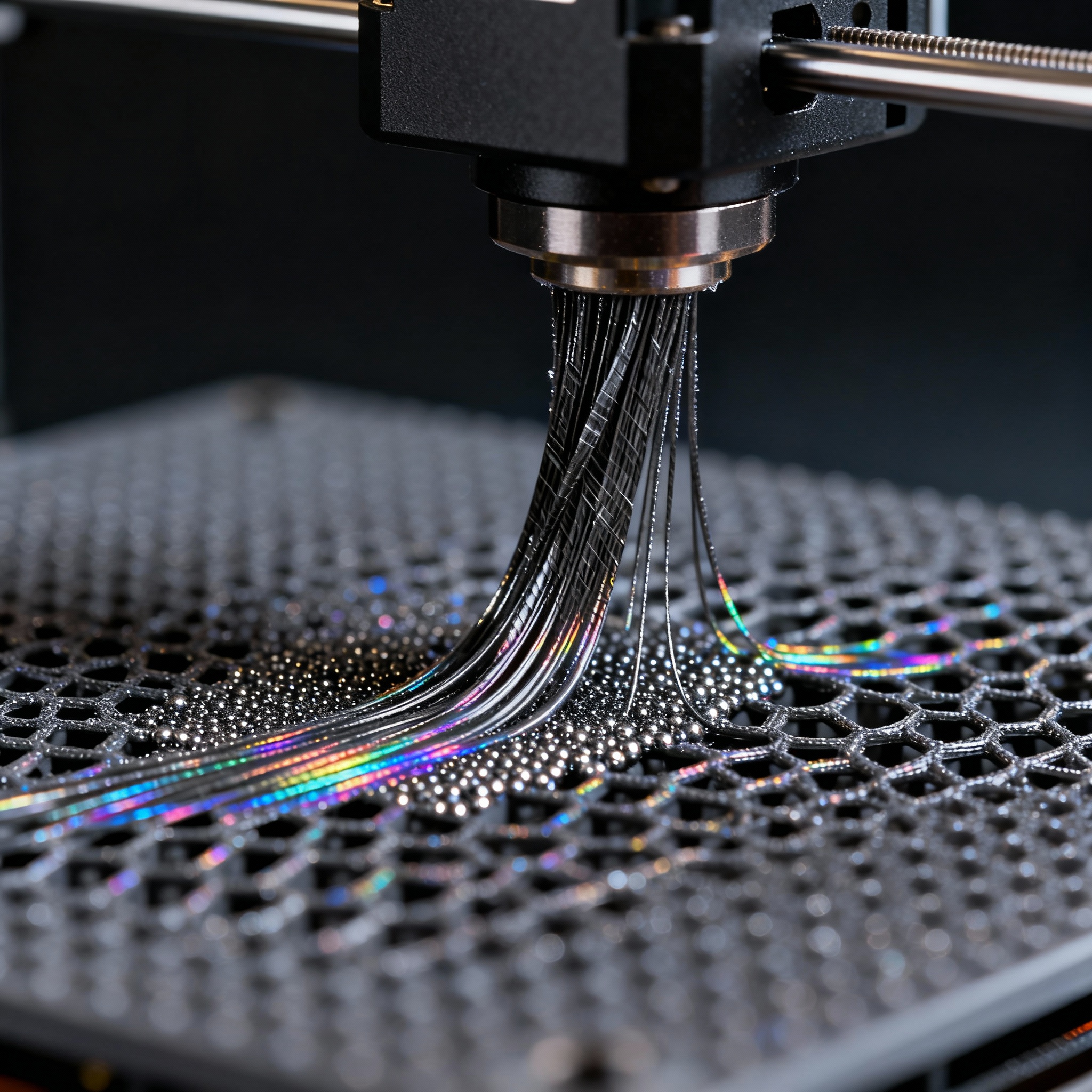
Industrial and continuous 3D printing solutions: advanced technologies for modern production
Definition and characteristics of industrial 3D printing solutions
Industrial 3D printing solutions represent a qualitative leap compared to hobbyist applications, offering always-active production capabilities integrated directly into production lines. The adoption of additive manufacturing allows companies to optimize production efficiency and unlock unlimited application opportunities, creating equipment, custom devices, and final components without resorting to outsourcing during product development.
In the automotive sector, integrating 3D printers into business operations allows for significant time and cost savings. In-house capabilities enable control over the entire production process, eliminating the need to outsource component production. This approach simplifies operations, reduces lead times, and maintains a competitive advantage in the market.
Production structures can design and print a wide variety of applications quickly, including tool organizers, safety devices, assembly tools, quality control, and transport, without using valuable CNC machining time.
3D printing technologies for continuous production
The most advanced technologies for continuous production include high-performance systems designed specifically for industrial applications. The INDUSTRY line by 3DGence, produced exclusively in proprietary facilities, guarantees high quality and performance.
The INDUSTRY F421 model represents the fastest solution for engineering-level production, reaching print speeds of up to 400 mm/s with 1 m/s of movement, using a dual extrusion system with fused deposition modeling. The INDUSTRY F350 reaches the same speeds, adds advanced safety features, and uses a slightly smaller build volume.
Both systems are compatible with a wide range of materials and leverage the proprietary 3DGence software: SLICER 4.0 and CLOUD. The CLOUD platform allows for remote monitoring and direct communication with the machines, enabling full control of the process remotely, starting, canceling, and queuing prints, as well as collecting usage statistics to optimize the workflow. The platform provides a live video feed for real-time monitoring and live assistance from support experts.
Materials used in industrial applications
The range of materials available for industrial 3D printing is extremely diversified and suitable for multiple applications. Composite materials allow for the production of parts that are more resistant than machined aluminum, with a finish suitable for end use.
For systems operating at 280 °C, PLA, ABS, ABS-ESD, ASA, PA6, PA-CF are available with ESM-10 and HIPS support materials. At 360 °C, LEXAN, PC, PC-ABS, PEKK-CF, ULTEM 9085™ can be used with ESM-10 support material. For temperatures up to 500 °C, PEEK, PEKK and VICTREX AM™ 200 are available, always with ESM-10 support.
Exploiting additive manufacturing reduces the product lifecycle from development to end use, including legacy components. With in-house 3D printing, it is possible to create rapid prototypes in one day, perform tests, modify the design and reprint.
Case studies: implementation in a production environment
Several case studies demonstrate the effectiveness of industrial 3D printing in real environments. Labman Automation reduced costs by 75% using 3D printing, while Volkswagen Autoeuropa employs the technology to produce custom tools and prototypes.
In the automotive sector, the global supplier Brose adopted SLS 3D printing for final components, while Dorman uses the technology to keep pace with OEM manufacturers. In motorsport, 3D printing produces final parts and heat-resistant spare parts.
Ford and Ultimaker collaborate on the 3D printing of tools, equipment, and fixtures, demonstrating how major car manufacturers are integrating these technologies into production lines. These examples highlight how 3D printing allows for testing and redesigning new ideas in days rather than weeks.
Economic and performance benefits compared to traditional methods
The economic benefits of industrial 3D printing are significant and measurable. Having a digital library of printable components on demand allows for substantial savings on storage and warehousing costs. Files can be shared globally for modification and remote printing, enabling distributed production.
3D printing helps the automotive industry react more quickly to changes, positioning companies at the forefront of innovation. Companies can print custom components, tools, and safety devices rapidly, reducing unplanned downtime.
A tool manufacturer saved £26,000 per year with a single 3D printed component, while Dunlop Systems and Components has reduced costs by thousands of pounds with Markforged carbon fiber 3D printing. These results demonstrate the tangible return on investment.
Technical challenges and current limitations
Despite the numerous advantages, industrial 3D printing still presents some challenges. The need for qualified personnel to manage and optimize processes remains an important consideration: companies must invest in training engineers to fully leverage the capabilities of additive manufacturing.
Material compatibility and the selection of optimal print parameters require in-depth expertise. Although software like SLICER 4.0 uses certified material databases to ensure reliable results, advanced users must still know how to modify existing print profiles.
Dimensional limitations can be a constraint for large components, although some systems offer the possibility of splitting models that are too large for the print space. Quality management and process repeatability remain critical areas that require continuous attention.
Future perspectives and technological developments
The future of industrial 3D printing appears promising, with continuous technological developments expanding application possibilities. The ever-closer integration between hardware, software, and cloud platforms is creating fully digitized production ecosystems, where remote monitoring and real-time assistance become standard.
The expansion of the range of compatible materials, including high-performance polymers and advanced composites, will continue to open up new application sectors. The trend towards ever-greater print speeds, as demonstrated by systems reaching 400 mm/s, will make additive manufacturing increasingly competitive compared to traditional methods for serial production.
Distributed production, enabled by the digital sharing of print files, will transform global supply chains, reducing delivery times and logistics costs. Companies that adopt these technologies now will strategically position themselves to lead innovation in their respective sectors, benefiting from more efficient processes, greater production flexibility, and significant competitive advantages in the modern manufacturing market.
article written with the help of artificial intelligence systems
Q&A
- How does industrial 3D printing differ from hobbyist printing and what advantages does it offer to companies?
- Industrial 3D printing is designed for 24/7 production integrated into lines, unlike hobbyist printing. It allows for in-house production of tools, devices, and final components without outsourcing, reducing times and costs and maintaining full control of the process.
- What are the printing speeds and features of the 3DGence INDUSTRY F421 and F350 models?
- Both reach 400 mm/s printing and 1 m/s travel speeds; the F421 is fastest for engineering production, while the F350 adds advanced safety and slightly lower volume. Both use dual extrusion, proprietary SLICER 4.0 software, and CLOUD platform for remote control, statistics, and live video.
- What materials can be printed at 360 °C and 500 °C and for what applications?
- At 360 °C, LEXAN, PC, PC-ABS, PEKK-CF, ULTEM 9085™ with ESM-10 support are used; at 500 °C, PEEK, PEKK, and VICTREX AM™ 200, always with ESM-10. These high-performance polymers enable parts stronger than aluminum for critical end-use applications.
- What concrete economic results have the companies cited in the case study achieved?
- Labman Automation reduced costs by 75%; a tooling manufacturer saved £26,000 per year with a single component; Dunlop Systems cut thousands of pounds using Markforged carbon fiber. These examples demonstrate tangible and rapid ROI.
- What are the main current challenges in managing industrial 3D printing?
- Qualified engineers are needed to optimize processes and parameters; material selection and print profiles require specific expertise; dimensional limitations may force splitting large models; finally, ensuring quality and repeatability requires constant monitoring.
- How will the supply chain change thanks to distributed manufacturing enabled by 3D printing?
- Digital files of components can be shared globally and printed locally, eliminating warehouses and shipments. This reduces delivery times and logistics costs, transforming supply chains into lean and reactive networks, with on-demand production near the point of use.