Bioinspired Soft Robotics: How Multimaterial 3D Printing is Revolutionizing Integrated Actuators and Sensors
Multimaterial 3D printing is radically transforming the production of nature-inspired soft robots, eliminating complex fabrication processes and allowing the direct integration of actuation and sensors into flexible structures. Researchers at Harvard University have developed a method that enables the creation of robotic devices with built-in programmable motion during the printing phase, accelerating prototyping and customization compared to conventional mold-based and multistep assembly methods.
This innovation opens up new prospects for medical and surgical applications, assistive wearable devices, and flexible industrial automation, where adaptability and precision represent decisive competitive advantages.
Foundations of Bioinspired Soft Robotics
Nature-inspired soft robotics offers significant advantages over traditional rigid systems, but has historically required complex fabrication processes that slowed design iteration and limited customization.
Predictable motion in soft robotics has traditionally depended on complex molds and multistep fabrication processes, slowing design iteration and limiting customization. Bioinspired soft robots replicate the capabilities of natural organisms like octopuses and elephants, which use flexible structures to manipulate delicate objects and exert controlled force.
The soft robotics R&D landscape is evolving from the pure research phase toward initial commercialization examples. Researchers have begun to focus on the genuine advantages of soft robots over rigid counterparts, and the open design capabilities of additive manufacturing have been fundamental to this evolution.
Multimaterial 3D Printing Technology: The Heart of the Process
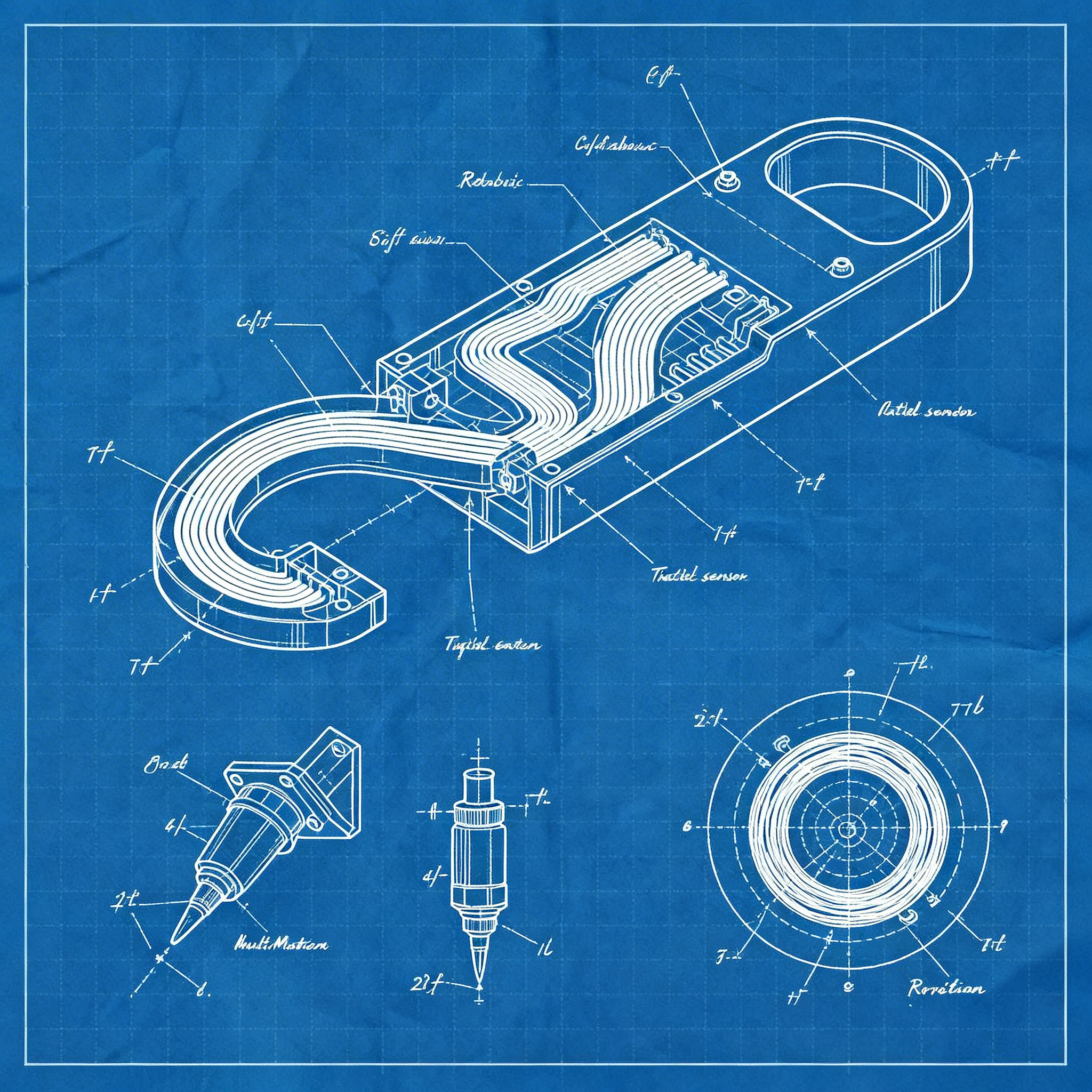
Multimaterial 3D printing allows for the precise deposition of different materials through a single rotating nozzle, enabling the fabrication of actuators with internally programmed channels directly during manufacturing.
The fabrication method is based on a technology known as rotational multimaterial 3D printing, previously developed in Jennifer Lewis's laboratory at the Harvard School of Engineering and Applied Sciences. This technique uses a single nozzle capable of depositing multiple materials simultaneously. As the printing system rotates and changes orientation, it deposits material in customizable configurations.
In the new study published in Advanced Materials, the team led by student Jackson Wilt and former postdoctoral researcher Natalie Larson produced filaments with an outer polyurethane layer combined with an internal channel formed by a poloxamer polymer commonly used in hair gels. These filaments can be arranged in linear, flat, or raised configurations.
By adjusting parameters such as nozzle geometry, rotation speed, and material flow rate, researchers precisely control the size, orientation, and geometry of each internal channel. “We use two materials from a single nozzle, which can be programmed to rotate to determine the direction in which the robot bends when inflated,” explained Wilt. “Our goals are aligned with the creation of bio-inspired soft robots for various applications.”
Design and Fabrication of Hinge Actuators
The actuator construction process using rotational printing techniques eliminates the need for molds, allowing for rapid programming and fast customization of actuation.
After the outer shell hardens, the poloxamer core is removed through a washing process, leaving behind tubular structures with precisely oriented internal channels. These channels allow for controlled deformation and bending when pressurized with air, eliminating assembly steps and enabling faster prototyping, design freedom, and on-demand customization compared to conventional manufacturing.
The method uses additive manufacturing to create filament-based components with precisely engineered internal channels. The group's previous rotational technique had already demonstrated how helical shapes could be exploited to create joints and hinges for soft robotics, functioning as artificial muscles and other adaptive components.
“In this work, we don't have a mold. We print the structures, we program them rapidly, and we are able to customize actuation quickly,” emphasized Wilt.
Sensor Integration: Tactile Feedback and Active Control
Sensors can be incorporated during the printing phase to obtain real-time tactile feedback, transforming robotic structures into self-sensing systems that integrate structural and sensory functions.
The integration of sensors into 3D printed soft structures represents a crucial evolution. Researchers are exploring bio-inspired approaches that replicate natural sensory principles: for example, the tactile hairs on an elephant's trunk exhibit a stiffness gradient along their length, with a stiffer base and a more compliant tip, encoding information about the contact point through material properties.
Soft optical sensors such as SOLen use 3D printed integrated waveguides with DLP technology, incorporating functional optical elements directly into the sensor body. In undeformed conditions, the photoreceptor signals are approximately equal; when the sensor is bent, the focus shifts, producing a robust differential signal that is insensitive to global intensity variations.
Structures with gradient porosity can become simultaneously sensors and load-bearing parts, reducing the need for glued sensors, wiring, or separate electronics. Self-measuring structural components can detect underwater water flows in real-time without external power, exploiting the direct conversion of mechanical energy into electrical signal at the material level.
Industrial and Medical Applications: From Prosthetics to Automation
This technology offers competitive advantages in terms of adaptability and precision in fields ranging from surgical robotics and assistive wearable devices to flexible industrial automation.
The new multimaterial printing method is set to accelerate the development of adaptive systems for surgical robotics, wearable assistive technologies, and flexible industrial automation. Soft robots with more “intelligent” limbs can integrate force measurement directly into the structure, reducing dependence on bulky external sensors and simplifying mechatronic architectures.
In medical applications, soft grippers can perceive force and position through internal optical paths, while transparent wearable devices can measure movement and pressure with programmable light paths within the same printed structure. In the prosthetic field, balancing comfort, adaptability, and precision in force control becomes possible by integrating strain sensors into composite structures with locally stiffened zones and others that are more deformable.
For industrial applications, marine sensing can monitor currents, vortices, or impacts in offshore structures, while self-sensing structural components in civil engineering provide feedback on operating conditions. The approach fits into the realm of multifunctional materials and architected metamaterials, where microstructure design allows control of mechanical, thermal, acoustic, or electrical properties.
Conclusion
The convergence between bioinspiration and multimaterial 3D printing is redefining the potential of soft robotics, transforming complex fabrication processes into rapid and customizable production methods. The direct integration of actuation and sensors into flexible structures eliminates assembly steps, accelerates prototyping, and opens new perspectives for medical, surgical, and industrial applications where adaptability and precision are essential requirements.
Discover how to implement these solutions in your engineering or advanced research projects, exploring the possibilities offered by multimaterial printing to create soft robotic systems with integrated sensory capabilities and programmable motion.
article written with the help of artificial intelligence systems
Q&A
- What are the main advantages of multimaterial 3D printing in bioinspired soft robotics?
- Multimaterial 3D printing enables the direct integration of actuators and sensors into flexible structures, eliminating complex assembly processes. This allows for greater customization, faster prototyping, and the achievement of programmed movements directly during printing.
- How does the multimaterial 3D printing process used by Harvard researchers work?
- The process uses a single rotating nozzle that deposits multiple materials simultaneously. By rotating and changing orientation, the system prints customized configurations, such as filaments with an outer polyurethane layer and an internal poloxamer channel, which are then processed to create precise internal channels.
- What types of sensors can be integrated into soft robots during 3D printing?
- Bio-inspired tactile sensors, such as those replicating the hairs of an elephant's trunk, and optical sensors like SOLen, which use integrated waveguides, can be integrated. These sensors provide real-time feedback without requiring external components or additional wiring.
- What industrial and medical applications benefit from this technology?
- Applications include surgical robotics, assistive wearable devices, flexible industrial automation, smart prosthetics, and marine sensing. These sectors benefit from the adaptability, precision, and structural-sensorial integration offered by 3D-printed soft robots.
- How does this technology simplify the production process compared to traditional methods?
- It eliminates the need for complex molds and multi-step processes, enabling the direct production of structures with programmed internal channels. This reduces prototyping times, increases design freedom, and allows for rapid, on-demand customization.