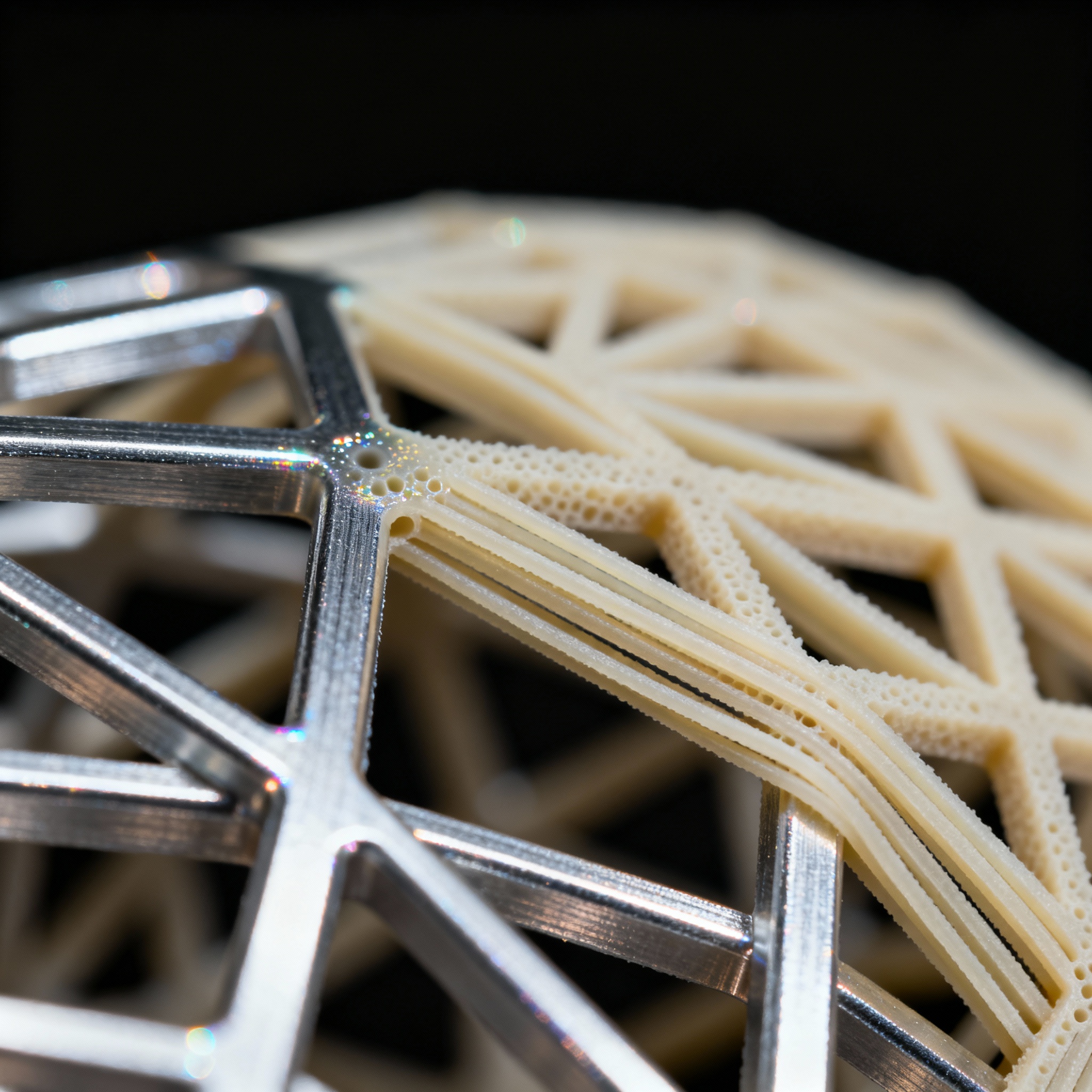
Revolutionary advances in 3D printing: cutting-edge new materials and technologies transforming manufacturing
Introduction to the modern evolution of 3D printing
3D printing is undergoing a radical transformation thanks to innovations in materials and production processes. Researchers from Xiamen University and the University of California, Berkeley, have developed a revolutionary method for printing thermoset materials without supports, combining direct ink writing with a laser polymerization system. The technique solidifies the material instantly as it exits the syringe, allowing for “mid-air” printing and drastically reducing post-processing times. Furthermore, it is possible to program local mechanical and electrical properties by adjusting stiffness and conductivity in different zones of the component.
Parallelly, multi-material printing is emerging as the next frontier of additive manufacturing. Supported by FDM, SLA, and material jetting platforms, it allows for the combination of rigid, flexible, and specialized materials in a single build, eliminating manual assembly and production costs.
Innovative polymeric materials for improved performance
New polymers expand the potential of 3D printing. Multi-material printing integrates aesthetic finishes—colors, textures, opacity—during the build, eliminating subsequent painting or coating and providing realistic prototypes and ready-to-use parts.
In the medical field, anatomical models with different shades and consistencies make surgical training more effective. Updated print heads and mixing systems—precision nozzles, dynamic chambers, automatic tool changing—ensure smooth transitions between materials, reducing misalignments and contamination.
Metal 3D printing: from aerospace to biomedical
Metal 3D printing is recording significant milestones. Researchers from UNSW Canberra have created biodegradable bone scaffolds with stochastic lattices that mimic the structure and mechanical response of natural bone. The structures withstand sudden impacts better than slow loads and allow for adequate circulation of blood and nutrients, promoting tissue regeneration before gradually dissolving, with less need for surgical revisions.
In the industrial sector, metal paste extrusion (PME) offers a safe alternative to powder-based technologies. The MetalPrinting Gauss MT90 machine, compatible with SUS 316L, copper, titanium, and aluminum, operates without powders, high temperatures, or explosion risks, making metal production accessible even in offices and laboratories.
Ceramic and composite materials that expand the boundaries of manufacturing
A new family of aluminum alloys—Al-Fe-Mn-Ti—obtained through powder bed laser melting has been developed at Nagoya University. The most performing alloy surpasses all other 3D-printed aluminums in mechanical strength and thermal tolerance, maintaining flexibility up to 300 °C. The use of low-cost, readily available, and recyclable elements makes the solution sustainable and suitable for automotive and aerospace components.
Multi-material printing and software integration technologies
Hardware evolution is accompanied by software tools like GraMMaCAD, which allows for defining graded material distributions directly in the CAD model, precisely controlling stiffness, flexibility, or conductivity in each zone.
The University of Texas at Austin introduced Holographic Metasurface Nano-Lithography (HMNL) for the production of electronic microstructures. Exploiting ultra-thin optical metasurfaces, the process projects holograms onto hybrid resin, solidifying circuits and packages with features smaller than the thickness of a hair and geometries impossible for traditional lithography, paving the way for soft sensors, stretchable electronics, and magnetic robots.
Sustainability and recyclable materials in additive manufacturing
Sustainability has become a pillar of 3D printing. New Japanese aluminum alloys employ low-cost and fully recyclable materials; multi-material printing reduces waste and simplifies the supply chain. Producing complete components in a single session lowers energy consumption compared to multiple processes, while soluble supports like PVA or HIPS avoid mechanical processing, speeding up cleanup and allowing for more complex geometries with less environmental impact.
Real-time monitoring and quality control systems
Advanced monitoring transforms the reliability of 3D printing. Bone scaffolds from UNSW Canberra underwent rigorous mechanical testing: they withstand rapid loads better, absorbing energy more efficiently; fracture behavior varies with orientation, highlighting the crucial role of internal architecture. These data allow for optimizing designs for specific applications.
In metal PBF printing, integrated HEPA filters and LED indicators guarantee safe environments and constant quality control during production.
Future perspectives: the convergence between materials science and advanced manufacturing
The future of 3D printing lies in the convergence between materials science and production technologies. Combining different materials, programming local properties, and realizing complex components without assembly opens up previously impracticable scenarios, from the footwear industry to robotics, from medical devices to consumer goods. Companies can thus create products that integrate structural resistance, flexibility, electronics, and aesthetics into a single build, reducing development times and costs.
Nagoya's research targets new classes of metals specifically designed for 3D printing, potentially accelerating innovation in many sectors. Bone scaffolds, still far from clinical use, however indicate the way to customized treatments, highlighting how design choices are as crucial as material selection. The versatility of multi-material printing makes it a tool not only for prototyping, but for large-scale production, marking the beginning of a new era in global manufacturing.
article written with the help of artificial intelligence systems
Q&A
- How does the new 3D printing method for thermosetting materials developed by the universities of Xiamen and Berkeley eliminate the need for supports?
- The material is solidified instantaneously as it exits the syringe thanks to a laser polymerization system, allowing “mid-air” printing without support structures and reducing post-processing times.
- What advantages does multi-material 3D printing offer over traditional processes?
- It allows combining rigid, flexible, and specialized materials into a single build, eliminating manual assembly, lowering costs, and integrating aesthetic finishes like colors and textures during printing.
- Why are the bone scaffolds made with 3D metal printing by UNSW Canberra more suitable for bone regeneration?
- They mimic natural bone structure with stochastic lattices, withstand rapid impacts better, allow blood and nutrient circulation, and biodegradate gradually, reducing the need for surgical revisions.
- What makes the Al-Fe-Mn-Ti alloy developed at Nagoya University particularly suitable for automotive and aerospace production?
- Outperforms other 3D printed aluminum in mechanical strength and thermal tolerance up to 300 °C, utilizes low-cost and recyclable elements, making the process sustainable and economical.
- How does GraMMaCAD software contribute to the evolution of multi-material 3D printing?
- It allows defining graded material distributions directly within the CAD model, precisely controlling stiffness, flexibility, or conductivity in every zone of the component.
- What are the future prospects of 3D printing according to the article?
- The convergence between materials science and advanced manufacturing will enable the creation of integrated products (structure, electronics, aesthetics) in a single session, paving the way for customized large-scale production in many sectors.