
Resin vs FDM 3D Printing: Which Technology Is Right for Your Projects?
Introduction
In the landscape of additive manufacturing, 3D printing stands as a technological revolution that has redefined the paradigms of design and production. Two technologies dominate this scenario: resin printing and FDM (Fused Deposition Modeling) printing, both leading a transformation that spans diverse sectors, from rapid prototyping to the creation of functional components.
The choice between these two methodologies is never trivial: it involves a complex balance between print quality, economic constraints, and specific application requirements. Understanding the substantial differences that characterize these technologies represents the first step towards a conscious and strategic selection.
What Is Resin 3D Printing?
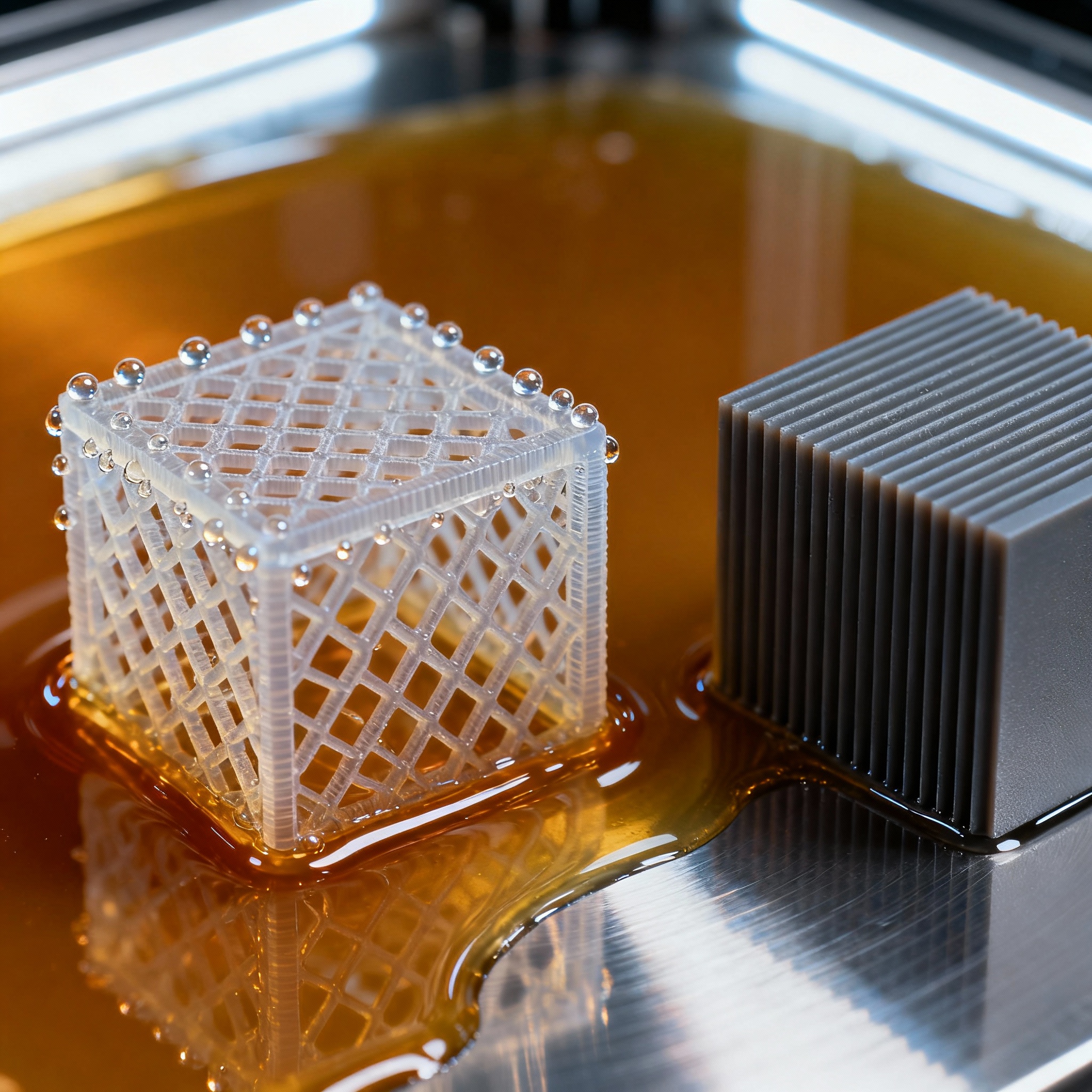
Resin 3D printing is based on the principle of photopolymerization: a photosensitive liquid resin is progressively solidified through controlled exposure to a light source, layer by layer. This process manifests in different technological variants, including SLA (Stereolithography), DLP (Digital Light Processing), and LCD technology.
In stereolithography, an ultraviolet laser traces every section with surgical precision on the surface of the liquid resin, triggering the polymerization of the material. The operating mechanism involves the build platform immersing itself in the tank containing the resin, then gradually rising as solidification proceeds. DLP printers adopt a different approach, using a digital projector to polymerize entire layers simultaneously, while LCD variants utilize a liquid crystal screen backlit by ultraviolet LEDs.
This technology is particularly distinguished by its extraordinary capacity to reproduce microscopic details and generate surfaces of considerable smoothness.
What Is FDM 3D Printing?
FDM (Fused Deposition Modeling) printing, also known as FFF (Fused Filament Fabrication), represents a radically different approach to additive manufacturing: thermoplastic material is extruded in a molten state through a heated nozzle with precision. Deposition occurs in a stratified mode on a build platform, where the material solidifies through natural cooling.
The thermoplastic filament, conventionally supplied on spools, is fed through an extrusion mechanism that brings it to the optimal melting temperature. The nozzle performs coordinated movements along the X and Y axes to define each layer, while the platform lowers progressively—or the nozzle rises—to allow for the vertical development of the structure.
This technology has secured a dominant position in the consumer market, thanks to a winning combination of economic accessibility and application versatility.
Key Differences: Technology and Process
The fundamental distinction between these two technologies lies in the mechanism of layer formation: while resin printing relies on light-induced polymerization, FDM operates through the thermal extrusion of material. In the resin process, construction typically develops in an upward direction, with the platform progressively emerging from the tank containing the liquid polymer.
FDM builds objects through the deposition of molten material in continuous and controlled paths, generating a stratified structure characterized by visible lines. Resin technology produces significantly thinner layers, generally in the range between 25 and 100 microns, while FDM typically operates with thicknesses ranging from 100 to 300 microns.
A further distinguishing element concerns the necessity, in resin printing, of support structures that require manual removal and an articulated post-processing stage, which includes washing in solvent and final UV polymerization.
Print Quality and Resolution Comparison
Resin printing positions itself at a higher quality level in terms of resolution, boasting the capability to reproduce details with precision up to 25 microns. Surfaces generated through this technology are characterized by considerable smoothness, drastically reducing the need for post-processing interventions to achieve high-quality finishes.
Prints made with FDM technology, on the other hand, present evident stratification lines, which may require sanding operations or other surface treatments to improve the final aesthetic appearance. Resin printing excels particularly in the reproduction of complex geometries, the definition of meticulous details, and the creation of perfectly smooth curved surfaces.
For applications that demand rigorous dimensional precision and intricate details—such as in the production of jewelry or dental models—resin technology generally represents the preferred choice.
Material Options and Properties
The universe of materials for FDM printing encompasses a wide range of thermoplastics, including PLA, ABS, PETG, TPU, and composite materials enriched with carbon fibers or metal particles. These materials offer diversified mechanical properties, ranging from the flexibility characteristic of TPU to the structural strength of ABS.
Photopolymer resines come in specialized formulations: standard, high-strength, flexible, transparent, and specifically developed for niche applications such as dentistry or jewelry. Resins tend to exhibit greater fragility compared to thermoplastics used in FDM, although advanced formulations exist designed to improve impact resistance and toughness.
FDM materials generally offer superior mechanical performance and higher durability for functional components subjected to significant stress.
Speed and Efficiency
Print speed is a variable parameter that depends significantly on the technology employed and the geometry of the object to be realized. Resin printers based on DLP and LCD technologies can polymerize entire layers simultaneously, making print time more dependent on the object's height than on its geometric complexity.
FDM, on the other hand, requires the nozzle to trace every path individually, which implies that objects with wider cross-sections require longer production times. For small objects rich in detail, resin may be faster, while for large components with simple geometry, FDM may prove more efficient.
Latest-generation FDM printers can reach considerable print speeds, especially when creating objects with low infill percentages.
Cost Analysis: Initial Investment and Operating Costs
Entry-level FDM printers generally sit in more accessible price brackets, with models available starting from a few hundred euros. Resin technology has seen a significant contraction in prices in recent years, with LCD printers now available at competitive costs that make them accessible to a wider audience.
Operational cost analysis must consider materials, consumables, and routine maintenance. FDM filament typically presents a lower cost per kilogram compared to resin. However, resin printing entails additional costs for post-processing materials, such as isopropyl alcohol for washing and disposable gloves for safe handling.
Resin printers also require periodic replacement of the FEP film coating the vat and the LCD screen, which are wear components.
Ease of Use and Maintenance Requirements
FDM printers are generally perceived as more intuitive and accessible, particularly for novice users, thanks to a less complex printing process. Resin printing, on the other hand, requires stricter material management and a mandatory post-processing workflow that includes solvent washing and final UV curing.
FDM printer maintenance includes operations such as cleaning the nozzle, calibrating the print bed, and occasional replacement of components.
article written with the help of artificial intelligence systems
Q&A
- What is the main difference in the layer formation mechanism between resin printing and FDM?
- Resin printing uses photopolymerization: a liquid resin is solidified layer by layer through exposure to UV light. FDM printing, on the other hand, extrudes molten thermoplastic material through a heated nozzle, depositing it in successive layers that solidify upon cooling.
- For which applications is resin printing preferable to FDM?
- Resin printing is preferred when extremely fine details (down to 25 microns), smooth surfaces without layer lines, or complex geometries are needed. It is the ideal choice for jewelry, dental models, miniatures, or high-precision aesthetic prototypes.
- What are the main additional operating costs of resin printing compared to FDM?
- In addition to the higher price of resin compared to filament, you need to budget for isopropyl alcohol for washing, disposable gloves, periodic replacement of the FEP film and LCD screen, as well as electricity for UV post-curing.
- How do DLP or LCD technologies affect resin printing speed?
- DLP and LCD polymerize an entire layer simultaneously, so the time depends mainly on the object's height, not its horizontal complexity. This makes resin faster than FDM for small, detailed pieces, while FDM can be faster for large, geometrically simple volumes.
- Why are FDM materials considered more suitable for functional components under stress?
- FDM thermoplastics (ABS, PETG, TPU, composites) offer better mechanical properties and greater toughness compared to standard resins, which tend to be more brittle. Therefore, for parts that must withstand loads or impacts, FDM ensures greater durability.
- What makes resin printing less ‘user-friendly’ than FDM for beginners?
- It requires safe handling of toxic and light-sensitive materials, mandatory washing in solvent, UV post-curing, vat cleaning, and replacement of disposable components. FDM, on the other hand, has a simpler workflow: load the filament, print, and remove the support.


