
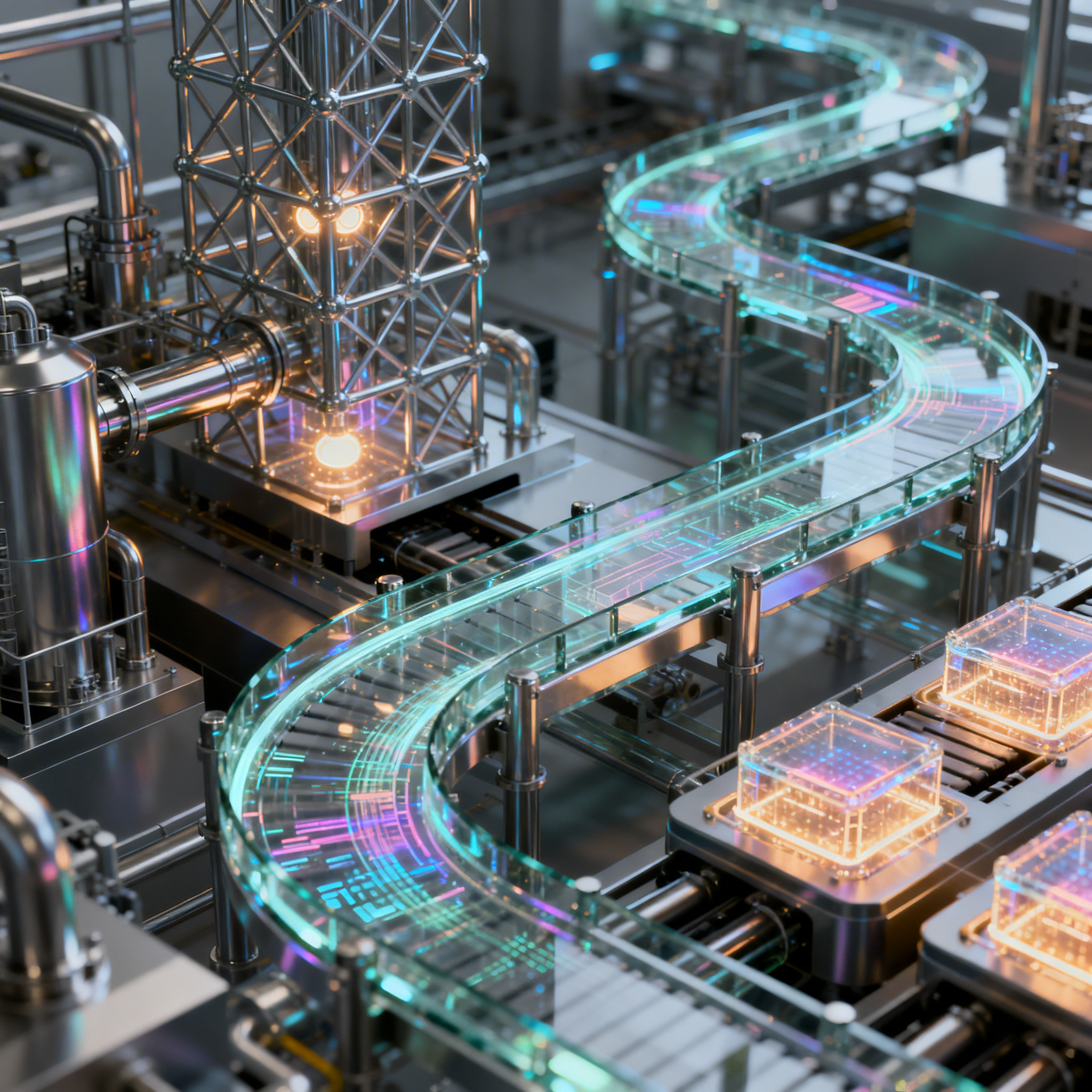
Designing an integrated factory for advanced metal production: a practical guide to implementation
Future factories are no longer built as sets of isolated operations, but as a single intelligent system in which every phase is optimized to minimize movement, downtime, and variations. The physical and logical integration between additive manufacturing, machining, heat treatments, and quality control allows for drastically shortening production times and eliminating sources of human or process error, transforming the entire facility into a coherent machine that learns and adapts.
The traditional model of metal production still reflects the logic of a previous industrial era: separate departments, isolated data, continuous material movements between distant workstations. Every handover introduces latency, variation, and hidden costs. The real bottleneck is no longer the capacity of a single machine, but the physical and operational distance between machines.
Definition of the integrated architecture
An integrated architecture for advanced metal production requires that additive manufacturing, subtractive machining, heat treatments, and quality control operate as subsystems of a single coordinated machine, sharing a common data layer and a unified process logic.
The starting point is to abandon the vision of the factory as a collection of separate disciplines. The integrated architecture considers the entire production environment a unitary system in which every process continuously communicates with others via a shared data platform. This model eliminates departmental boundaries that block the flow of information and materials.
The design is based on four pillars: dense additive capability for metal production, scalable machining, integrated quality and metrology systems, computational infrastructure that orchestrates the flow. When these elements are connected, decisions are synchronized in real time, feedback circulates freely, and variability is reduced.
Artificial intelligence becomes the conductor: models trained on multi-phase data identify patterns invisible at the single instrument level, anticipate thermal variations, and guide machining tolerances based on predicted distortions.
Optimized layout for continuous production flows
Layout must minimize physical material movement and maximize operational continuity, considering every movement a potential source of cost, variation, and delay to be eliminated or minimized.
Every time a component is moved, re-fixed, or transferred between isolated disciplines, the distance traveled adds cost, variation, and delay. Factories that outperform competitors shorten this distance, consolidate steps, and design flows where material and energy follow the most direct path.
The methodology starts with material flow analysis: identify which components require additive-subtractive sequences, which need intermediate heat treatments, and where to insert dimensional controls without interrupting the flow. The goal is to create integrated cells where the distance between additive machines, CNC work centers, furnaces, and measurement stations is reduced to the technical minimum.
Automation and robotics become essential: robotic systems handle transfer between adjacent processes, reducing dead times and positioning variability. Sensors and traceability systems ensure that each part maintains its digital identity at every stage.
Control systems and data platforms integration
A centralized and interoperable data platform constitutes the nervous system of the factory, orchestrating processes in real-time and ensuring complete synchronization and total traceability along the entire value chain.
The integrated system requires preventive layout planning that minimizes material movement and a common data platform that coordinates all processes in real-time. The digital infrastructure must connect design, engineering, simulation, automation, and production through a continuous digital thread.
The platform must support executable digital twins and structured data governance, enabling a faster transition from concept to certifiable production, with greater predictability and cross-industry compatibility. The openness and interoperability of the technology stack allow machine builders, suppliers, OEMs, research partners, and startups to collaborate without proprietary constraints.
Industrial AI acts as a force multiplier: integrated co-pilots and AI capabilities make workflows faster and more intuitive; AI agents orchestrate multi-step workflows, guiding, coordinating, and adapting operations in real-time.
Case studies: convergent additive manufacturing and machining
Concrete examples from advanced production environments demonstrate how the integration between metal 3D printing and CNC milling, supported by unified control systems, drastically improves efficiency, quality, and scalability compared to traditional models.
Environments that combine dense metal additive capabilities, scaled machining, and integrated quality and computing systems already show the benefits of a coordinated architecture. Improvements in stability, repeatability, and throughput are measurable on an industrial scale.
Additive manufacturing expresses its transformative potential only when it is woven into the digital and automation landscape, rather than treated as a separate specialty. Additive production becomes a natural part of engineering and production: designed from the digital thread, simulated before printing, integrated with subtractive and post-processing steps, and scalable from a single machine to an entire factory.
The benefits are concrete: reduction of cycle times, elimination of data transfer errors, rapid adaptation to new specifications. Overall efficiency, final product quality, and scalability capability clearly surpass traditional models.
Integrated heat treatments and measurement in the production cycle
The implementation of heat treatment furnaces and measurement cells directly connected to the production flow eliminates interruptions, reduces cycle times, and allows for immediate feedback for process correction during operations.
Traditionally, heat treatments and metrology require separate structures, with transfers, waiting times, and risks of traceability loss. The integrated architecture inserts these processes into the continuous flow.
Furnaces are positioned adjacent to production cells, with automated transfers that maintain continuity. Thermal behavior is predicted and managed along the entire workflow, optimizing parameters based on the characteristics of each component.
Measurement becomes an active contributor to planning, not just a final checkpoint. Integrated dimensional control stations allow for intermediate checks without removing components from the flow. Data immediately feeds control systems, enabling real-time corrections and continuous learning.
Scalability and maintenance of the integrated system
The growth and maintenance of an integrated system require specific strategies to preserve operational efficiency, minimize downtime, and ensure that expansion does not compromise overall consistency.
Scalability is not achieved simply by adding machines, but by expanding production capacity, data infrastructure, skills, and maintenance in a coordinated manner. Planning must foresee how new cells will integrate into the existing flow without creating bottlenecks.
Preventive maintenance is critical: the downtime of a single element can impact the entire chain. Predictive strategies based on continuous operational data allow for scheduling interventions without interrupting production. Selective redundancy for critical processes guarantees continuity even during scheduled maintenance.
The regional approach to manufacturing ecosystems supports scalability: networks that align industrial demand
article written with the help of artificial intelligence systems
Q&A
- What is the main advantage of the integrated architecture compared to the traditional model with separate departments?
- It eliminates the physical and logical distance between machines, shortening production times and reducing errors and variations. All processes share a single data platform and operate as subsystems of a single coordinated machine.
- How is the layout of an integrated factory designed to minimize waste?
- It starts with the analysis of the material flow to identify additive-subtractive sequences, intermediate treatments, and controls. The cells are arranged so that the distance between 3D printing, CNC, furnaces, and measurement is minimal, with robots managing transfers.
- What role does artificial intelligence play in the integrated system?
- AI acts as the conductor: models trained on multi-phase data anticipate thermal variations, drive machining tolerances, and orchestrate multi-step workflows in real-time, making the factory adaptive.
- Why are heat treatments and metrology inserted directly into the production flow?
- To avoid transfers, waiting times, and loss of traceability. Furnaces and measurement stations adjacent to cells allow for immediate feedback, on-the-fly corrections, and continuous optimization of thermal parameters.
- What distinguishes the scalability of an integrated system from the simple purchase of new machines?
- Scalability requires the coordinated expansion of production capacity, data infrastructure, skills, and maintenance. New cells must integrate without creating bottlenecks, with predictive maintenance and selective redundancy to guarantee continuity.


