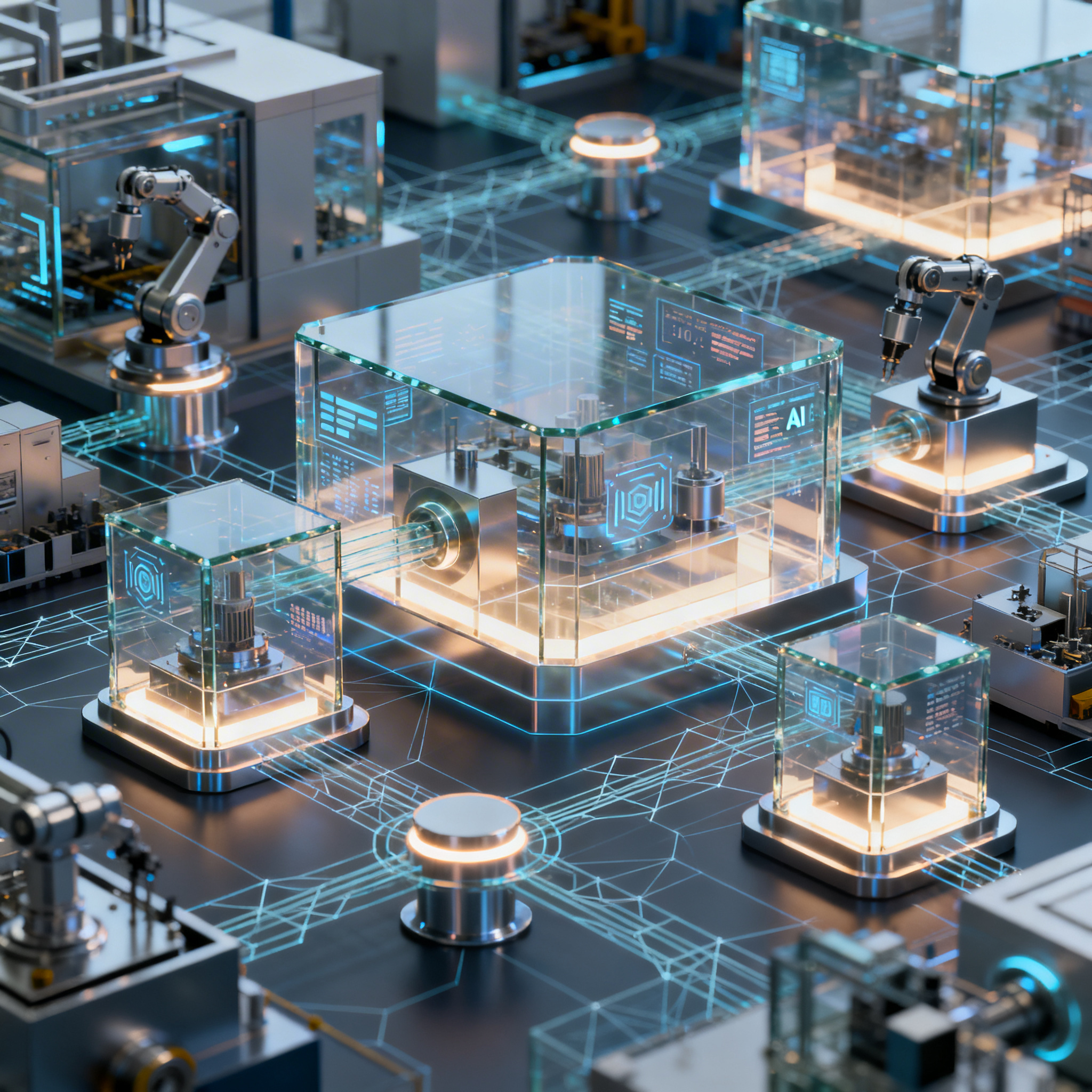
Designing Lightless Factories: The Software Architecture That Makes the Difference
Building a lightless factory requires more than smart machines: it needs a software infrastructure capable of orchestrating every phase of the production process. While advanced automation and artificial intelligence promise to transform industrial manufacturing, the real obstacle does not lie in the technology of individual components, but in the architecture that connects them. Without a software infrastructure designed for interoperability, even the most advanced systems risk remaining isolated islands, incapable of generating the expected value.
Foundations of Industrial Automation and Software-Enabled Architectures
Open and modular software architectures represent the essential foundation for modern automation, enabling the overcoming of the limits of proprietary and fragmented solutions.
Advanced production environments today combine multiple additive platforms, robotic handling systems, post-processing equipment, inspection technologies, CNC machines for finishing, and enterprise IT systems. To operate efficiently, these heterogeneous assets must function as a unified system, not as individual islands of automation.
This requires a production infrastructure capable of orchestrating 3D printers, factory equipment, robots, and IT systems in real time, managing interoperable workflows, sequencing operations, and synchronizing data along the entire process chain. The increasingly widespread approach in advanced manufacturing environments is software-defined automation: instead of encoding specific control logic in individual machines or PLCs, modern platforms provide centralized orchestration capabilities that connect plant equipment, data flows, and production workflows.
Open architectures that support standard interfaces, modular integration, and configurable flows allow manufacturers to introduce AI techniques in a controlled manner, scale successful applications across different factories, and adapt processes without rebuilding the core automation infrastructure.
Common Errors in Production System Integration
The lack of coordination between systems generates critical inefficiencies, operational delays, and drastically limits the use of artificial intelligence for predictive and optimization purposes.
Most industrial manufacturing applications involve complex multi-stage process chains: digital build preparation, material conditioning, printing, part removal, cleaning, heat treatment, surface finishing, inspection, and secondary machining. Historically, these workflows have been assembled through manual coordination or custom scripts.
Many of these steps are performed on equipment from different vendors, with different control systems, data formats, protocols, and automation technologies. Without proper coordination, machine downtime occurs, compliance risks increase, bottlenecks emerge, data becomes fragmented, and the benefits of AI-driven optimization remain limited.
Fixed automation architectures and proprietary systems make it difficult to adapt workflows, integrate new tools, and deploy custom AI models as production methodologies evolve. A common mistake is treating the network like electricity: plug it in and it should work. This has led to networks built organically and unstructured, where security is an afterthought rather than a core component. With modern use cases, performance and bandwidth demands far exceed what these legacy architectures can handle.
Software-Defined Platforms: The Foundation for Scalability and AI Control
Software-defined platforms enable the flexible implementation of production processes and the secure integration of predictive AI models, overcoming the limitations of traditional architectures.
In additive manufacturing contexts, these platforms are designed to unify data from printers, post-processing equipment, robotics, inspection systems, sensors, safety PLCs, and other factory assets, coordinating multi-stage workflows with automatic compliance and enabling AI-driven closed-loop control across production processes.
AI innovation in additive manufacturing is evolving rapidly: new sensing technologies, digital twin models, reinforcement learning techniques, and predictive quality algorithms continue to emerge from both industry and academia. To leverage these advancements, production environments must be designed for flexibility and extensibility, while ensuring reliability and compliance.
Cybersecurity is currently the main limiting factor for AI adoption in manufacturing: 46% of manufacturers cite it as their number one concern. In the industrial world, the primary concern is not just losing data or time, but losing control of the process. If a plant shuts down, the costs are enormous, but if someone takes control of the physical infrastructure, the safety of the workforce is compromised.
Case Study: Real-World Implementation in the Automotive Environment
Practical examples of the transition to lights-out manufacturing demonstrate how system integration generates measurable competitive advantages in real-world industrial contexts.
An emerging model is taking shape in the production of advanced metals: instead of treating a factory as a set of discrete operations, manufacturers are building environments that behave like a single integrated machine. Additive, machining, heat treatment, inspection, automation, and data systems are linked in a coordinated framework that operates from a shared level of intelligence.
Companies like NVIDIA use metal additive manufacturing to produce complex cold plates and thermal management components for AI servers, with internal channels optimized for heat transfer that would be impractical to machine conventionally. The advantage is not just performance: additive manufacturing allows for faster hardware design iteration, testing of multiple thermal configurations, and deployment of customized solutions for specific data center environments.
Teradyne's automated test systems provide precision automated platforms to validate chips, boards, and electronic modules at every stage of production, covering functional, parametric, and thermal testing. Integrated with robotics and automated handling, these systems enable high-speed lights-out operations, proving critical for advanced AI, automotive, and high-performance computing applications.
Operational Roadmap for Implementation
A structured guide to evaluate, design, and implement a consistent automated architecture requires methodical attention to infrastructure, security, and scalability.
Before integrating new AI software platforms, it is necessary to have a structured plan that accounts for the additional bandwidth and hardware requirements needed to support AI in the work environment. The evolution from using digital manufacturing technologies as peripheral additions to traditional skills, to treating them as instrumental sections in a production orchestra, requires foundations based on edge computing.
The operational path begins with evaluating the alignment of existing production systems. The network must be designed specifically for the performance and security required by the process, no longer treating it as a commodity. The architecture must support data collection from industrial control systems (IACS), securely connect machines, sensors, and cloud applications, and manage cyber risk across the entire OT/IT architecture.
Build preparation automation, including AI-optimized nesting, part import, slicing, and export, provides the digital backbone for truly automated industrial AM users. Solutions like AMIS Runtime enable fully autonomous and continuously re-optimized build preparation, translating directly into lower costs per part and more predictable production.
Conclusion
Effective industrial automation arises from harmony between technology and architecture: investing in intelligent software infrastructure is the true competitive driver. Every time a part is moved, fixtured, re-fixtured, or transferred between isolated disciplines, the distance traveled by those atoms adds cost, variation, and delay. Factories that outperform competitors are those that shorten that distance, consolidating steps, simplifying movements, and designing workflows where material and energy follow the most direct path possible.
article written with the help of artificial intelligence systems
Q&A
- What is the role of software architecture in creating a lights-out factory?
- Software architecture is fundamental to orchestrating every phase of the production process, connecting machines, robots, and IT systems into a single interoperable infrastructure. Without this foundation, even the most advanced technologies remain isolated and fail to generate the desired value.
- What characterizes a software architecture for automation defined by software?
- A software-defined architecture allows for the centralized coordination of equipment, data flows, and production workflows. It offers modularity, scalability, and the possibility to integrate AI technologies in a controlled and flexible manner.
- What are the common errors in the integration of production systems?
- Common errors include the lack of coordination between different systems, the use of fixed or proprietary architectures, and considering the network as a generic resource. This leads to inefficiencies, fragmented data, and difficulties in applying predictive AI solutions.
- How do software-defined platforms contribute to security and production efficiency?
- These platforms guarantee the secure integration of AI models, closed-loop control, and centralized data management. Furthermore, they improve cybersecurity, a crucial element for protecting both data and the physical control of plants.
- What advantages does the implementation of an integrated architecture bring in the automotive sector?
- It allows for reducing production times and costs, accelerating project iteration, and achieving greater precision thanks to complete automation. Furthermore, it facilitates the adoption of complex components realizable only with technologies like additive manufacturing.