
Post-Prototype Operational Models in the Advanced Metal Industry
The factory of the future is not a collection of isolated machines, but an integrated system where every phase of production collaborates in real time.
The advanced metal industry is undergoing a radical transformation: the traditional model based on separate departments – additive, machining, heat treatment, inspection – is giving way to integrated operating systems that function as a single intelligent machine. This evolution represents not a simple technological update, but a complete rethinking of production logic, where the physical and operational distance between phases becomes the real bottleneck to eliminate.
From Production Islands to the Integrated Line
The traditional model separates production disciplines into isolated departments, each with its own equipment, personnel, and data. This approach generates structural limits that no local optimization can overcome.
Most metallurgical factories still operate according to logic inherited from previous industrial eras. Additive production occupies one section of the building, machining another, while heat treatments and metrology often require completely separate structures. Every transfer of parts between these departments adds costs, variability, and delays: every time a component is moved, re-fixtured, or delivered between isolated disciplines, the distance traveled by atoms translates into measurable inefficiency.
This fragmented model presents obvious structural constraints. Every handover introduces latency and variation. Data remains trapped within local processes, unable to inform upstream or downstream decisions. Optimization tends to focus on improving single phases rather than the entire chain. When demand increases, factories respond by adding more equipment instead of increasing the intelligence that governs the system. Even the best-managed operations inevitably reach this limit.
The emerging alternative replaces this fragmentation with a tightly connected production architecture, where every phase functions as a subsystem of a larger machine. Additive and subtractive processes share a common data layer that updates continuously. Thermal behavior is predicted and managed along the entire workflow, not addressed in isolation.
Automation and Central Control: The Brain of the Modern Factory
Operational integration is achieved through enabling technologies – PLCs, MES systems, IoT – that allow real-time coordination between different production phases, transforming local data into system intelligence.
Once these elements are connected, the factory begins to operate in a fundamentally different way. Decisions synchronize in real time. Feedback flows freely instead of stopping at department boundaries. Variability decreases. Over time, the environment develops a deeper understanding of its own patterns and uses this knowledge to improve stability and productivity.
Artificial intelligence becomes the conductor that holds this system together. Models trained on multi-phase data can detect patterns invisible at the single-instrument level. They can anticipate thermal variations that affect both the additive and mechanical processing. They can drive machining overmetals based on predicted distortion. They can adjust process conditions as builds develop. They can interpret inspection results in ways that refine the next production cycle.
The result is cumulative intelligence: every completed part strengthens the system. Production environments that combine dense additive metal capabilities, scaled mechanical machining, and integrated quality and computing systems are already demonstrating the benefits of a coordinated architecture. Improvements in stability, repeatability, and productivity are measurable and documented.
Intelligent Material Flows: Reducing Physical Movement
Strategic design of production layouts aims to minimize internal part transport, reducing dead times and increasing operational efficiency through optimized routes.
At the heart of this change is a fundamental physics problem: every movement of a part represents an opportunity to introduce errors, delays, and additional costs. The factories that outperform competitors are those that shorten this distance. They consolidate steps, simplify movement, and design workflows where material and energy follow the most direct path possible.
Designing intelligent material flows requires a complete rethinking of the production layout. It is no longer about organizing departments by function, but structuring the entire environment around the optimal path of the component. This approach drastically reduces physical movement, eliminates queues and wait times, and minimizes fixturing and re-fixturing operations that introduce dimensional variability.
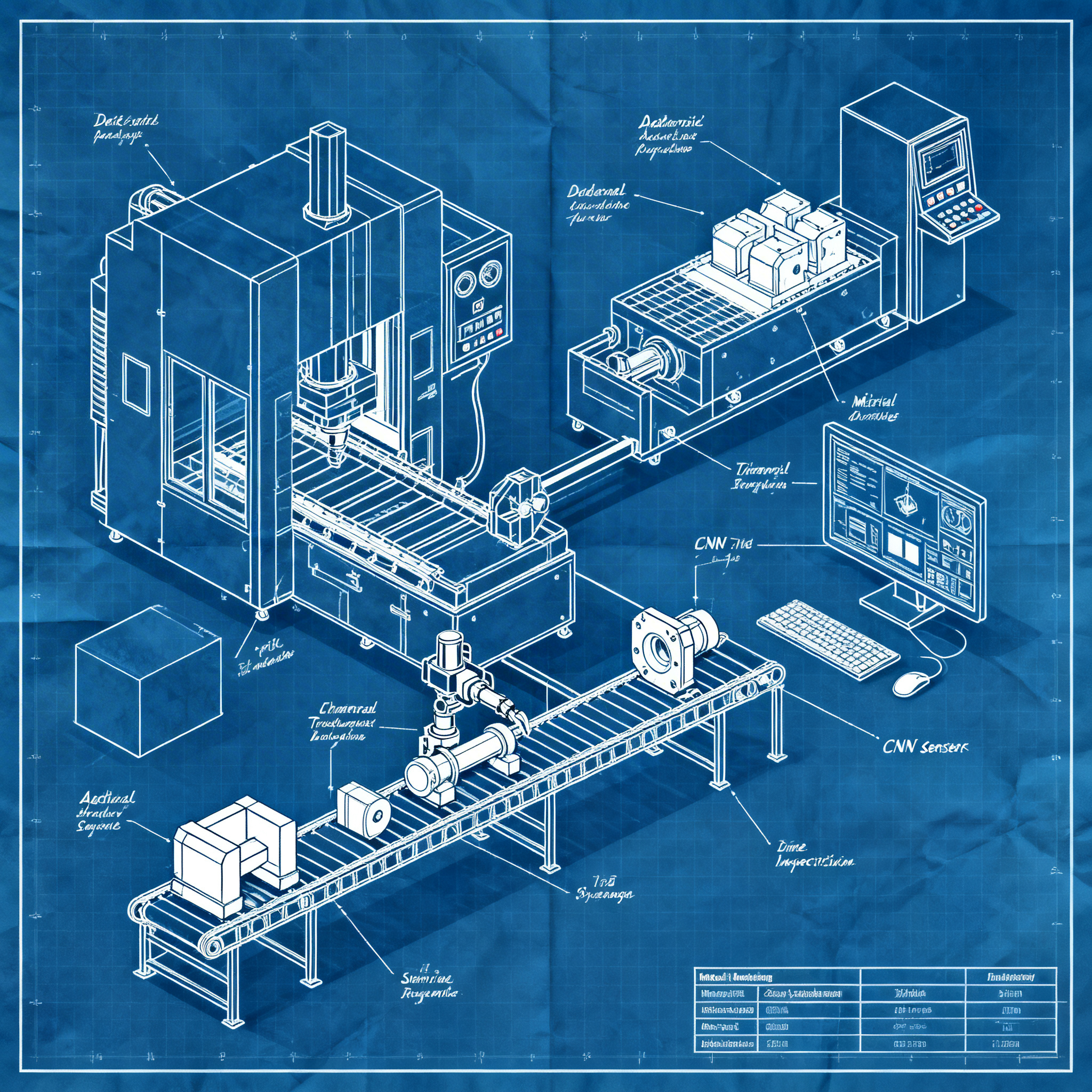
Vertical and horizontal process integration becomes possible only when the physical layout supports operational continuity. The most advanced factories are redesigning their spaces to create integrated production cells where additive, machining, treatment, and quality control coexist in immediate proximity, connected by automated and intelligent handling systems.
Practical Cases: From Single Machines to Connected Production Systems
Concrete examples in the metallurgical sector demonstrate how operational integration has led to significant reductions in lead times and substantial improvements in final quality.
What this model means in practice is becoming increasingly clear. Production environments that combine dense metal additive capacity, scaled machining, and integrated quality and computing systems are beginning to show the benefits of a coordinated architecture. Companies like VulcanForms are operating this model at an industrial scale, with measurable improvements in stability, repeatability, and productivity.
The broader signals of the industry point in the same direction. As part requirements become more complex and development timelines shrink, manufacturers are recognizing that gains will not come from individual tools operating faster, but from systems working in concert, where data and decisions move freely across the entire workflow.
The real divide now lies between two approaches to industrial production. One treats digital tools as overlays on existing structures. The other treats the factory itself as a unified machine, designed to learn, adapt, and scale as a coherent system. The companies moving toward this architecture will set the pace of advanced metal production.
Conclusion
Post-prototype operational models represent a fundamental competitive shift for the metalworking industry. It is not about adopting isolated technologies, but rethinking the entire production logic as an integrated, intelligent system. Factories embracing this transformation achieve faster, more flexible, and sustainable production, overcoming the structural limits of the traditional model based on separate departments.
The transition requires significant investment not only in technology, but also in process redesign, staff training, and organizational culture. However, the results show that operational integration generates lasting competitive advantages: reduced lead times, higher quality, lower variability, and the ability to respond rapidly to market needs.
Explore how your company can evolve toward an integrated operational model adapted to the challenges of advanced production. The time to act is now: companies that delay this transformation will continue to encounter the same structural limits, no matter how advanced their individual tools become.
article written with the help of artificial intelligence systems
Q&A
- What is the main problem with the traditional production model in the metal industry?
- The traditional model separates production disciplines into isolated departments, causing inefficiencies due to the continuous transfer of parts between different phases. Every movement introduces delays, additional costs, and variability, making it difficult to optimize the entire production process.
- How does operational integration contribute to improving production?
- Operational integration connects all production phases into a single coordinated system, enabling the continuous exchange of data and decisions in real time. This approach reduces latency, improves quality, and increases productivity thanks to a unified view of the process.
- What technologies enable the functioning of the smart factory?
- Technologies such as PLCs, MES systems, IoT, and artificial intelligence enable real-time coordination between production phases. These tools transform local data into systemic intelligence, continuously improving stability and performance.
- Why is it important to reduce physical movement within the factory?
- Every movement of parts introduces opportunities for error, delay, and cost. Reducing movement allows for minimizing dead times, dimensional variability, and refixturing operations, increasing overall efficiency and precision.
- What benefits does the adoption of an integrated production layout bring?
- An integrated layout allows the coexistence of additive, machining, heat treatment, and quality control in immediate proximity. This favors operational continuity, flow automation, and a significant reduction in throughput times.


