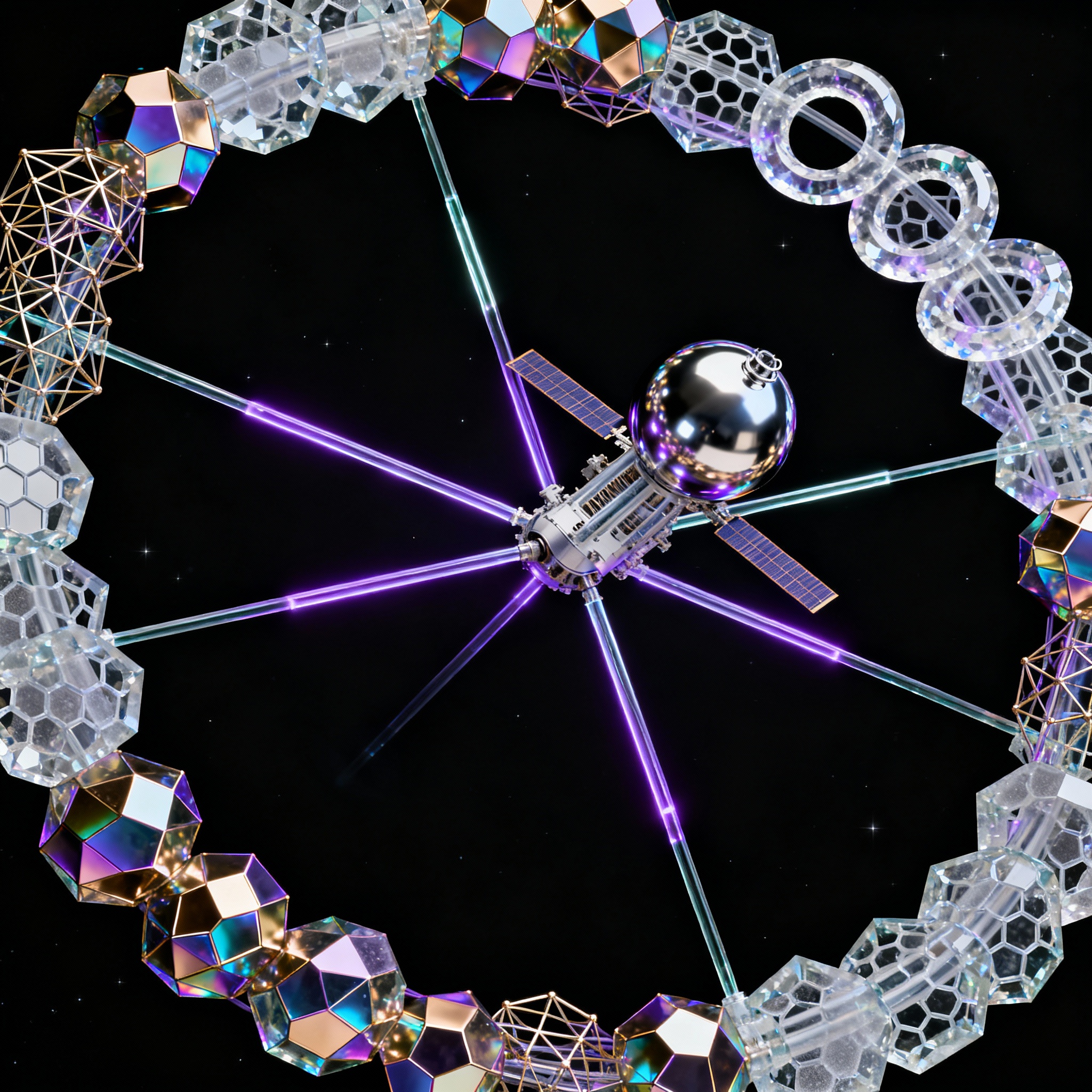
Spatial and Aerospace Integration: Advanced Technologies for Orbital Convergence
The integration between space and aerospace systems represents one of the most strategic frontiers for the defense and communications industry today. Significant investments from agencies like ESA and the growing demand for sovereign satellite communication capacity are driving additive manufacturing and phased-array antenna systems to generate a new family of multi-domain platforms capable of operating in LEO, MEO, and GEO orbits.
Integrated System Architectures for Multi-Domain Missions
Modern architectures require ultra-lightweight components, precise to the micrometer, and resistant to the space environment. Projection Micro Stereolithography (PµSL) technology achieves resolutions of 2 µm and allows the production of polymer components subsequently metallized for satellite applications. The resulting hybrid parts exhibit electromagnetic and thermal properties similar to solid metal, but with a fraction of the weight.
The AIAA SciTech Forum 2026 demonstrated that additive manufacturing has entered aerospace workflows: 6,000 participants and 115 exhibitors presented concrete applications, from design to production. Companies like Fathom have converted AS9100 certified and ITAR registered facilities into centers where 3D metal printing, CNC machining, heat treatments, and coatings coexist under one roof, providing parts for satellites, high-altitude vehicles, and UAVs.
Cross-Domain Communication Protocols in Space-Air Environment
Interoperability between space and air domains requires antennas capable of operating on multiple orbits. SWISSto12 obtained 73 million euros from ESA through the ARTES program to accelerate the development of the HummingSat platform and phased-array technologies, designed for LEO, MEO, GEO satellites and ground terminals, offering flexible and resilient connectivity.
The funding, approved by Switzerland, Germany, Austria, Sweden, Norway, and Canada during the ESA Ministerial Conference 2025, reflects the European need for sovereign capabilities in GEO satellite communications. SWISSto12's multi-orbit approach responds to commercial and governmental needs, overcoming the cost and time limits of traditional GEO satellites.
The Air Force Research Laboratory emphasizes that additive manufacturing is central to the concept of “affordable mass”: reducing the cost, size, weight, and energy consumption of satellites, UAVs, robotics, and autonomous platforms, by integrating advanced digital workflows and autonomous decision-making systems.
Technical Challenges in the Interfacing between Orbital and Atmospheric Platforms
The main criticalities are component qualification and process control. Innospace produced a titanium spherical tank without internal supports using the proprietary low-overhang method on a standard Laser Beam Powder Bed Fusion system, demonstrating the feasibility of complex geometries without dedicated hardware.
Qualification remains the bottleneck: printing is fast, but testing takes time. ZEISS highlighted that optical inspection and 3D scanning become critical when parts enter aerospace programs; the real difficulty is preparation: highly reflective surfaces require spray coatings, precisely positioned targets, and uniform surface preparation.
Micro-printed and metallized components for space must pass NASA ASTM E595 and ESA PSS-01-702 outgassing tests, which measure Total Mass Loss (TML) and Collected Volatile Condensable Materials (CVCM). Specific polymers for micro-3D printing, when properly coated, maintain excellent structural stability, allowing the miniaturization of RF antennas, optical sensors, and micro-electric propulsion systems.
Case Studies: Operational Implementations of Space-Air Integration
The University of Oklahoma Aerospace Institute for Research and Education transfers innovative aeronautical configurations from digital simulation to real flight in the Simulation to Flight Applied Research Laboratory, using 3D printed components to accelerate the transition from design to testing and to compare simulation and flight data.
SWISSto12 employs MetalFabG2 printers from Additive Industries to produce multibeam X GEO clusters and other RF components. The company, with four Additive Industries machines, partnerships with Northrop Grumman and CAES, and contracts for maritime satellites and a 30 million euro ESA satellite, will launch HummingSat in 2027. Thanks to additive manufacturing, the satellite is smaller, cheaper to produce and launch, and faster to deploy.
Lab AM 24, a South Korean company, developed a wire-based directional energy deposition system with portable shielding that creates an inert environment at the print head, dynamically controlling the argon flow and reducing oxygen below 20 ppm. The system replicates the protective conditions of a chamber without the costs and build times, becoming operational in less than a minute; it has already attracted interest from aerospace and defense clients, with support from the AFRL.
Future Perspectives and Strategic Developments
Space-aerospace integration is moving from experimentation to operational production: additive manufacturing is becoming standard infrastructure. The European approach, led by the ESA, aims to strengthen sovereign capabilities in GEO satellite communications, responding to growing competitive pressures. While small LEO satellites enable low-latency global services, European GEO systems remain critical for secure, wide-area, and government-controlled communications.
The concept of “affordable mass” will drive future developments: components that are increasingly lighter, cheaper, and faster to produce. Miniaturization in CubeSats will benefit from the possibility of printing waveguides or custom connectors with micrometric tolerances, maximizing the efficiency of scientific instruments.
The integration of advanced digital workflows, agentic AI, and autonomous systems with additive manufacturing will accelerate the cycle from idea to application. The presence of universities, government labs, prime contractors, and startups within the same ecosystem, demonstrated at AIAA SciTech 2026, facilitates technology transfer and the training of the next generation of aerospace engineers, consolidating orbital convergence as an operational reality.
article written with the help of artificial intelligence systems
Q&A
- What is the role of Projection Micro Stereolithography (PµSL) in the production of space components?
- PµSL achieves resolutions of 2 µm and prints polymeric components that are subsequently metallized. The resulting parts possess electromagnetic and thermal properties similar to solid metal, but weigh significantly less, making them ideal for satellite applications.
- Why did SWISSto12 receive 73 million euros from ESA and what technologies will it develop?
- The funding, approved by six ESA member states, aims to develop the HummingSat platform and phased-array antennas operating on LEO, MEO, and GEO orbits and ground terminals, ensuring flexible and sovereign connectivity for European satellite communication needs.
- What are the main challenges in qualifying 3D-printed components for the space environment?
- The bottlenecks are qualification testing: printing is fast, but inspections are time-consuming. Parts must pass NASA/ESA outgassing tests, optical inspections, and 3D scans, addressing reflectivity and surface preparation issues.
- How will the concept of “affordable mass” impact future space systems?
- The Air Force Research Laboratory promotes “affordable mass” to reduce the cost, weight, size, and consumption of satellites, UAVs, and robotics, integrating additive manufacturing, advanced digital workflows, and autonomous decision-making systems to produce lightweight and economical components.
- What does the Lab AM 24 case demonstrate regarding the competitive advantage of portable additive manufacturing?
- Lab AM 24 has developed a portable wire-based system that, without an inert camera, lowers oxygen below 20 ppm in under a minute. This reduces setup times and costs, attracting aerospace and defense customers with support from the AFRL.