
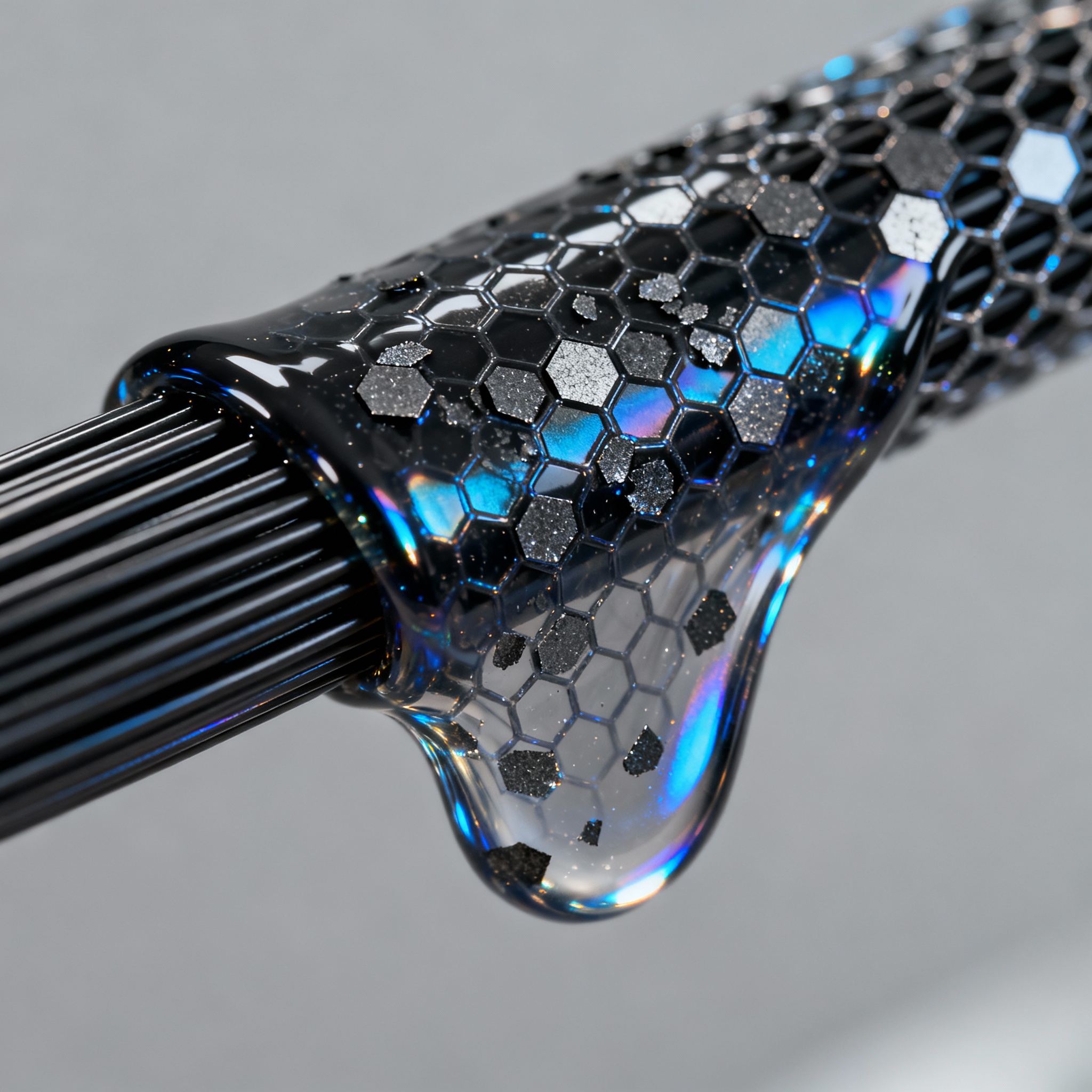
New materials for 3D printing filaments: innovations revolutionizing the industry
Lead: The latest news in the field of filament materials
In the landscape of additive manufacturing, a silent but profoundly disruptive transformation is taking place. Innovation in filament materials does not constitute a mere incremental progress, but rather an evolutionary leap that redefines the very boundaries of what 3D printing can achieve.
Among the most significant news stands out the integration of graphene into nylon composites, a solution that surpasses the consolidated performance of traditional carbon fiber. The new composite filament with graphene mesh reaches a tensile strength on the Z-axis of 60 MPa, a value 2.5 times higher than that of 3DXTech and clearly more elevated than the standard Nylon 12CF from Stratasys.
In the segment of desktop printers for composites, solutions are emerging that challenge the consolidated market equilibria. The FibreSeeker 3, rebranding of the industrial manufacturer Anisoprint, intends to disrupt the monopoly of desktop composites through an open-source approach and an innovative co-extrusion process that promises tensile strengths up to 900 MPa.
Composite and bio-based materials: the new frontier
Composite materials currently represent the most promising horizon of innovation in the filament sector. Graphene, in particular, is establishing itself as a valid and superior alternative to conventional carbon fiber. The carbon-graphene mesh applied to nylon offers extraordinary mechanical properties, with resistance levels that redefine industrial standards.
This new generation of materials does not merely increase mechanical performance: it opens unprecedented application scenarios in sectors where structural strength is essential. The ability of graphene to distribute stresses uniformly within the polymer matrix constitutes a substantial advantage compared to traditional reinforcement systems, radically transforming the approach to the design of 3D printed components.
High-performance filaments for industrial applications
Industrial applications require materials with increasingly advanced mechanical characteristics. The new filament with graphene mesh reaches performances such as to make it suitable for critical structural uses, with a tensile strength on the Z-axis of 60 MPa, opening perspectives until yesterday unthinkable for FDM technology.
The co-extrusion process developed for the FibreSeeker 3 represents a further turning point for the industrial sector. The technology promises tensile strengths up to 900 MPa, values approaching those of traditional metallic materials, blurring the boundaries between additive manufacturing and conventional production processes. The open-source approach adopted makes high-performance 3D printing technologies accessible, previously the preserve of few industrial actors with significant resources.
Sustainability and recyclability: green innovation
Sustainability emerges as a determining factor in the evolution of materials for 3D printing. The industry responds to increasing pressure for eco-compatible solutions by developing materials that combine high performance and reduced environmental impact, demonstrating that technical excellence and ecological responsibility are not in contradiction.
The use of graphene in composites entails a significant advancement also in terms of material efficiency: it allows obtaining superior performance using smaller quantities of reinforcement compared to traditional carbon fiber, with evident economic and environmental benefits.
Expert statements and market perspectives
The high-performance filament market is undergoing a phase of accelerated expansion. The introduction of technologies such as graphene mesh redefines the sector's benchmark parameters, surpassing consolidated materials such as Stratasys' Nylon 12CF and forcing traditional manufacturers to revise their development strategies.
The open-source approach of solutions such as the FibreSeeker 3 challenges the traditional monopoly in the desktop composites sector, opening unprecedented opportunities for manufacturers and users. This democratization of technology can act as a catalyst for a more rapid adoption of high-performance 3D printing in areas previously unexplored.
Impact on applications: from automotive to medical
New generations of filaments significantly expand the application field of 3D printing. In the automotive sector, materials with tensile strengths of 900 MPa make concrete the production of functional structural components, no longer confined to the role of prototypes or aesthetic parts but integrated into production chains.
The ability to reach high mechanical strengths, such as 60 MPa on the Z-axis of the graphene composite, allows addressing applications that require multidirectional loads, one of the historical limitations of FDM 3D printing. This opens interesting prospects also for the medical sector, where mechanical strength must be combined with dimensional precision and biocompatibility, creating a complex but fundamental balance.
Conclusion: The future of 3D printing lies in materials
The future of 3D printing is intrinsically linked to the evolution of available materials. Innovations in composite filaments, particularly the introduction of graphene as a reinforcement, overcome the traditional limits of carbon fiber and open up application possibilities that redefine the very role of additive manufacturing.
The open-source approach and the democratization of high-performance technologies indicate that we will witness a significant acceleration in the adoption of these solutions. As advanced materials become more accessible, 3D printing will establish itself as a mainstream production technology, no longer relegated to prototyping but integrated into industrial processes, radically transforming the contemporary manufacturing landscape.
article written with the help of artificial intelligence systems
Q&A
- What is the main advantage of the new composite filament with graphene mesh compared to traditional carbon fiber?
- It achieves a tensile strength on the Z-axis of 60 MPa, a value 2.5 times higher than that of 3DXTech and significantly higher than the standard Nylon 12CF from Stratasys, redefining industrial standards.
- What does the co-extrusion process of the FibreSeeker 3 promise?
- Tensile strengths up to 900 MPa, approaching the values of traditional metallic materials, and an open-source approach that democratizes access to high-performance 3D printing.
- How does graphene also improve the environmental impact of composites?
- It allows for superior performance with smaller quantities of reinforcement compared to carbon fiber, reducing the use of raw materials and offering clear economic and environmental benefits.
- Which sectors will benefit the most from the use of the new high-performance filaments?
- Automotive, for functional structural components, and medical, where mechanical strength, dimensional precision, and biocompatibility are fundamental requirements.
- Why is the open-source approach of FibreSeeker 3 considered disruptive?
- It challenges the monopoly of desktop composites, making technologies previously reserved for a few industrial players accessible and accelerating the adoption of high-performance 3D printing.


