New management and innovation technologies in filaments for 3D printing
The 3D printing industry is undergoing a profound transformation in filament management, with innovations ranging from domestic recycling to advanced composite materials and intelligent quality monitoring systems. These technologies aim to optimize the entire material lifecycle, reducing waste and improving production performance.
Development of smart filaments with integrated monitoring
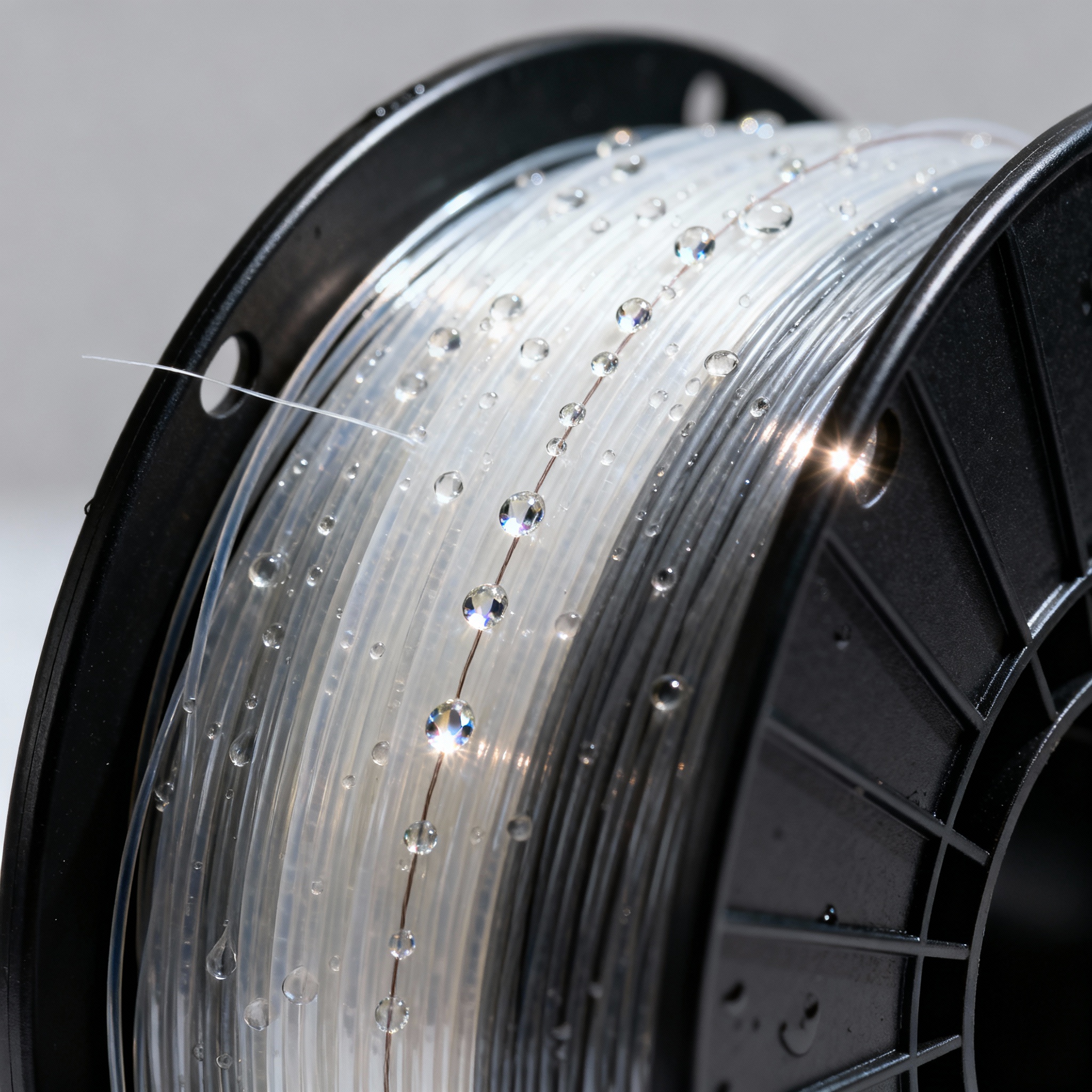
One of the most promising innovations is the integration of advanced functionalities directly into the filament. German Kai Parthy, known for the Lay Filaments family, has proposed a revolutionary concept: a thermoplastic filament that incorporates an optical fiber for data transmission, compatible with standard hotends without hardware modifications.
This “materials-centric” approach shifts functionality from the machine to the consumable. Integrated optical fibers open up scenarios beyond aesthetic lighting: signal transmission through the component, fiber sensors for deformation or temperature, and “smart” functions where the part becomes a communication channel.
The main technical challenge is making fiber and polymer coexist in a conventional hotend, managing friction, curvature, and thermal compatibility. Parthy indicates two paths: integration during filament production or post-production, with the goal of scalability and industrialization.
IoT systems for quality traceability
Humidity is one of the main causes of printing defects. Optimal management requires controlled storage, particularly for hygroscopic filaments such as Nylon, PEEK, and PVA.
Creality is testing a domestic recycling system composed of the Shredder R1 and the Filament Maker M1. The prototype creates a closed loop: it shreds and dries waste, then extrudes it into filament wound on spools. It is possible to mix virgin pellets, coffee grounds, or aromatic additives.
The Shredder R1 reduces failed prints into particles ≤4 mm, feeding the Filament Maker M1 which melts and extrudes the material. Creality declares a production of 1 kg/hour with a tolerance of ±0.05 mm on virgin pellets and ±0.1 mm on recycled material. The system supports PLA, PETG, ABS, ASA, PA, PC, TPU, and PET; PLA and PETG are the easiest to recycle.
Advanced composite materials for industrial applications
Mature FFF/FDM technology offers standard polymers and high-performance composites. Composite filaments incorporate functional fillers that confer specific properties.
Parthy explored fibers for low-resistance current transport, avoiding conductive graphite or expensive nanoparticles, and continuous carbon fiber reinforcements.
Storage is critical: PLA, ABS, and ASA withstand hot-dry environments; Nylon, PEEK, and VPA require airtight containers with desiccants. Professional dry boxes, such as those from Markforged, are essential to maintain the quality of hygroscopic materials.
Software platforms for usage optimization
Software management is crucial for controlling feed rates, temperatures, and humidity. In the Creality system, an automatic feeding mechanism captures the extrusion and wraps it, eliminating manual threading.
Quality is indispensable: current desktop FFF printers are so precise that even minimal variations in the filament compromise the part. If previously machine errors exceeded those of the material, today excellent filament is required to obtain satisfactory results.
Domestic recycling presents barriers: high cost, complex operation, lower quality than commercial. ProtoPasta demonstrates that professional recycling is possible: color selection, double grinding, and fusion guarantee perfect mixing.
Future perspectives in material management
Evolution points to an integrated approach that combines material innovation, automation, and software intelligence. Smart filaments, domestic recycling systems, and monitoring platforms are the pillars of the transformation.
Contamination remains central: an ABS fragment in a PLA batch can clog the nozzle. Future solutions will need to provide automatic identification and separation.
Sensors and IoT will transform management from a passive process to an active quality control system; advanced composites will expand applications from hobbyist to industrial. Success will depend on balancing cost, ease of use, and quality, making technologies accessible to an ever-wider audience.
article written with the help of artificial intelligence systems
Q&A
- What is the concept of the smart filament proposed by Kai Parthy and what functionalities does it enable?
- Parthy devised a thermoplastic filament with an integrated optical fiber for data transmission, compatible with standard hotends. It allows for transporting signals, monitoring deformations/temperatures, and transforming the printed part into an active communication channel.
- How does the Creality home recycling system work and what materials does it support?
- The Shredder R1 shreds and dries waste up to ≤4 mm, then the Filament Maker M1 extrudes new filament with a tolerance of ±0.05-0.1 mm. It supports PLA, PETG, ABS, ASA, PA, PC, TPU, and PET; PLA and PETG are the easiest to recycle.
- Why is humidity a critical problem and how are hygroscopic filaments stored?
- Humidity causes printing defects in hygroscopic materials like Nylon, PEEK, and PVA. They must be stored in airtight containers with desiccants or professional dry boxes to maintain mechanical properties and extrusion quality.
- What are the main barriers to home recycling and how does ProtoPasta overcome them?
- High cost, complex operation, and lower quality hinder home recycling. ProtoPasta selects granules by color, performs double grinding and homogeneous fusion, obtaining a recycled filament of professional quality.
- What role will sensors and IoT play in the future of filament management?
- Sensors and IoT will transform management from a passive process to an active quality control system, enabling real-time traceability of humidity, temperature, and tolerances, and automatic identification of contamination between different materials.