
Metamaterials in Nitinol for Medical Applications and Actuators: How Geometric Design Restores Superelasticity
Thanks to woven-like structures inspired by tissues, 3D-printed Nitinol metamaterials can now exhibit superelasticity close to that of traditional components, without modifying the alloy composition. A group of researchers from the IMDEA Materials Institute and the Universidad Politécnica de Madrid (UPM) has demonstrated that it is possible to overcome the typical mechanical limitations of 3D-printed Nitinol by exclusively exploiting the material's geometry, opening new perspectives for advanced biomedical devices and intelligent actuator systems.
Limitations of Nitinol in 3D Printing
3D printing of Nitinol presents structural problems that compromise its superelasticity, limiting its direct applicability in biomedical and mechatronic fields.
Nitinol (NiTi) is a nickel-titanium alloy renowned for superelasticity, shape memory, biocompatibility, and corrosion resistance, widely used in stents, cardiac devices, surgical guides, and actuators. However, when produced via laser powder bed fusion (LPBF), the most widespread 3D printing technology for this alloy, significant criticalities emerge.
The combination of rapid solidification, residual porosity, internal stresses, and local composition variations tends to drastically reduce superelasticity compared to components made with traditional industrial methods such as forging or machining. Studies indicate that microstructure, phase distribution, and nickel content decisively influence the martensitic transformation temperature and the material's ability to deform and recover elastically.
For advanced applications, especially in the biomedical field where superelasticity is fundamental for the operation of devices such as stents and heart valves, this performance loss limits the potential of additive processes on Nitinol. Researchers have observed that the shape memory and superelastic properties of additively manufactured NiTi parts still do not correspond to those obtained with conventional industrial processes, making an alternative approach necessary that does not rely solely on process optimizations or post-printing heat treatments.
Metamaterials: An Architectural Solution
The introduction of metamaterial structures allows to bypass the intrinsic limitations of Nitinol produced via LPBF, exploiting geometry to improve mechanical properties.
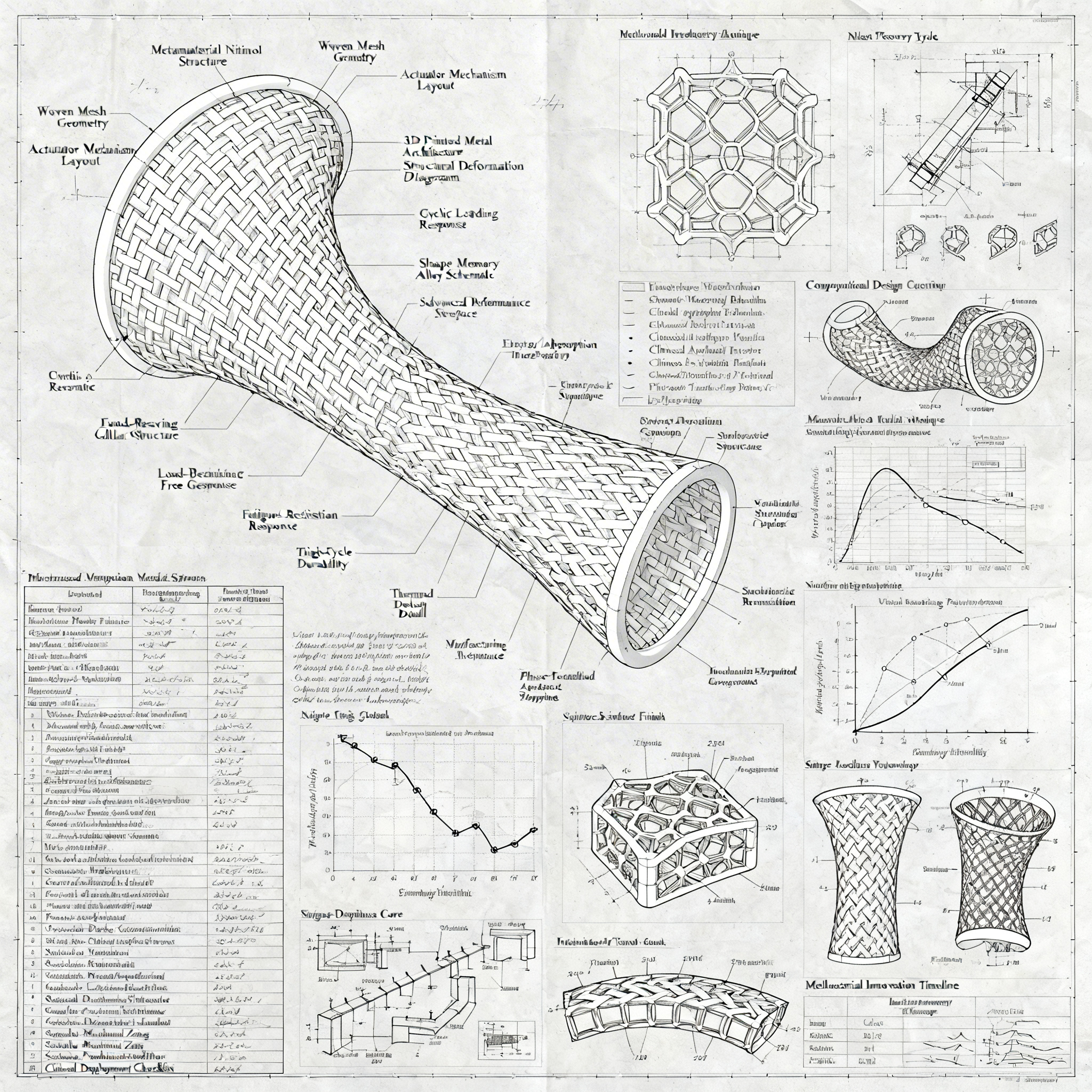
In the new study published in Virtual and Physical Prototyping, researchers led by IMDEA Materials and UPM have chosen a “design-driven” approach: instead of intervening exclusively on the material or process parameters, they have developed interwoven and lattice architectures based on LPBF-printed Nitinol, capable of deforming markedly and recovering the initial shape.
The designed structures include meshes, rings, woven tubes, and fabric-like geometries, produced directly via additive manufacturing without the need for additional supports. These metal textures are among the most complex woven Nitinol structures realized so far with LPBF, and demonstrate the possibility of obtaining self-supporting NiTi “wovens” – configurations that behave more like textiles than conventional metallic components.
The adoption of computational design algorithms allows for the control of density, weaving angle, filament thickness, and unit cell topology, resulting in a metamaterial where the mechanical response is dominated by geometry rather than just chemical composition. According to researcher Carlos Aguilar Vega, “this work represents the first demonstration of design-based optimization of additively manufactured superelastic Nitinol, showing that the mechanical limits intrinsic to current additive manufacturing processes can be effectively mitigated through architecture.”
Lattice Design and Mechanical Behavior
Specific lattice geometries allow for a programmable mechanical response, with high elastic recovery capacity even under extreme conditions.
The reported mechanical tests show that, by varying only the design of the interwoven architectures, it is possible to modulate stiffness, load-bearing capacity, and energy absorption over multiple orders of magnitude, while maintaining very high reversible deformation. The samples are able to deform significantly under cyclic loading and recover their shape thanks to the superelasticity of Nitinol, while the interwoven structure distributes stresses and reduces stress concentrations.
To verify the accuracy of the process, the team used computerized tomography to compare real samples with digital models, confirming the fidelity of the print to the designed geometries and the robustness of the adopted LPBF strategy. According to Professor Andrés Díaz Lantada, “these were some of the most complex-shaped woven Nitinol structures ever created. Promisingly, they represent a breakthrough in the additive manufacturing of superelastic alloys and demonstrate the possibility of obtaining self-supporting NiTi wovens via LPBF techniques.”
The results are presented as the first systematic demonstration of “design-based” optimization of additively manufactured superelastic Nitinol, with improvements obtained primarily through the metamaterial architecture. The team also reported that additively manufactured parts can cost about half as much as those produced conventionally, adding an economic advantage to design flexibility.
Biomedical Applications and Actuator Systems
Thanks to the new mechanical properties, these metamaterials open innovative scenarios for stents, minimally invasive devices, and intelligent micro-actuators.
This methodology paves the way for a new generation of Nitinol-based devices with customizable interwoven architectures, potentially interesting for biomedical implants, protective devices, actuators, and engineering structures with high energy absorption capacity. Interwoven and tubular Nitinol is already used in catheter tubes and heart valves, but the new 3D-printed architectures allow for levels of complexity and customization previously impossible.
Thanks to the combination between the intrinsic superelasticity of NiTi and the metamaterial architecture, it is possible to design structures capable of undergoing large reversible deformations, adapting to variable conditions, and dissipating energy in a controlled manner. This is particularly relevant for devices such as advanced stents, customized heart valves, complex medical actuators, filters, and next-generation catheters.
The timing is particularly favorable: the production of medical devices with 3D printing is expanding across many systems, while populations affected by cardiovascular diseases are living longer than ever. The need and the market for new treatments and devices are therefore present and expanding. Especially in cardiac and vascular devices, these types of structures could quickly find clinical application.
The work fits into a broader research stream on smart materials and shape-changing structures, a field in which IMDEA Materials and UPM are also involved in projects focused on “shape-shifting” implants and actuators governed by geometry, controlled degradation, and material properties.
Conclusion: The Future of Architectural Design for Advanced Alloys
Architectural design represents a promising way to overcome the limits of additive processing of Nitinol, opening new frontiers in advanced engineering.
The research by IMDEA Materials and UPM demonstrates that the mechanical limits of 3D printing Nitinol are not insurmountable: through a design approach that prioritizes the metamaterial architecture, it is possible to restore and even surpass the performance of traditional components. This represents a paradigm shift in the additive manufacturing of shape-memory alloys, where geometry becomes the main tool to optimize functional performance.
In perspective, the same logic of “manufacturing-driven design” could be extended to other 3D-printed shape-memory alloys, expanding the spectrum of solutions for the design of functionalized metamaterials. With the expansion of medical device production via 3D printing and the growing demand for customized solutions, this type of design work could generate solid intellectual properties.
article written with the help of artificial intelligence systems
Q&A
- What are the main limits of 3D printing Nitinol?
- 3D printing Nitinol presents structural problems such as rapid solidification, residual porosity, and internal stresses that drastically reduce superelasticity. These factors compromise its properties compared to components made with traditional methods.
- How do metamaterials solve the problems of 3D-printed Nitinol?
- Metamaterials use interwoven geometric structures designed to improve mechanical properties without altering the material composition. This approach allows for restoring and even exceeding the superelasticity of traditional Nitinol.
- What types of structures have been created by researchers?
- Complex structures such as meshes, rings, braided tubes, and fabric-like geometries have been created. These architectures allow for marked deformation and full elastic recovery thanks to programmable geometry.
- What economic benefits does this new technology offer?
- Parts produced with this technology can cost about half as much as those made with conventional methods. This represents a significant economic advantage in addition to greater design flexibility.
- What biomedical applications could benefit from this technology?
- This technology is particularly useful for advanced stents, custom heart valves, medical actuators, filters, and next-generation catheters. It allows for highly customizable structures with controlled deformation capabilities.


