Superelastic Metamaterials: How the Combination of Reticulated Structures and NiTi Works for Advanced Mechanical Properties
Thanks to a combination of Nitinol superelasticity and 3D printed woven architectures, it is now possible to create metamaterials that behave more like fabrics than metals, opening new paths in advanced engineering.
A group of researchers from the IMDEA Materials Institute and the Universidad Politécnica de Madrid has developed superelastic metamaterials in Nitinol (NiTi) with woven architectures that overcome the mechanical limits of traditional 3D printing. Published in Virtual and Physical Prototyping, the study demonstrates that it is possible to obtain advanced mechanical properties by exploiting the geometry of the material exclusively, without altering its chemical composition. These metal structures behave more like fabrics than conventional metal components, opening perspectives for biomedical implants, protective devices, actuators, and engineering structures with high energy absorption capacity.
NiTi Superelasticity: The Physical Basis of Advanced Mechanical Behavior
Nitinol (NiTi) shows superelasticity due to stress-induced martensitic transformation, useful for applications requiring high reversible deformability.
Nitinol is a nickel-titanium alloy known for its superelasticity, shape memory, biocompatibility, and corrosion resistance, and is widely used in stents, cardiac devices, orthodontic guides, and actuators. Superelasticity derives from stress-induced martensitic transformation: under load, the crystal structure passes from austenite to martensite, allowing high deformations that are completely recovered upon load release.
However, when Nitinol is produced via laser powder bed fusion (LPBF), the combination of rapid solidification, residual porosity, internal stresses, and local composition variations tends to reduce its superelasticity compared to components made with traditional industrial methods. Microstructure, phase distribution, and nickel content decisively influence the martensitic transformation temperature and the material's capacity to deform and return to its original shape. For advanced applications, especially in the biomedical field, this reduced elasticity limits the potential of additive processes on Nitinol.
Reticular Geometries: Architectural Design for Controlled Deformation
Optimized reticular structures allow for customized load distributions and programmable mechanical responses thanks to their periodic architecture.
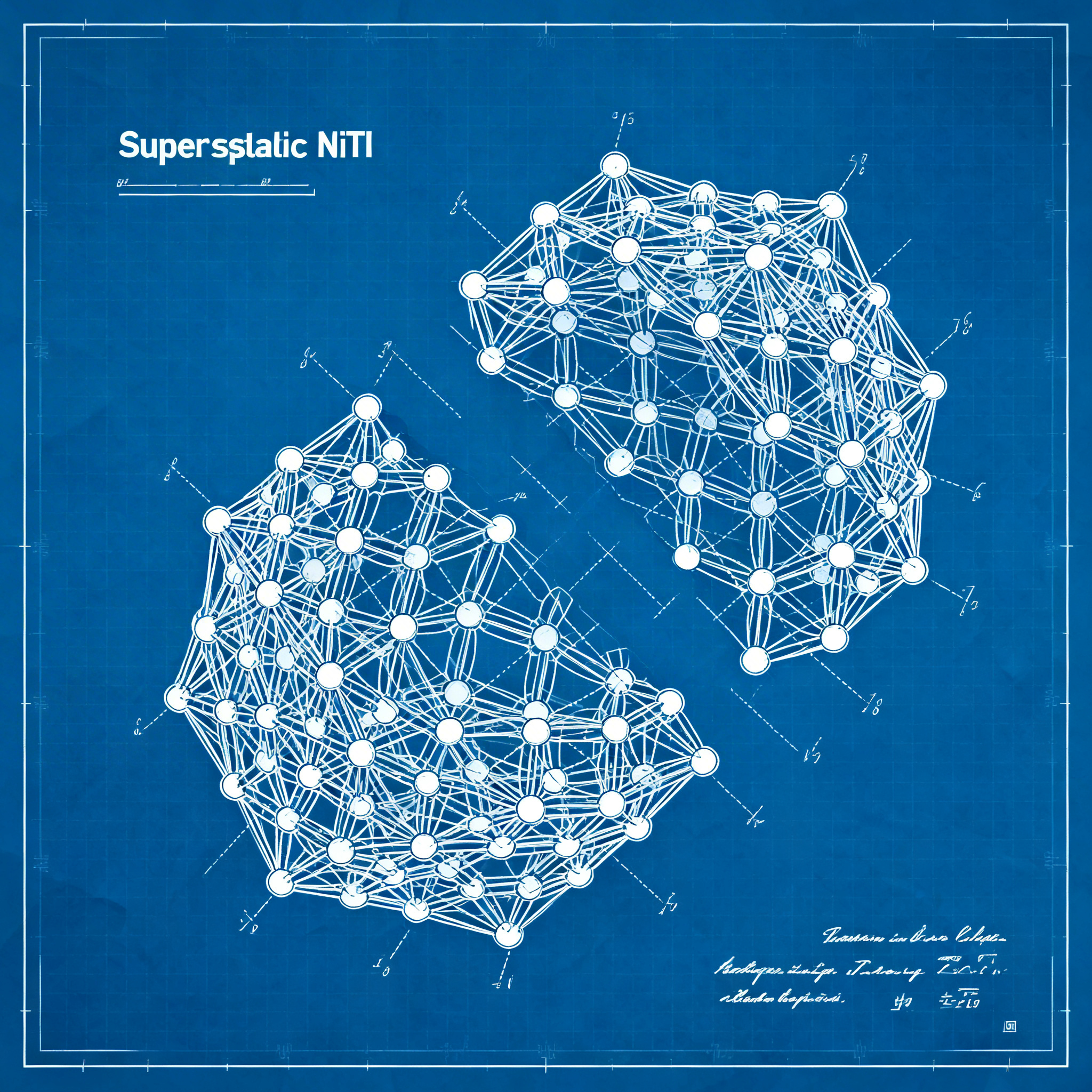
Researchers followed a “design-driven” approach: instead of intervening only on the material, they developed interwoven and reticular architectures based on LPBF-printed Nitinol, capable of undergoing considerable deformations and recovering the initial shape. The designed structures include meshes, rings, twisted tubes, and fabric-like geometries, produced directly via additive manufacturing without the need for additional supports.
These metal fabrics are among the most complex interwoven Nitinol structures realized so far with LPBF, and demonstrate the feasibility of obtaining self-supporting NiTi “wovens.” The use of computational design algorithms allows control of density, weave angle, filament thickness, and unit cell topology, resulting in a metamaterial whose mechanical response is dominated by geometry rather than composition alone. As highlighted by researcher Carlos Aguilar Vega, this work represents the first demonstration of design-based optimization of additively manufactured superelastic Nitinol, showing how the intrinsic mechanical limits of additive manufacturing processes can be effectively overcome.
Synergy between Superelasticity and Architecture: A New Metamaterial Paradigm
The combination of the pseudoelastic behavior of NiTi with reticular geometries enables the achievement of mechanical properties unattainable with bulk materials.
The combination of the intrinsic superelasticity of NiTi and the metamaterial architecture allows the design of structures capable of undergoing large reversible deformations, adapting to variable conditions, and dissipating energy in a controlled manner. Interwoven geometries allow for high reversible deformations, adaptation to stresses, and controlled energy dissipation—characteristics impossible to achieve with traditional bulk materials.
Parallel studies on NiTi lattices based on triply periodic minimal surfaces (TPMS) have confirmed that some sheet-based TPMS topologies offer a favorable trade-off between elastic modulus, yield stress, and the ability to dissipate energy through a stable deformation plateau. The more uniform stress distribution on minimal surfaces contributes to improved fatigue resistance compared to geometries with concentrated nodes and junctions, a critical element for superelastic materials subjected to repeated cycles.
Advantages of 3D Printing: Overcoming the Limits of Traditional Machining
Additive production enables complex shapes and internal geometries impossible to achieve with conventional techniques, maximizing material effectiveness.
3D printing via LPBF allows the realization of self-supporting interwoven architectures that would be impossible to produce with conventional methods. The variability of process parameters and scanning strategies can lead to very different results in terms of superplasticity and shape memory, making it possible to program and tune the properties of components.
Interwoven, woven, and tubular Nitinol wire is already used in catheter tubes and heart valves. With additive production, it is now possible to extend these geometries to complex three-dimensional structures with precise control over density, orientation, and topology. This “manufacturing-driven design” approach can overcome the mechanical limits of traditional NiTi machining, making the material more versatile for advanced applications.
Industrial Cases: From Aerospace to Biomedical
In sectors such as aerospace and biomedical, these structures are used in components that require lightness, impact resistance, and conformability.
This methodology paves the way for a new generation of Nitinol-based devices with customizable interwoven architectures, potentially interesting for biomedical implants, protective devices, actuators, and engineering structures with high energy absorption capacity. In the biomedical sector, the biocompatibility of NiTi combined with conformable geometries can lead to implants that better adapt to biological tissues.
In the aerospace and protection sector, the ability to absorb energy through controlled and reversible deformations offers advantages for components subjected to impacts or cyclic loads. Lightweight reticular structures in superelastic NiTi can replace heavier traditional materials, maintaining or improving mechanical performance. The work is part of a broader research stream on smart materials and shape-changing structures, an area in which IMDEA Materials and UPM are also involved in projects focused on shape-shifting implants and actuators governed by geometry, controlled degradation, and material properties.
Conclusion
The convergence between superelasticity and architectural design opens innovative scenarios for advanced materials engineering.
The demonstration that the mechanical properties of 3D-printed Nitinol can be optimized through geometric design, without modifying the alloy chemistry, represents a paradigm shift in the design of functional metamaterials. The same logic of “manufacturing-driven design” could be extended to other 3D-printed shape-memory alloys, broadening the spectrum of solutions for the design of functionalized metamaterials. Further exploring the integration of other shape-memory materials could lead to new developments in adaptive metamaterials, with applications in sectors ranging from biomedical to advanced structural engineering.
article written with the help of artificial intelligence systems
Q&A
- What are the main characteristics of Nitinol (NiTi) that make it useful for advanced applications?
- Nitinol exhibits superelasticity, shape memory, biocompatibility, and corrosion resistance. Its superelasticity derives from stress-induced martensitic transformation, which allows high reversible deformations.
- How does 3D printing via LPBF affect the properties of Nitinol compared to traditional methods?
- 3D printing via LPBF can reduce the superelasticity of Nitinol due to rapid solidification, residual porosity, and internal stresses. However, through targeted architectural design, these limitations can be overcome.
- How do interwoven lattice structures improve the mechanical properties of Nitinol?
- Interwoven lattice structures allow for customized load distributions and programmable mechanical responses. Geometry dominates the mechanical response, enabling high reversible deformations and controlled energy absorption capability.
- What advantages does additive manufacturing offer over traditional methods in the fabrication of NiTi metamaterials?
- Additive manufacturing allows for complex geometries and self-supporting structures that are impossible to achieve with traditional methods. Furthermore, it allows precise control of density, orientation, and topology without altering the chemical composition.
- What are the possible industrial applications of superelastic metamaterials in Nitinol?
- These metamaterials find employment in the biomedical field for conformable implants, in aerospace for lightweight and impact-resistant components, and in protective devices and actuators thanks to their ability to absorb energy in a controlled manner.