
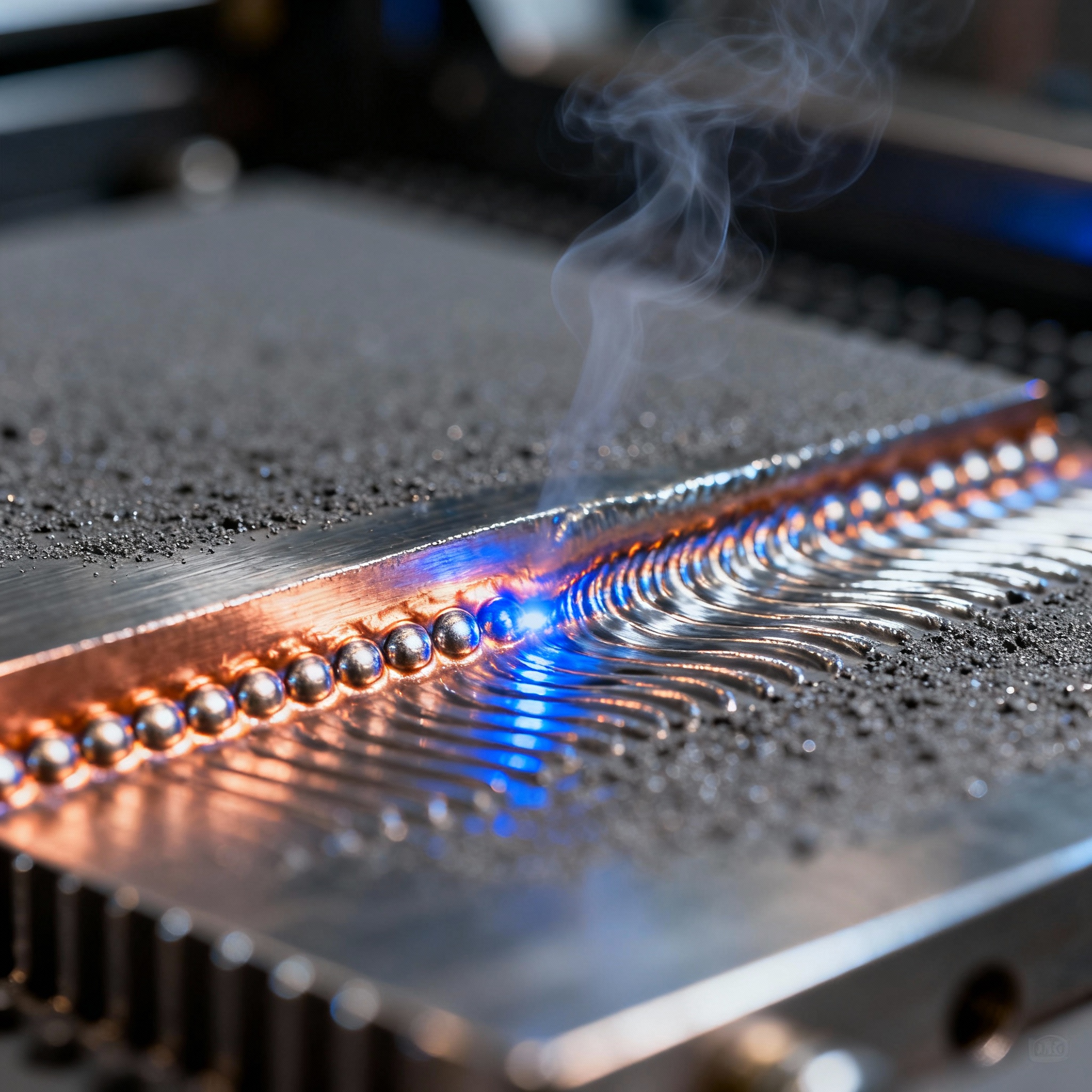
Expansion of metal additive production: technologies, markets and future prospects
Metal additive production is undergoing a significant expansion phase, driven by technological innovations that drastically increase deposition rates and growing confidence in the use of these technologies in critical sectors such as aerospace, defense and energy. By 2026, the sector is at a turning point: current processes are capable of producing components weighing several tons and advanced materials capable of operating in extreme environments.
Current technological landscape
Researchers at Oak Ridge National Laboratory, in collaboration with ARC Specialties, have developed Electroslag Additive Manufacturing (ESAM), a high-productivity process for large metal components. The technique combines electroslag strip cladding (ESC) with wire arc additive manufacturing (WAAM), achieving deposition rates three to six times higher than conventional wire processes.
ESAM uses gas tungsten arc welding (GTAW) to create containment walls that delimit the ESC deposition zone, combining the high productivity of ESC with the geometric control of WAAM. During tests with alloy 625, the system recorded 22.7 kg/h in a purely ESC configuration and 11.3 kg/h for ESC filling in a convergent configuration, maintaining mechanical properties comparable to the cast material.
A British initiative led by the University of Nottingham and the UK Atomic Energy Authority is exploring Multi-Metal Laser Powder Bed Fusion (MM-LPBF) to create metamaterials for nuclear fusion machines. The DIADEM project aims to fuse different metals – tungsten and copper, for example – characterized by very different thermal properties, for applications in extreme environments.
Innovative materials and processes in 2026
Microstructural analysis of ESAM highlighted strong texture in the build direction in both stacking strategies tested. Mechanical tests showed that direct stacking produces slightly higher yield and tensile strength, while staggered stacking confers significantly greater ductility; differences are mainly attributable to variations in iron dilution.
When the ESC filling was combined with the GTAW containment walls in the complete ESAM configuration, microanalysis and nanoindentation indicated that the presence of the GTAW walls does not negatively affect the material properties. Hardness and elastic modulus remained constant in the GTAW, ESC and interface regions.
The AMPP (Advanced Materials Production & Processing Center) center, operational at the LIFT facility in Detroit, deals with the production and development of powder, wire and bar materials for additive processes. It produces aluminum, titanium, nickel alloys, niobium C103 and stainless steel, providing experimental batches of custom alloys for specific operational needs.
Industrial applications and high-growth sectors
DIADEM will support critical technologies for nuclear fusion programs, including STEP, the British fusion power plant prototype expected to be operational by 2040. Future applications of multi-metallic metamaterials will extend to aerospace, defense, and healthcare, where high-performance multi-metallic components are required.
In the aerospace sector, metal additive manufacturing is evolving from niche applications to an essential tool for lighter and more efficient components. The increasing availability of real flight performance data has generated new confidence in the use of the technology in aeronautical design.
Heat exchangers made with AM enable highly efficient, lightweight, and conformal structures capable of following the natural curves of a fuselage or engine manifold. Defense programs, characterized by faster development cycles and greater tolerance for technical risk when performance benefits are evident, are adopting metal additive manufacturing more quickly than civil aviation.
Technical challenges and production scaling solutions
The team at Oak Ridge National Laboratory is developing a fully robotic ESAM work cell that integrates coordinated ESC and GMAW systems, with the goal of transforming the process from a laboratory demonstration to an automated production platform. Next steps include larger test specimens, full-scale mechanical testing, and advanced capabilities such as in-situ alloying and functional grading of materials.
Variability in additive manufacturing represents an obstacle for manufacturers. LIFT addresses the problem by leveraging integrated computational materials engineering (ICME) tools, based on modeling and simulation software to develop materials and related processes. The automation and integration of these tools accelerate material development and enable simulation-based testing, reducing the need for physical testing.
The AMPP center plays a key role not only in material development but also in defining process parameters for AM. Using 3D printing equipment and a laboratory at LIFT, the initiative develops optimal printing parameters and processing windows for new materials.
Global market analysis and forecasts to 2030
ESAM offers a potential pathway to accelerate the adoption of additive manufacturing in applications requiring large-scale metal components in near-net-shape, especially where build rate and supply chain resilience are critical. According to researchers, the approach could support the production of components weighing several tons currently manufactured via casting and forging, particularly in the energy sector.
The primary objective of the AMPP center is to integrate a multi-filament supply chain specific to AM, preventing customers from relying on a single supplier. The center also focuses on sourcing materials from US origins to simplify processes through national partnerships.
The long-term potential in civil aviation is enormous: lighter and more efficient engines and airframes could significantly reduce emissions and fuel consumption. Additive manufacturing also makes it possible to produce low-volume spare parts for aircraft that have been in service for decades without having to restart entire production lines.
Regulations, standardization, and quality
Before in-flight deployment, additive components must pass a very rigorous certification process. Engineers define “allowables,” statistical limits that describe the behavior of a material. Traditionally, this has required the production and testing of thousands of small samples over years, often at a cost of millions of dollars.
For metal additive parts, the process is even more complex: every machine and every set of parameters can generate different material properties, and a single component can include both thick sections and very thin internal walls. Demonstrating the reliability of such geometries requires new testing methods and a deeper statistical understanding.
Inspection technology is improving: engineers can use CT scanning and other advanced techniques to examine the inside of printed parts and understand their behavior in detail. Collaboration with facilities like the Australian Synchrotron provides access to world-class beamlines, allowing microscopic examination of metal components and providing essential data to develop reliable statistical allowables.
Development prospects and future roadmap
Thanks to the design freedom offered by additive manufacturing, it is now possible to create parts that are 30 to 40 percent smaller and lighter while maintaining or improving performance. Conformal projects could support completely new aerospace architectures with shapes and configurations previously impossible to build.
Collaboration is essential to advance the technology. Qualification and certification of additive parts require strong cooperation between large manufacturers, smaller technology specialists, research institutes, and governments. Once a process or
article written with the help of artificial intelligence systems
Q&A
- What is the main innovation introduced by the ESAM process and what benefits does it offer compared to conventional technologies?
- ESAM (Electroslag Additive Manufacturing) combines electroslag strip cladding and wire arc additive manufacturing, achieving deposition rates 3 to 6 times higher than traditional wire processes. In testing with alloy 625, it recorded 22.7 kg/h in pure ESC mode, maintaining mechanical properties comparable to cast material.
- For which specific applications is the DIADEM project developing multi-metallic metamaterials?
- DIADEM aims to produce metamaterials for nuclear fusion machines by melting metals with very different thermal properties, such as tungsten and copper. Future applications will extend to aerospace, defense, and healthcare, where high-performance multi-metallic components are required in extreme environments.
- How does the AMPP center contribute to reducing variability in metal additive manufacturing?
- AMPP uses ICME (Integrated Computational Materials Engineering) tools to model and simulate materials and processes, accelerating development and reducing physical testing. It also defines optimal printing parameters for new materials, integrating a multi-filament supply chain to avoid dependence on single suppliers.
- What are the main challenges for certifying additive components in the aeronautical sector?
- Every machine and set of parameters can generate different properties; a component may have thick sections and thin walls. Demonstrating reliability requires new testing methods, CT scans, and data from synchrotrons to build statistical allowables, since the traditional process would require thousands of samples and millions of dollars.
- How can metal additive manufacturing influence the life cycle of existing aircraft?
- It enables the production of low-volume spare parts for obsolete aircraft without reactivating entire production lines, reducing costs and lead times. In the long term, lighter and more efficient engines and airframes obtained with AM could reduce emissions and fuel consumption, extending the operational life of fleets.


