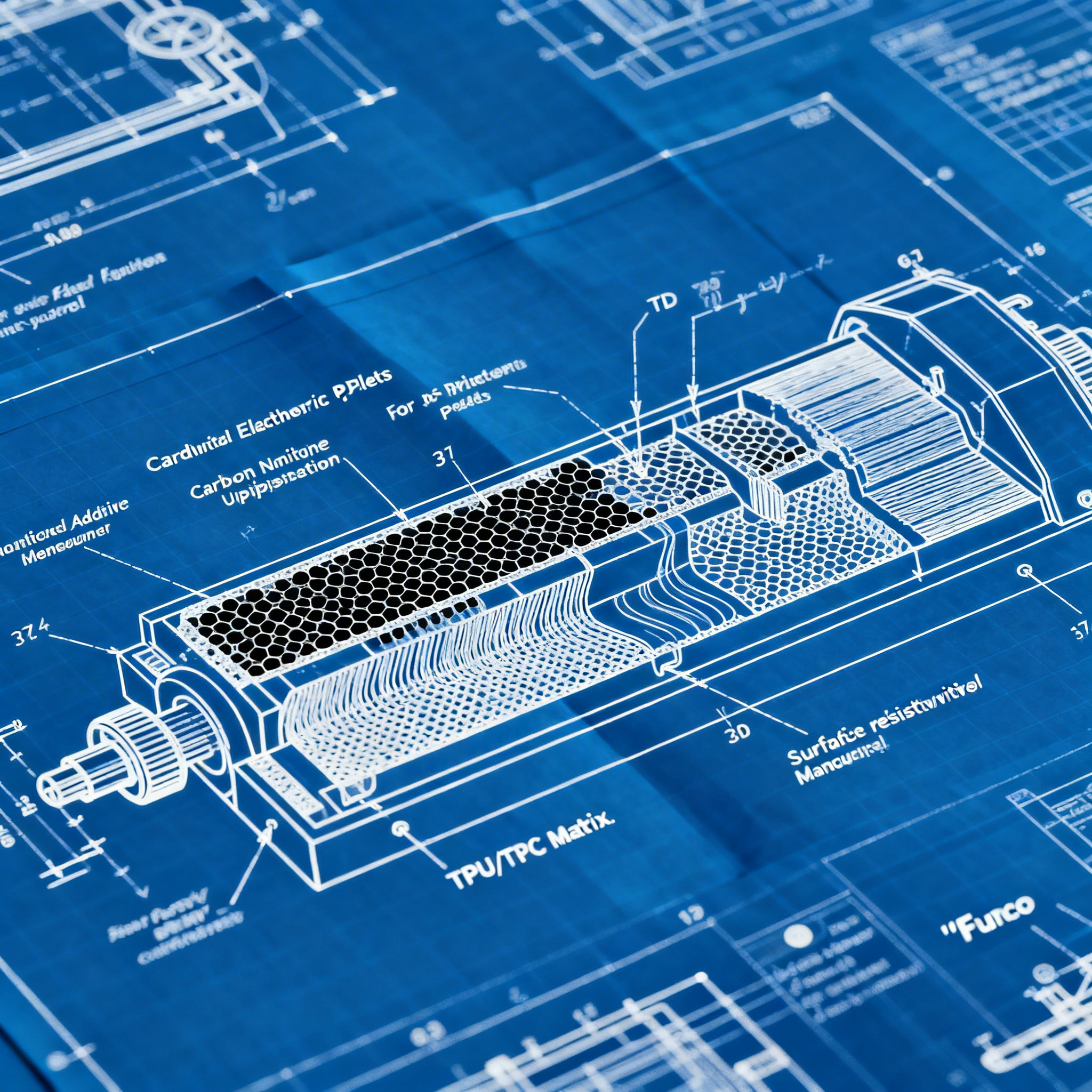
How Conductive Elastomer Pellets Work for Reliable 3D Printing
Mechnano's new conductive elastomeric pellets leverage an advanced carbon nanotube dispersion to ensure stable electrical performance and reliable mechanical properties, solving the homogeneity issues typical of traditional ESD materials.
The US-based company Mechnano has introduced a new line of conductive elastomeric pellets intended for pellet-based additive manufacturing systems, designed to produce flexible components with stable and uniform electrostatic dissipation characteristics. These materials, based on TPU and TPC with typical hardness around 90-95 Shore A, are intended for sectors such as electronics, sensitive component handling, industrial automation, and medical devices. The proprietary D'Func technology for the dispersion of discrete and functionalized carbon nanotubes represents the core of the innovation, overcoming the limitations of traditional CNT-filled elastomers where the non-homogeneous distribution of the filler can compromise both mechanical properties and the consistency of surface resistivity.
The Homogeneity Challenge in Conductive Materials for Molding
The effectiveness of conductive materials depends heavily on the uniformity of the distribution of conductive particles within the polymer matrix, an aspect critical to ensuring reliable performance.
In traditional conductive elastomeric materials, carbon nanotubes tend to form agglomerates and non-homogeneous domains within the polymer matrix. This phenomenon compromises both electrical conductivity, creating irregular local conductive paths (carbon trails), and the mechanical properties of the final component. The non-uniform distribution also generates variability in performance between different batches and even within the same printed component, making it difficult to guarantee constant quality standards in critical industrial applications.
For applications in environments sensitive to electrostatic discharges, such as electronic assembly lines or clean rooms, this inconsistency represents an unacceptable risk. Components must maintain a controlled and predictable surface resistivity to effectively protect sensitive electronic devices, avoiding both charge accumulation and uncontrolled discharges.
D'Func Technology: Controlled Dispersion of Carbon Nanotubes
D'Func technology allows for an isotropic and stable dispersion of nanotubes through a process of separation, chemical functionalization, and controlled distribution, eliminating aggregates that can cause local conductivity defects and mechanical degradation.
The core of Mechnano's proposal is the D'Func technology, an acronym standing for “detangled, separated and functionalized dispersion” of carbon nanotubes. This approach involves three critical phases: first, the nanotubes are mechanically separated to eliminate initial agglomerates; subsequently, they are chemically functionalized to improve compatibility with the polymer matrix; finally, they are distributed in a controlled manner to build a uniform three-dimensional conductive network.
Unlike traditional CNT compounds, where nanotubes form non-homogeneous domains, D'Func aims to create a conductive path uniformly distributed in all directions. This ensures isotropic properties, i.e., identical regardless of the measurement direction, a fundamental requirement for components that can be mechanically and electrically stressed from different angles during use.
Controlled dispersion also allows for maintaining good elongation at break of the elastomer, preserving the characteristic flexibility of TPU and TPC materials without sacrificing it to achieve conductivity. This balance between mechanical and electrical properties represents one of the main advantages of the technology over conventional solutions.
Properties of Conductive TPU/TPC Compounding
The compound features a controlled hardness of approximately 90-95 Shore A and a consistent surface resistivity in the ESD range between 10⁶ and 10⁹ Ω, ideal for protecting sensitive components without reaching full electrical conductivity.
The new family of conductive elastomer pellets includes formulations based on TPU (thermoplastic polyurethane) and TPC (thermoplastic copolyester) with typical hardness values around 90-95 Shore A. This hardness offers an optimal balance between flexibility, tear resistance, and the ability to maintain shape under load, making them suitable for applications requiring controlled deformability.
The isotropic surface resistivity is typically within the range of 10⁶-10⁹ Ω, a value that places these materials in the ESD (Electrostatic Discharge) category. This range is suitable for preventing static charge accumulation and uncontrolled discharges, without reaching the full conductivity of conductive antistatic materials. The choice of this resistivity range is strategic: values that are too low could create short-circuit risks, while values that are too high would not guarantee effective dissipation of static charge.
The use of discrete and uniformly dispersed CNTs allows for maintaining good elongation at break, avoiding the embrittlement phenomena typical of materials heavily loaded with conductive fillers. This improves the reliability of flexible components used near sensitive electronics, where repeated deformation cycles must not compromise ESD properties over time.
Compatibility with Flexible Production Technologies
The pellets are compatible with extrusion and pellet molding systems, including validated industrial platforms such as Arburg Freeformer, making them suitable for the scalable production of industrial and medical parts with lower costs per kilogram compared to traditional filaments.
The pellet format allows industrial users to feed screw extruders or hybrid print/extrusion systems directly, increasing productivity compared to filament-based systems. This format is particularly advantageous for the production of medium batches and large volumes, where the material cost per kilogram becomes a significant competitive factor.
Mechnano has already announced the validation of its PC ESD pellets on Arburg Freeformer platforms, demonstrating compatibility with industrial additive manufacturing solutions based on pellets and a relatively rapid tuning curve. Extending the same logic to conductive elastomeric pellets aims to make flexible ESD materials available for production lines oriented towards industrial volumes.
Potential applications cover a broad spectrum: grippers and flexible inserts for robotic clamps destined for the handling of printed circuit boards, seals and cable glands for electrical panels, deformable housings for measuring instruments and medical devices, up to damping systems in ESD-safe areas. The combination of elastomeric behavior and ESD properties allows for the replacement of multi-material solutions or surface coatings with monolithic, directly printed parts, reducing assemblies and simplifying the supply chain.
Conclusion
Mechnano's conductive elastomeric pellets represent a reliable solution for obtaining high-performance ESD components thanks to a controlled and repeatable dispersion of conductive fillers, overcoming the homogeneity limits of traditional materials and opening up new possibilities for scalable industrial production.
D'Func technology demonstrates how a scientific approach to the dispersion of carbon nanotubes can transform potentially problematic materials into reliable industrial solutions. The combination of elastomeric mechanical properties, controlled ESD performance, and compatibility with pellet-based production systems positions these materials as a concrete option for demanding sectors such as electronics, automation, and medical devices.
Explore the technical specifications of the material to evaluate integration into your production processes and verify compatibility with your existing pellet printing systems to take advantage of the benefits of this advanced technology.
article written with the help of artificial intelligence systems
Q&A
- What are the main advantages of Mechnano's conductive elastomeric pellets compared to traditional ESD materials?
- Mechnano's conductive elastomeric pellets offer uniform distribution of carbon nanotubes thanks to D'Func technology, ensuring stable electrical and mechanical properties. Unlike traditional materials, they avoid agglomerates that can compromise conductivity and mechanical resistance.
- In which industrial sectors are these materials used?
- These materials are employed in the electronics, handling of sensitive components, industrial automation, and medical device sectors. They are ideal for applications that require flexibility and protection against electrostatic discharge.
- How does D'Func technology work for the dispersion of carbon nanotubes?
- D'Func technology mechanically separates nanotubes, chemically functionalizes them to improve compatibility with the polymer matrix, and distributes them in a controlled manner. This creates a uniform and isotropic conductive network, avoiding agglomerates and ensuring consistent performance.
- What are the electrical and mechanical characteristics of the conductive pellets?
- The pellets have a hardness of approximately 90-95 Shore A and a surface resistivity in the ESD range (10^6–10^9 Ω). They maintain good elongation at break, combining flexibility and electrostatic protection without sacrificing mechanical properties.
- With which production technologies are the conductive elastomer pellets compatible?
- They are compatible with pellet extrusion and molding systems, including industrial systems like Arburg Freeformer. This enables scalable and cost-effective production compared to traditional filaments.