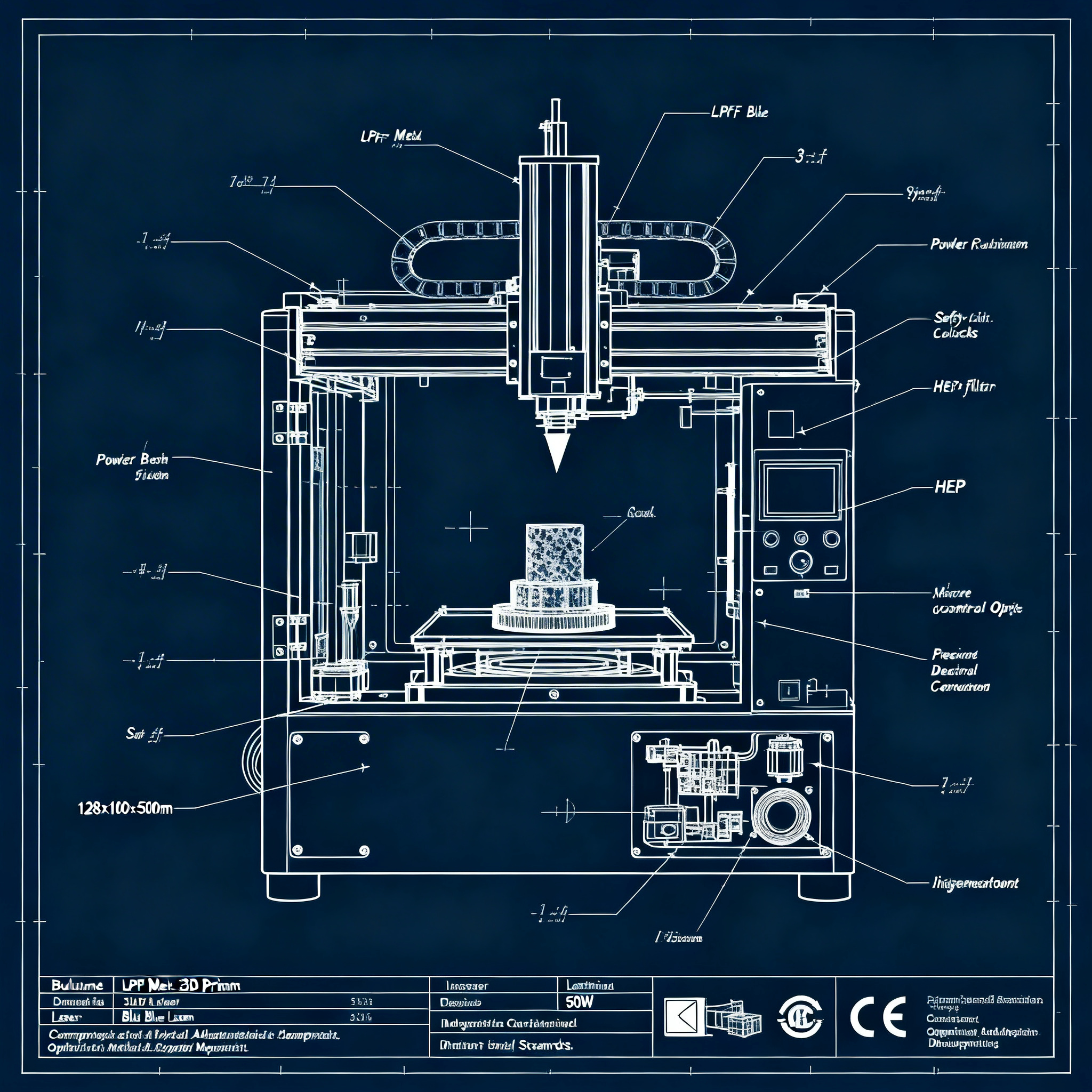
Accessible LPBF: How Startups Can Produce Metal Without Costs from Industry
A new generation of LPBF systems is making metal production accessible to startups and laboratories, with costs under 10,000 euros and industrial flexibility.
The landscape of metal 3D printing is undergoing a silent but disruptive revolution. Laser Powder Bed Fusion (LPBF) systems, which until recently required investments exceeding 100,000 euros, are now available for a fraction of the cost, opening concrete opportunities for startups, research laboratories, and small R&D teams. The Metal-Base machine, developed in the Netherlands by an engineer with experience at ASML, represents the most extreme case of this democratization: a complete LPBF system offered in Super Early Bird for about 8,500 euros, well below the psychological threshold of 10,000 euros.
The Entry-Level Systems Revolution
New LPBF systems have drastically reduced the cost of entry while maintaining sufficient quality standards for prototyping and small batch applications, eliminating the typical infrastructural barriers of industrial plants.
The Metal-Base system demonstrates how it is possible to rethink the LPBF architecture without sacrificing productive quality. The machine uses a 60 W blue diode laser with a wavelength of 445 nm, paired with an XY gantry system similar to that of advanced FFF printers, instead of the expensive galvanometers and fiber lasers of traditional industrial solutions. This technical choice exploits the greater absorptivity of the blue laser by many metal alloys, allowing the complete fusion of the powder bed with lower powers.
The declared build volume is approximately 128 × 100 mm in XY with a Z-axis expandable up to 150 mm, with a productivity of 1.5 cm³/h. Compact dimensions allow installation on standard laboratory benches, without the need for dedicated infrastructure. The machine operates with a normal domestic power outlet, with consumption under 800 W, completely eliminating the need for special electrical plants. The work chamber is completely closed, equipped with safety interlocks, HEPA filtration, and monitoring of critical parameters such as laser status, oxygen level, and door opening, guaranteeing CE compliance.
The declared target is explicitly that of engineers, advanced makers, and R&D teams who want to introduce metal 3D printing as a low-cost “production-grade” platform, without the typical investments of industrial plants. The Kickstarter campaign is scheduled for the first quarter of 2026, with a beta testing phase already completed with selected European users, including specialized workshops and realities with LPBF experience.
Open Source Software: The Heart of Optimization
Thanks to open platforms like Klipper and OrcaSlicer, startups and laboratories can customize and monitor every aspect of the production process, transforming the machine into a true experimental research platform.
A distinctive feature of the Metal-Base system is the choice of a completely open software ecosystem. The machine uses Klipper as the control firmware and offers compatibility with OrcaSlicer for preparing print jobs, allowing users to access and modify an extended range of process parameters. This openness contrasts sharply with the typical approach of closed industrial LPBF systems, where material profiles are pre-configured and often not very modifiable by the end user.
For laboratories, universities, and startups, in-depth access to parameters allows the machine to be used as an experimental research platform for scanning strategies and process windows. This flexibility aligns with the trends of data-driven optimization and machine learning studied in the LPBF field, enabling experiments that would normally require access to expensive industrial systems with development licenses.
Founder Tom Bakker, a systems engineer at VDL Enabling Technologies Group (where he worked on wafer handling robots for ASML's EUV machines), emphasizes that the focus should not be exclusively on the laser: “having a short optical path close to the melt pool, good gas circulation, good airflow, keeping the optics clean, and the effective laser power on the bed are more important.” The engineer dedicated most of his development time to the system's fluid dynamics, achieving 20-30 joules per cubic millimeter in a controlled manner, compared to the 80-100 joules typical of industrial machines with fiber lasers.
Small Spaces, Big Operational Impact
The compactness of the new entry-level LPBF solutions allows for adoption even in urban contexts, incubators, or temporary laboratories, without heavy infrastructure investments or the need for dedicated industrial environments.
The compact format and the possibility of connecting to a normal power outlet drastically simplify installation in environments such as university laboratories, applied research centers, incubators, and small prototyping departments. No dedicated technical rooms, special cooling plants, or enhanced electrical panels are necessary. This operational accessibility represents a paradigm shift for those who want to experiment with metal additive production without having to justify infrastructure investments of tens of thousands of euros.
The system requires about 30 hours of assembly and a nitrogen generator costing approximately 1,200 euros, bringing the total investment still well below 10,000 euros. Metal-Base emphasizes that a well-equipped laboratory is necessary for assembly and operation, and that the use of personal protective equipment is always mandatory when handling metal powders.
The first systems in the hands of customers are yielding positive results: between May and December 2025, feedback collected from an LPBF expert, a manufacturing company, and a 3D printing service was integrated into the new version of the machine. The founder's stated goal is not “to seek a unicorn startup, but only to make metal printing more accessible,” with the intention of selling 10-20 systems via Kickstarter and investing the funds primarily in documentation.
Conclusion
With costs kept under 10,000 euros and unprecedented operational flexibility, entry-level LPBF systems like Metal-Base are concretely redefining the possibilities for innovators, researchers, and small businesses who want to access metal additive production.
The platform is designed to extend to other alloys compatible with LPBF, leveraging the greater absorptivity of the blue laser and the ability to finely regulate scanning parameters. This positioning opens up new opportunities for applications in R&D, small-batch production, custom equipment, and functional components where mechanical performance requirements demand a metallurgical structure comparable to traditionally worked alloys.
Evaluate today which LPBF system can integrate into your lab or startup, without waiting for industrial budgets. Access to metal 3D printing is no longer a question of prohibitive economic availability, but of strategic choice and the ability to leverage open platforms to develop specific skills and applications.
article written with the help of artificial intelligence systems
Q&A
- What is the access cost for new LPBF systems like Metal-Base?
- New LPBF systems are available at a fraction of traditional costs, with the Metal-Base offered at approximately 8,500 euros in the Super Early Bird version, well under 10,000 euros.
- What are the technical characteristics of the Metal-Base system?
- The system uses a 60 W blue diode laser, a gantry XY system similar to advanced FFF printers, and offers a build volume of 128 × 100 mm in XY with an expandable Z axis up to 150 mm.
- What infrastructural advantages does Metal-Base offer compared to industrial systems?
- It is compact, works with a normal domestic power outlet, does not require special electrical systems and can be installed on standard laboratory benches.
- How does Metal-Base software differ from industrial systems?
- It uses open source platforms like Klipper and OrcaSlicer, allowing users to access and modify process parameters, unlike closed industrial systems.
- What is the main objective of founder Tom Bakker with Metal-Base?
- The goal is to make metal 3D printing more accessible, not by seeking a unicorn startup but by providing a low-cost platform for innovators and researchers.