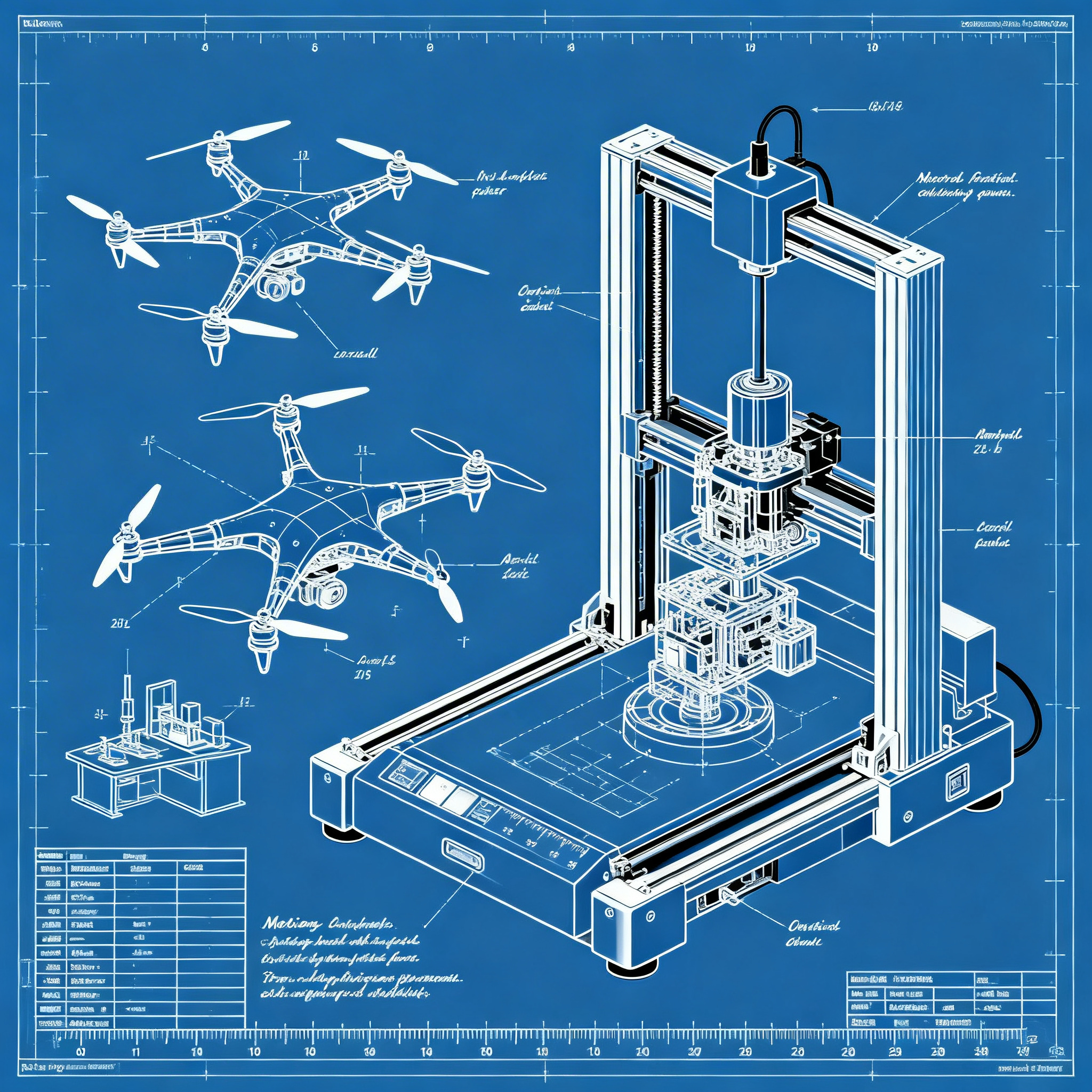
Cutting-Edge University Labs: How 3D Printing Transforms Research and Education
Universities are transforming their engineering laboratories into dynamic hubs thanks to 3D printing, where students and researchers design, test, and optimize real solutions in real time. This technological revolution is redefining both teaching and applied research, with concrete methodologies demonstrating how additive production is now an integral part of the academic workflow.
Rapid Prototyping in Engineering Education
3D printing allows students to translate theoretical concepts into immediately testable physical models, accelerating experiential learning and bridging the gap between theory and practice.
University laboratories are integrating 3D printing as a fundamental tool for practical learning. At the Florida Institute of Technology, 3D-printed components are integrated into electronics, motion systems, and laboratory-scale production tools, allowing students to validate projects and understand the real behavior of printed parts. The approach goes beyond isolated demonstrations: some workflows are automated, while others remain intentionally manual to give students direct experience in project validation.
This methodology transforms laboratories from simple exhibition spaces into true operational work environments. 3D printing is not presented as a standalone technology, but as an integrated element in real systems, where students experience the entire cycle from design to production. The goal is to prepare a workforce that understands not only additive technology, but the entire production process into which it fits.
Case Studies: Drones and Innovative Components in Academic Laboratories
Leading universities are developing drones and complex mechanical parts via 3D printing, demonstrating the practical applicability of the technology in advanced engineering contexts.
At the University of Illinois Urbana-Champaign, Professor Jason Merret's laboratory operates as a mixed teaching and research environment, using 3D-printed drones and enclosures to allow students to experiment, test, and iterate rapidly. The drone laboratory has been operational for about three years and includes a dedicated flight room with a complete motion capture system.
At the Oklahoma Aerospace Institute for Research and Education, the Simulation to Flight Applied Research Laboratory brings innovative aeronautical configurations from digital simulation to physical flight testing. Using aerodynamic modeling techniques, the group designs and builds aircraft, then comparing simulation results with real flight data. 3D-printed components allow for a rapid transition from design to testing, significantly accelerating the development and validation cycle.
These examples demonstrate how 3D printing is not limited to conceptual prototypes but supports research projects that extend to testing in real operational conditions, preparing students for the challenges of contemporary aerospace engineering.
Integration with Motion Capture Systems and Environmental Testing
The combined use of motion capture and controlled environments allows for detailed analysis of prototype performance, significantly improving the quality and rigor of scientific research.
The drone laboratory at the University of Illinois Urbana-Champaign represents an excellent example of advanced technological integration. The dedicated flight room is equipped with a complete motion capture system that uses about a dozen high-resolution cameras to track movements within a 20x20x10 foot space. The system allows for simultaneous testing of multiple drones with sub-millimeter precision.
This configuration transforms what might seem like a simple test space into a rigorous research environment. The ability to measure the behavior of 3D-printed prototypes with extreme precision allows students and researchers to validate design hypotheses, optimize configurations, and understand the real performance of additive components in controlled but realistic conditions.
The integration of 3D printing and advanced measurement systems represents a qualitative leap in the approach to academic research, where the iteration speed typical of additive production combines with the rigor of scientific validation.
Automation and Integrated Workflows for Applied Research
Additive production has become a central element in academic processes, supporting both teaching and advanced research projects through increasingly automated and integrated workflows.
In the most advanced university laboratories, 3D printing is no longer an isolated tool but part of an integrated technological ecosystem. At the Florida Institute of Technology, printed components are incorporated directly into real experiments rather than remaining separate demonstrations, with workflows that balance automation and manual intervention for educational purposes.
This integration reflects a broader change in the way universities prepare future engineers. 3D printing becomes the connection point between digital design, materials science, process control, and quality assurance – skills traditionally not taught together but increasingly necessary in the modern industry.
The integrated approach allows students to understand the entire production cycle, from digital design to physical validation, preparing them for an industry where additive production is increasingly central to product development and advanced manufacturing strategies.
Conclusion
University laboratories are redefining the role of 3D printing, transforming it from a simple prototyping tool into a strategic pillar of modern engineering research and training.
The integration of 3D printing in academic laboratories represents much more than a technological update: it is a methodological transformation that is changing the way engineering is taught and researched. From flight rooms with motion capture to laboratories simulating real production environments, universities are creating ecosystems where theory and practice merge, preparing students who are not only technically competent but capable of thinking in terms of integrated systems.
Explore how your university can implement similar solutions to enhance research and teaching with additive production. Investing in integrated 3D printing infrastructure, advanced measurement, and controlled testing environments is today a distinguishing factor for universities that want to train the professionals of the future manufacturing industry.
article written with the help of artificial intelligence systems
Q&A
- How is 3D printing transforming university engineering laboratories?
- 3D printing is transforming university laboratories into dynamic hubs where students and researchers can design, test, and optimize real solutions in real time. It integrates additive production directly into the academic workflow, turning laboratories into true operational work environments.
- What benefits does rapid prototyping offer in university teaching?
- Rapid prototyping allows students to translate theoretical concepts into immediately testable physical models, accelerating experiential learning. This approach bridges the gap between theory and practice, enabling a deeper understanding of the real behavior of components.
- How is 3D printing used in university aerospace laboratories?
- In aerospace laboratories, 3D printing is used to develop drones and complex mechanical components, enabling a rapid transition from design to operational testing. For example, at the University of Illinois Urbana-Champaign, 3D-printed drones are used in a flight room with a motion capture system for controlled tests.
- How do motion capture systems contribute to testing in university laboratories?
- Motion capture systems enable precise real-time analysis of prototype behavior, improving research quality. Thanks to high-resolution cameras, it is possible to monitor movements with sub-millimeter precision, validating design hypotheses and optimizing configurations.
- What is the role of automation in university laboratories that use 3D printing?
- Automation in university laboratories allows for the integration of 3D printing into complex workflows, while still maintaining manual moments for educational purposes. This balance enables students to understand both the automation of production processes and the importance of human intervention in project validation.