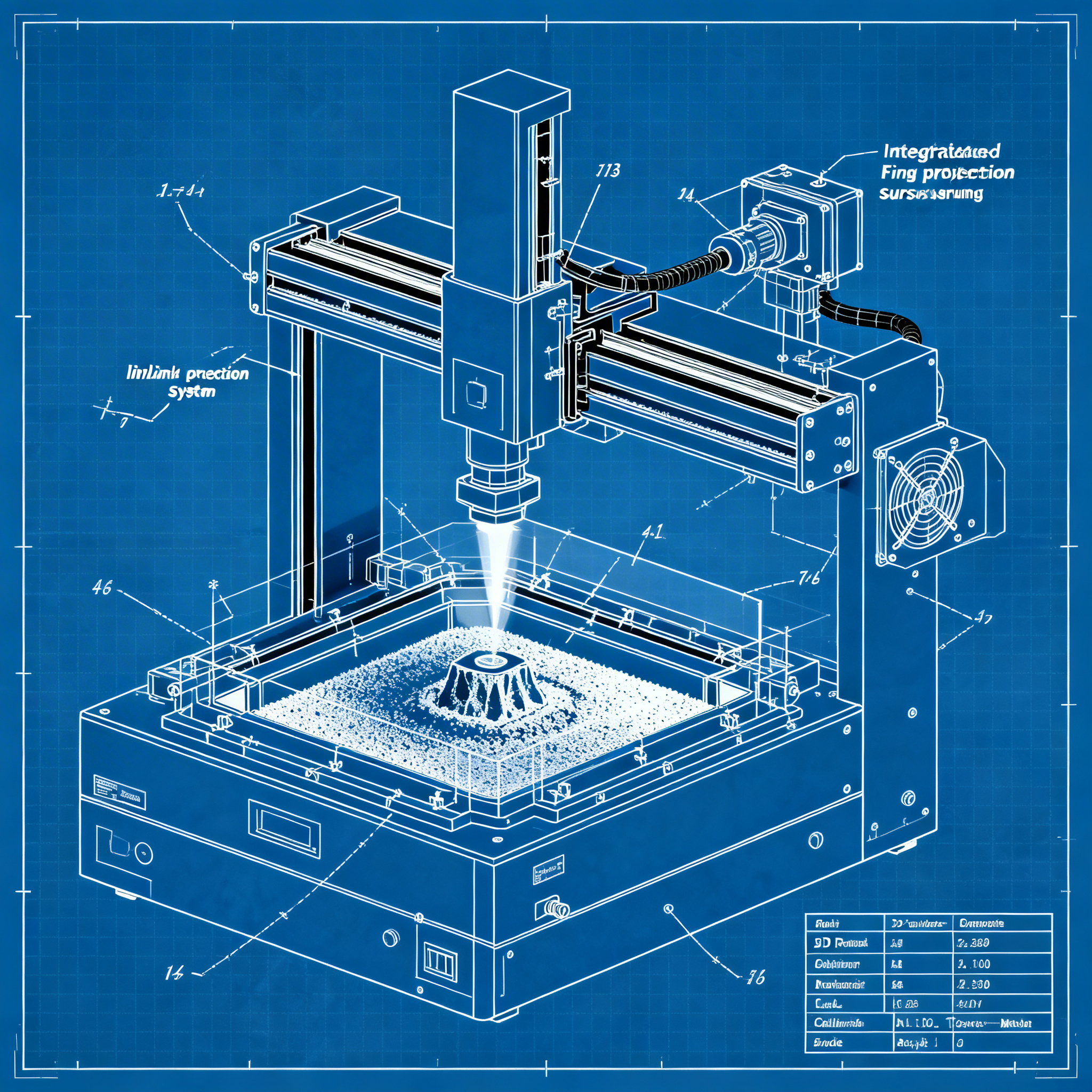
In-Process Inspection for Metal 3D Printing: How Calibrated Measurement-Based Quality Control Works
In the sector of metal 3D printing, the transition towards reliable production requires real-time calibrated measurement systems, far beyond simple visual monitoring. While the metal additive industry evolves from prototyping to serial production, a crucial challenge arises: ensuring constant quality without relying exclusively on costly post-process inspections. The solution lies in in-process inspection based on calibrated measurements, a technology that transforms quality control from a reactive activity into a proactive strategy integrated into the production cycle.
Limitations of Traditional Visual Monitoring Systems
Systems based on cameras and artificial intelligence offer visibility into the process but lack calibrated and traceable data necessary for reliable production decisions.
Most current metal powder bed fusion (PBF) systems use combinations of optical imaging, infrared cameras, photodiodes, or AI-assisted anomaly detection. These tools provide useful visibility but are fundamentally subjective and uncalibrated, relying on “black box” AI systems that do not produce traceable measurements.
In traditional manufacturing, qualitative decisions are never made based solely on subjective monitoring: machined parts are verified with calipers, coordinate measuring machines (CMMs), and tools that produce traceable data based on measurement units. Additive manufacturing, on the other hand, has attempted for years to deduce quality from relative signals that vary from machine to machine and from build to build.
As AM programs expand, this gap becomes a concrete business risk. Post-process inspection can represent more than half the cost of a qualified metal AM component and, in some cases, becomes physically impossible, such as for large aerospace components. The industry no longer needs more monitoring, but in-process inspection that enables timely decisions and reduces surprises in later stages.
Fringe Inspection: The Technology Behind Precise Measurement
Structured light fringe projection technology enables the acquisition of high-resolution three-dimensional maps of the powder layer, a critical element for quality control during the process.
The Fringe Inspection system applies structured light metrology to additive manufacturing. Instead of indirectly estimating the process state, it directly measures the three-dimensional surface profile of each layer (fused surface and distributed powder) during the build.
For laser powder bed fusion, this translates into quantitative measurements of powder layer uniformity, fused surface topology, and actual layer thickness. Since these measurements are calibrated and based on units, they can be compared across different machines, materials, and facilities, providing an essential requirement for industrial qualification and process control.
A concrete example concerns the detection of spatter (molten or partially molten material ejected during laser melting), recognized as a primary cause of surface roughness and porosity. Using Fringe Inspection, Phase3D and the University of Louisville addressed spatter as a measurable surface phenomenon rather than a visual artifact. By capturing metrology-grade height maps for each layer, the system objectively quantified spatter particles, surface roughness and their spatial distribution in the build area.
Using 17-4PH stainless steel samples printed on an EOS M 290, the data showed that regions with higher measured surface roughness and spatter counts consistently exhibited higher porosity, while smoother regions produced denser parts. This result demonstrates a direct and quantitative link between in-process surface measurements and final component quality.
Integration of Calibrated Data into the Production Process
The use of measured and calibrated data enables immediate and reliable decisions, avoiding costly and often inadequate post-print interventions.
With calibrated surface data available layer by layer, manufacturers can begin to implement closed-loop strategies, adjusting powder distribution, modifying laser behavior or automatically reporting localized risk zones.
This approach naturally aligns with IQ (Installation Qualification), OQ (Operational Qualification) and PQ (Performance Qualification) frameworks and supports emerging standards such as SAE 7032 and NASA-STD-6033/6035. The transition to a “process-centric” logic means demonstrating that a qualified process produces consistent results and that each build possesses a set of digital evidence (data, logs, sensors) sufficient to support compliance.
Objective inspection enables the creation of clear acceptance/rejection criteria based on quantified thresholds linked to known defect risks. Instead of relying on intuition, operators can make data-driven decisions. When relevant anomalies are measured and controlled, qualification becomes a continuous process rather than a costly final obstacle.
Industrial Cases: Reducing Scrap with In-Situ Quality Control
Leading companies in the sector have already implemented integrated inspection systems, achieving significant scrap reductions and improvements in traceability.
The implementation of complete data acquisition systems represents a critical step in the industrialization of semiconductor component production and other high-tech applications. Recent cases show the integration of the entire production chain, capturing structured data from the moment raw material enters the plant, through the build process, post-processing and final CT scanning.
Creating a unique and connected view of the history of every component represents a shift from reactive quality control based on inspection toward proactive, data-driven process-level quality assurance. Every variable is linked in a single digital thread, while structured process data can be visualized to show process stability and variation.
The economic impact of real-time inspection and qualification is significant. Manufacturers gain the ability to immediately identify regions of poor quality rather than discovering defects after post-print inspection. Furthermore, the shift to an in-process qualification method reduces the need for costly post-print inspections such as sample density, X-ray computerized tomography, and destructive performance testing. Conservative market estimates for the US and Europe for qualification were approximately $3.3 billion in 2025, with forecasts of over $7.8 billion by 2030, as production for critical industries increases.
Conclusion
Moving quality control directly into the manufacturing process represents a competitive turning point for the metal 3D printing industry, transforming AM from a monitored process to a controlled process.
A recent publication from the Joint EASA-FAA Additive Manufacturing Workshop 2025 highlights the need for high-fidelity, in-situ inspection methods in real time for qualification. When the process is measured, quality becomes predictable. And when quality is predictable, additive manufacturing becomes truly industrial.
The future competitive advantage will be defined by who can produce confidently at scale. Objective inspection transforms AM from a monitored process to a controlled process, enabling the transition from prototyping to reliable and repeatable production.
Discover how to integrate advanced in-process inspection solutions into your production chain to maximize efficiency and quality, reducing post-process inspection costs and increasing traceability and compliance with more rigorous industrial standards.
article written with the help of artificial intelligence systems
Q&A
- What is the main limitation of traditional visual monitoring systems in metal 3D printing?
- Traditional systems provide only subjective and uncalibrated visibility, relying on 'black box' artificial intelligence that does not produce traceable measurements. They do not guarantee the objective and reproducible data necessary for reliable production decisions.
- How does Fringe Inspection technology work in metal 3D printing?
- Fringe Inspection uses structured light projection to directly measure the three-dimensional surface profile of each layer during the build. It provides quantitative measurements of powder layer uniformity, fused surface topology, and actual layer thickness.
- What benefits does in-process inspection based on calibrated measurements bring?
- It enables timely and reliable decisions during production, reducing the need for costly post-process inspections. It also allows for the implementation of closed-loop strategies and improves traceability and compliance with industrial standards.
- How does in-process inspection contribute to waste reduction?
- It immediately identifies areas of poor quality during printing, allowing for real-time corrections. This avoids the production of defective components and reduces the need for destructive inspections or posterior tomographies.
- What is the expected economic impact of adopting in-process inspection by 2030?
- Estimates indicate a growing qualification market from $3.3 billion in 2025 to over $7.8 billion by 2030, thanks to the reduction of post-printing inspection costs and the increase in production in critical sectors such as aerospace and medical.