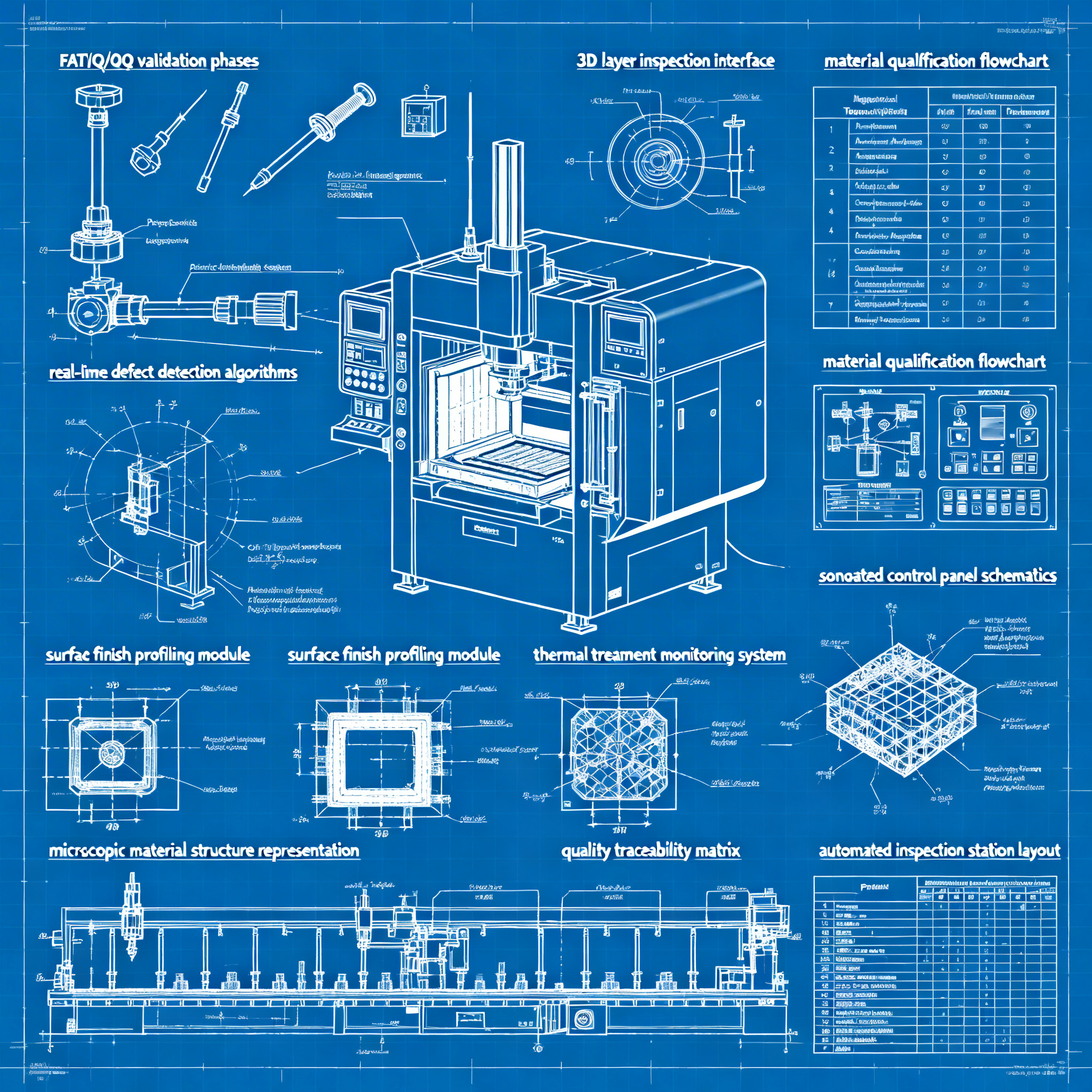
Implementing Innovations in Mechanical Testing and Quality Assurance: An Operational Plan for the Advanced Industry
The evolution of testing technologies requires new and structured approaches to ensure quality and compliance without compromising efficiency. In the advanced manufacturing industry, particularly in metal additive manufacturing, the qualification of materials, machinery, and production processes represents a crucial step for the transition from prototyping to scale production. A clear operational plan allows for the integration of innovations in mechanical testing without compromising reliability and traceability, fundamental requirements for critical applications in sectors such as aerospace, energy, and defense.
Feedstock Qualification: From Intrinsic to Contextual
Material evaluation cannot be limited to intrinsic physical characteristics but must include real behavior in the final production process, integrating controls on morphology, chemistry, and print performance.
Feedstock qualification represents one of the fundamental prerequisites for any additive manufacturing process. As highlighted by industrial best practices, the qualifying organization must decide whether the feedstock facility will be qualified based solely on its intrinsic merits — composition, powder particle size distribution or wire diameter, production method — or whether qualification also requires evaluations of the feedstock in the printed material.
In the case of critical applications for turbines and propulsion, qualification includes controls on powder morphology and chemistry (particle size distribution, contamination, oxygen, moisture, recyclability), definition of process windows (laser or electron beam parameters, scan strategies, orientations, supports), and evaluation of the impact of post-process treatments on microstructure and defects. Technical evidence shows that materials such as ABD900/ABD-900AM, evaluated in different PBF modes (laser and electron beam), exhibit significant microstructural differences between processes, with an important role of heat treatments and HIP in controlling porosity and creep performance.
There is often an overlap between printing and testing for Material Qualification (MQ) and the generation of design values, making an integrated approach necessary that considers the feedstock not as an isolated entity but as part of a process-material system.
Machine Qualification: Distinguishing FAT, IQ, and OQ
The three phases of machine qualification — Factory Acceptance Testing, Installation Qualification, and Operational Qualification — have distinct and sequential objectives that must not be overlapped or omitted to ensure correct implementation.
According to the best practices of the Aerospace Industries Association (AIA), machine qualification requires an approach articulated in three parts. The Factory Acceptance Testing (FAT) verifies that the printer functions correctly and is performed by the manufacturer before delivery, assuring the customer that the machine has a known predefined condition.
The’Installation Qualification (IQ), sometimes called Site Acceptance Testing (SAT), verifies that the printer is suitable for producing hardware and is performed at the user's site. SAT and FAT are very similar, but SAT may involve a different alloy, specific geometries, movements, and energy levels not covered in the FAT.
The’Operational Qualification (OQ) verifies that the printed material meets a specific given specification and is performed at the user's facility after the completion of the IQ. This requires the production of one or more test specimen builds, the execution of required heat treatments and NDT. The specimens undergo compositional, microstructural, and mechanical testing, and the results are compared with the material requirements and specifications. OQ is required for each specification requirement.
The systematic approach to the three phases naturally aligns with the IQ, OQ, and PQ frameworks and supports emerging standards such as SAE 7032 and NASA-STD-6033/6035, enabling the implementation of closed-loop control strategies based on available calibrated data layer by layer.
Integrated Testing in Design: Strategies and Benefits
Integrating testing from the early design phases, rather than relegating it to final control, improves the reliability of results, accelerates qualification processes, and reduces post-process inspection costs.
Most metal powder bed fusion systems today rely on combinations of optical imaging, infrared cameras, photodiodes, or AI-assisted anomaly detection. However, these tools provide useful visibility but are fundamentally subjective and uncalibrated. In traditional manufacturing, quality decisions are never made solely based on subjective monitoring: machined parts are verified with calipers, CMMs, and gauges, all tools that produce traceable data based on units of measure.
The industry does not need more monitoring, but in-process inspection that allows for earlier decisions and fewer surprises downstream. Metrology technologies based on structured light applied to AM directly measure the three-dimensional surface profile of each layer during the build, resulting in quantitative measurements of powder layer uniformity, fused surface topology, and actual layer thickness. Since these measurements are calibrated and based on units, they can be compared across machines, materials, and facilities, providing an essential requirement for industrial qualification and process control.
Advanced testing capabilities allow for direct testing on components and thin samples up to 0.75 mm, extracting accurate mechanical data without destructive sectioning, and mapping mechanical properties across welds and complex geometries with an indentation spacing of 1.5 mm. This level of resolution supports more efficient design decisions, whether adjusting printing parameters, refining welding procedures, or reducing unnecessary safety margins while maintaining structural integrity.
Case Studies: Industrial Applications of Advanced Testing
Concrete examples from aerospace and energy sectors demonstrate how the systematic application of qualification methodologies reduces costs, times, and uncertainties in the transition from prototype to qualified production.
NASA used multi-scale testing capabilities to characterize local variations in mechanical properties within spaceflight components. By mapping stress-strain responses across an additively manufactured part, process-structure-property relationships were revealed, which informed production optimization and reduced conservative safety factors. Yield strength decreased by approximately 15% as wall thickness decreased, information that would have been lost with traditional tensile testing.
In the case of spatter detection — particles of melted or partially melted material expelled during laser melting — the quantitative approach demonstrated that regions with higher measured surface roughness and higher spatter counts consistently exhibited greater porosity, while smoother regions produced denser parts. This result demonstrates a direct and quantitative link between in-process surface measurements and final part quality.
Conservative market estimates for qualification in the US and Europe were approximately $3.3 billion in 2025, with projections exceeding $7.8 billion by 2030, as production for critical industries increases. Post-print inspection can represent more than half the cost of a qualified metal AM part, and in some cases becomes physically impossible, such as for large aerospace components.
Conclusion: Towards Systematic Quality Implementation
A clear and structured operational plan allows for the full exploitation of the potential of innovations in mechanical testing and quality, transforming AM from a monitored process to a controlled process.
Effective implementation of innovations in mechanical testing requires a methodical approach that clearly distinguishes between prerequisites (requirements, feedstock qualification, machine qualification) and pre-production qualification (facility and part/performance qualification). The distinction between FAT, IQ, and OQ is not bureaucratic formalism but an operational necessity to ensure that each qualification phase is completed with the appropriate criteria before proceeding to the next.
Feedstock qualification must be based on both intrinsic properties and behavior in the final print process.
article written with the help of artificial intelligence systems
Q&A
- What are the two main approaches to feedstock qualification?
- Feedstock qualification can occur by evaluating only its intrinsic properties, such as composition and particle size distribution, or by also including its performance in the final production process. In the second case, the material's behavior during printing and the impact of post-process treatments are evaluated.
- What do FAT, IQ, and OQ distinguish in machine qualification?
- FAT verifies the correct operation of the machine at the manufacturer's site. IQ confirms the suitability of the machine at the user's site with specific geometries. OQ verifies that the printed material meets the required specifications, using tests on specimens made by the user.
- How do in-process metrology technologies contribute to quality in additive manufacturing?
- These technologies measure parameters in real-time such as powder layer uniformity, surface topology, and layer thickness. They provide calibrated and traceable data that enable early decisions, reducing the need for destructive inspections and improving process reliability.
- What benefits does integrating testing from the design phases bring?
- Integrating testing during the design phase improves the reliability of results, accelerates qualification, and reduces post-process inspection costs. It also allows for the optimization of printing parameters and procedures, avoiding excessive safety margins and maintaining structural integrity.
- What results did NASA obtain in the application of advanced testing?
- NASA used multi-scale testing to map mechanical properties in additive components, discovering that yield strength decreased by 15% with wall thickness. It also correlated surface roughness and spatter with final porosity, improving process optimization.