Innovative Materials for Industry 4.0: Advanced Solutions in Technical Ceramics and Reinforced Polymers
Introduction to New Frontiers in Industrial Materials
Industry 4.0 is undergoing a radical transformation thanks to the introduction of innovative materials that combine high performance with advanced production processes. Technical ceramics and reinforced polymers are currently strategic solutions for sectors requiring high-performance components, from electric mobility to aerospace.
The commercialization of 3D-printed ceramics has seen significant acceleration, with specialized suppliers such as Steinbach AG, Bosch Advanced Ceramics, and Schunk Technical Ceramics consolidating their market position. In parallel, the AMPP (Advanced Materials Production & Processing Center) at LIFT in Detroit focuses on the development of metallic and ceramic materials for additive manufacturing, offering calibrated experimental quantities to meet industrial needs and supporting manufacturers in defining optimal process parameters.
Advanced Technical Ceramics: Properties and Applications in the Automotive Sector
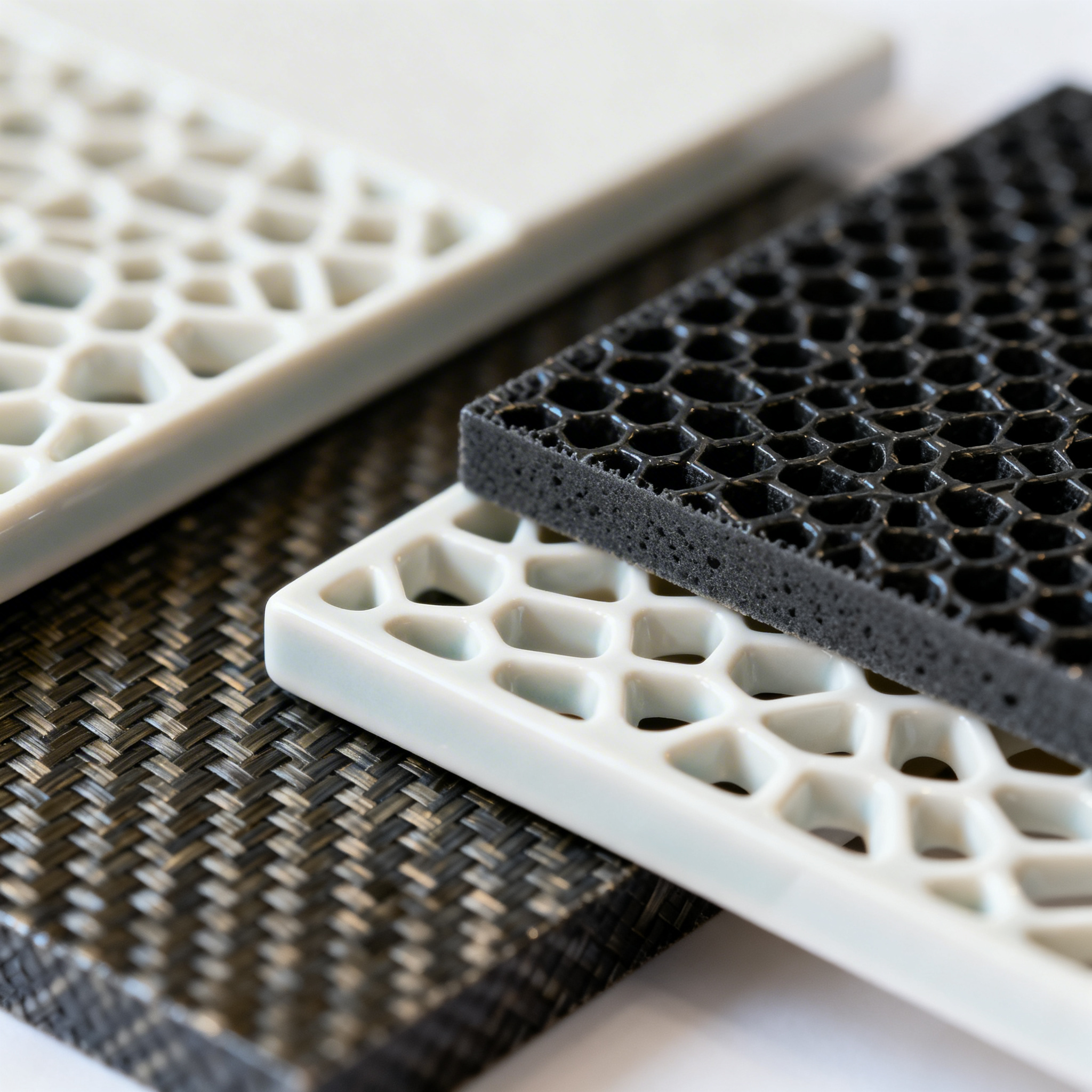
Technical ceramics are emerging as key materials for critical industrial applications due to their distinctive properties: high thermal stability, hardness, chemical resistance, and wear resistance. A particular trend concerns the increasing use of silicon carbide (SiC), a material that offers exceptional performance in extreme environments. Although the dark color of SiC makes processing with light-based methods complex, sintering techniques have proven effective in the production of functional components.
In the automotive sector, particularly for electric mobility, ceramics are used in thermal, electrical, and magnetic components. Additive manufacturing facilitates the creation of optimized internal channels and functional surfaces that improve the thermal management of electric motors. Applications range from semiconductor components – such as gas injectors for etching processes produced in quantities up to 2,000 units per month – to custom dental prostheses and hearing aids. A significant example is the production of ceramic cores for the fusion of single-crystal turbine blades in nickel alloy, made using LCM (Lithography-based Ceramic Manufacturing) technology for the aerospace sector.
Carbon Fiber Reinforced Polymers: Production Processes and Quality Control
Carbon fiber reinforced polymers represent an advanced solution for applications requiring a high strength-to-weight ratio. The quality control of these materials constitutes a critical challenge in the industrial context, as the microstructure develops under non-equilibrium thermal conditions, with repeated cycles and high gradients. Given the same nominal material, the local thermal history – influenced by geometry and deposition strategy – can determine different properties within the same component.
To address this complexity, the industry is adopting approaches based on artificial intelligence and advanced process control, particularly in robotic direct energy deposition (DED) systems. The flexibility of robot orientation introduces additional variables such as kinematics, trajectories, nozzle-substrate distance, and local heat accumulation, increasing the need for sensors and adaptive strategies. Process stability, the use of new high-performance materials, and simulation-supported design are central elements to ensure tolerances, properties, and repeatability between batches.
A fundamental aspect concerns the traceability and qualification of the process: in regulated sectors, it is not enough to produce compliant components, but it is necessary to demonstrate quality criteria in an auditable manner through “digital passports” and shared standards.
Innovative Sintering Technologies for Complex Structural Components
Sintering technologies are evolving to enable the production of large-sized ceramic components with complex geometries. The IntrinSiC binder jetting process developed by Schunk Technical Ceramics allows for the realization of parts up to 1.8 × 1.0 × 0.7 meters, opening up new possibilities for large-scale structural applications.
Several technologies are currently available on the market: the MoldJet process based on Tritone sintering, XJet's NanoParticle Jetting (NPJ) based on material jetting, and D3-AM's Micro Particle Jetting (MPJ), founded on industrial inkjet technology. The latter has demonstrated the capability to produce static mixers for chemical applications, where jetting technology has allowed not only more effective geometries but also the replacement of metal with more resistant ceramic.
The increasing use of processes based on sintering allows for the processing of materials such as silicon carbide, overcoming the limitations of photopolymer methods. The combination of geometric freedom and ceramic material properties is making these technologies competitive for end-use components in industrial volumes.
Cost-Benefit Analysis in the Implementation of Innovative Materials
The implementation of innovative materials requires a cost-benefit analysis that goes beyond the simple cost of the material or machine time. The total cost of additive manufacturing includes the machine, material, process times, productive yield, post-processing, quality control, and waste. Economic convenience depends on the entire process chain, not just the deposition or solidification phase.
A critical aspect concerns overcoming two myths: that geometric complexity is “cost-free” and that production is completely automated. Even when the deposition works correctly, preparation, fixtures, supports, distortion management, heat treatments, material removal, finishing, and controls come into play. The orientation towards greater sensing, control, and traceability should be interpreted as a strategy to reduce variability and rework, making costs more predictable and defensible in an industrial context.
The AMPP center offers “growler-sized” quantities of experimental alloys – a middle ground between laboratory samples and industrial batches – allowing manufacturers to test specialized materials in the necessary quantity, reducing waste and helping to establish the market for new advanced materials before increasing production. This approach facilitates the qualification of innovative materials by reducing economic risk for manufacturers.
Future Perspectives and Ongoing Technological Developments
Future prospects for innovative materials in Industry 4.0 focus on three main directions: the integration of simulation and digital twin to predict defects and distortions before production, reducing trial-and-error; the standardization of measurement modalities and the availability of experimental data to make knowledge transferable between plants; and the development of closed-loop control systems that require data infrastructure, sensors, and near-machine computing capabilities.
The increasing use of artificial intelligence for quality control and the definition of robust process windows represents a key element for the transition from laboratory demonstrations to industrial production. Experimental validation and transferability between machines, configurations, and different alloys constitute the most delicate step towards industrialization.
In the ceramics sector, expansion towards stationary industrial applications and the production of components for electric motors demonstrate how these materials are overcoming traditional niches. For reinforced polymers, the integration of innovative finishing processes and the control of microstructure through process parameters open up possibilities for critical structural applications. The main challenge remains the demonstration of reliability, repeatability, and economic convenience on an industrial scale, an objective that requires collaboration between technology developers, material suppliers, and end users.
article written with the help of artificial intelligence systems
Q&A
- What are the main advantages of technical ceramics in Industry 4.0?
- Technical ceramics offer high thermal stability, hardness, chemical resistance, and wear resistance. They are ideal for applications in extreme environments and allow for the realization of complex components via additive manufacturing, improving thermal efficiency in electric motors.
- How are carbon fiber reinforced polymers used?
- Carbon fiber reinforced polymers are used for applications that require a high strength-to-weight ratio. They are used in sectors such as automotive and aerospace, where ensuring lightness and structural resistance is crucial.
- What sintering technologies are used to produce complex ceramic components?
- Technologies such as binder jetting (e.g., IntrinSiC by Schunk), MoldJet, NanoParticle Jetting (XJet), and Micro Particle Jetting (D3-AM) allow for the production of large-sized ceramic components with intricate geometries, overcoming the limits of traditional methods.
- What factors influence the total cost in the additive manufacturing of innovative materials?
- The total cost includes machine, material, process times, post-processing, quality control, and scrap. It is important to consider the entire process chain, as geometric complexity is not 'free' and automation still requires manual interventions.
- What are the future prospects for innovative materials in Industry 4.0?
- Prospects include the use of digital twins and simulations to predict defects, the standardization of measurements, and the development of closed-loop control systems. Artificial intelligence and traceability will be central to ensuring quality and industrial scalability.