Innovation in Materials and Advanced Recycling: Solutions for a Sustainable Future
Introduction to Material Innovations
The manufacturing industry is undergoing a radical transformation thanks to material innovation and advanced recycling technologies. Arkema launched the Virtucycle® program, a partnership initiative that allows customers to “enter the cycle” by providing polymers for reprocessing or purchasing materials with a guaranteed minimum recycled content, without compromising performance. The program focuses on polyamide 11 and polyamide 12 resins, PEBA elastomers, and PVDF fluoropolymers.
The acquisition of Agiplast by Arkema has expanded the traditional offering. Agiplast is a recycler and regenerator of high-performance polymers, with established experience in the re-engineering, re-compounding, and re-certification of these materials. Arkema acts as an intermediary in sourcing recyclable materials and matching them with customers interested in partially recycled grades characterized by a more favorable life cycle assessment (LCA) profile.
Emerging Technologies in Chemical Recycling
In the additive manufacturing sector, recycling technologies are yielding concrete results. JawsTec uses the QLS 230 printer to recycle excess powder from other printers, mixing it with virgin material in a ratio of approximately 80/20 (recycled/new). This proportion was defined through tests aimed at maximizing the use of recycled material without sacrificing part quality. Using only recycled powder would make components as fragile as paper, prone to breakage.
The printer is designed for rapid print cycles, completed in about 24 hours including cooling, allowing for one build per day. This is significantly less time than the several days required for cooling traditional SLS printers. JawsTec has already avoided the disposal of over 2 tons of powder, achieving capacity goals and nearly doubling production.
Another significant collaboration involves CNPC Powder and automotive supplier Brose, who have formed a strategic partnership to transform steel scrap from Brose's Chinese production lines into iron-based powders for additive manufacturing. The new powder, named Green Steel, is produced entirely from stamping scrap and maintains the chemical composition and mechanical properties of conventional sheet metal components.
Biodegradable and Compostable Materials
Arkema's Virtucycle® program recovers injected or extruded waste, powders, parts, and granules of long-chain polyamides (PA11, PA12), PEBA thermoplastic elastomers, and PVDF. The program distinguishes between pre-consumer materials (industrially processed but not transformed into finished products) and post-consumer materials (industrially processed and used as finished products in end-use applications).
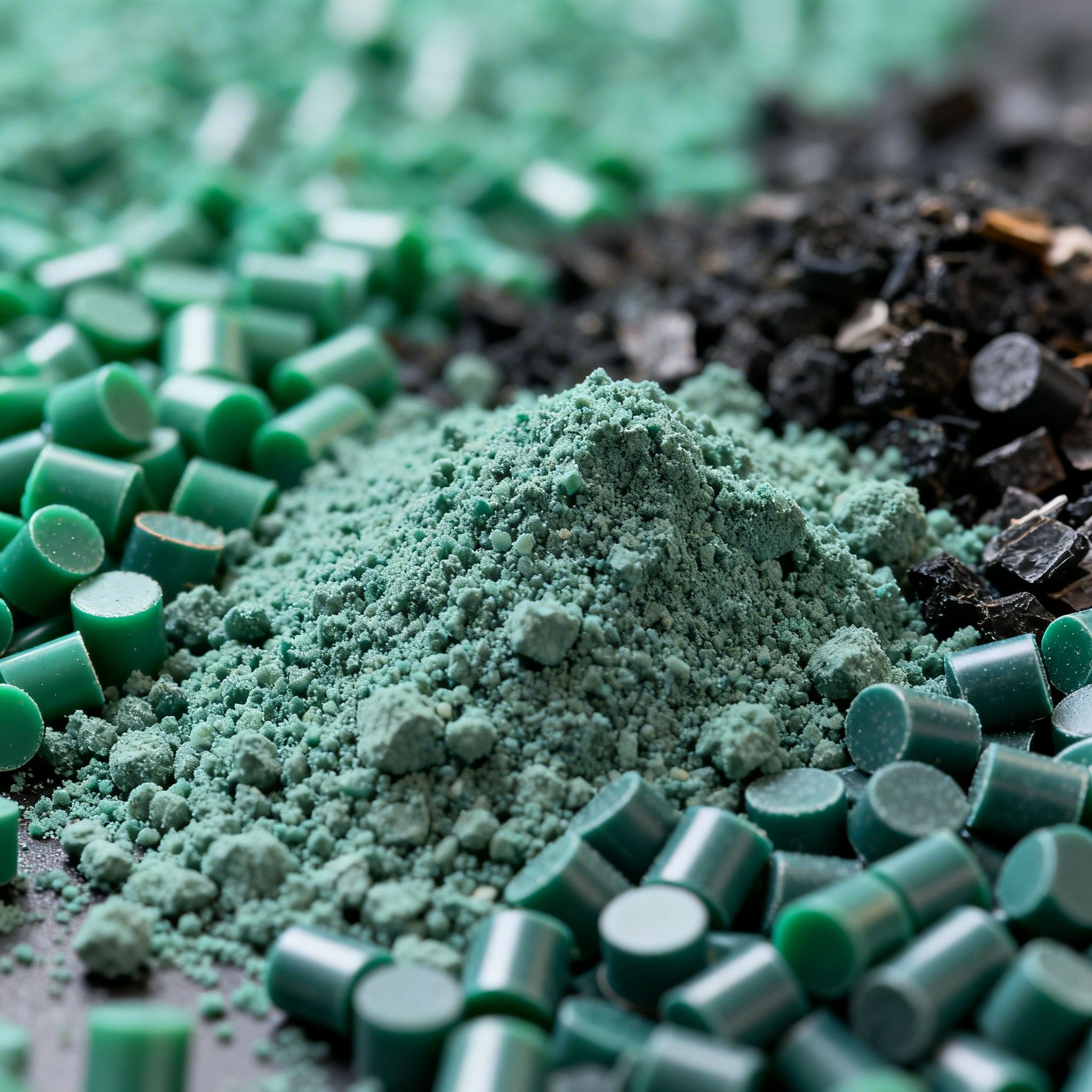
Materialise, leader in the production of 3D printed eyewear and promoter of sustainability in 3D printing, has committed to reducing its carbon footprint by 50% by 2025. Regarding 3D printing powder no longer usable in the additive manufacturing process, Materialise collaborates with Arkema's Agiplast recycling site to transform it into pellets destined for injection molding.
Arkema also collaborates with the Swiss sportswear manufacturer On, which designed and launched the world's first shoe made from bio-based polyamide 11, fully recyclable and marketed via a monthly subscription model. These innovative shoes are made with Rilsan® polyamide 11 Advanced Bio-Circular, derived from sustainable castor beans.
Circular Economy and Design for Recycling
Arkema provides certified recycled polymer grades through independent certifications, ensuring that high-performance recycled materials contain a certified minimum recycled content and exhibit properties similar to virgin materials. In June 2024, Arkema obtained recertification of its expanded range by SCS Global Services. Over 26 references were certified for recycled content after careful verification of production and suppliers. The certified offering includes PA11, PA12 and PEBA containing from 30% to 95% recycled material.
The program offers three collaboration models for polymer recycling projects: collection and recycling, supply of recycled materials, and collection with integrated supply. It is important to distinguish between closed-loop and open-loop recycling models. In the first case, articles are recycled into similar objects for analogous applications; in the second, they are transformed into different products for different uses.
Recycling solutions like that of JawsTec allow for selling parts at lower prices, since the recycled material is obtained without additional costs, thus reducing material costs to consider in pricing. This makes the offer particularly competitive, especially for new customers to the 3D printing sector who intend to try it for the first time.
Challenges and Opportunities of the Sector
Despite progress, the additive manufacturing industry still has many steps to take to implement truly sustainable production practices. Many initiatives aimed at improving sustainability involve higher costs for companies, however solutions like powder recycling allow for reducing the carbon footprint and generating economic benefits.
From the suppliers' point of view, it is essential to understand that the development of systems based on more sustainable materials — such as recycled or bio-based polymers — is not the only way to address the issue of sustainability in 3D printing. Printer manufacturers must consider sustainability also at the system level, that is, in the design and production of the printers themselves.
Some companies have designed printers specifically made with recyclable materials, such as aluminum, to reduce consumables, with over 80% of the energy used directly in the production of the parts. The main challenge consists in finding the right balance between the use of recycled materials, the quality of the parts produced and production costs, maintaining high performance standards.
Future Perspectives and Conclusion
Innovation in materials and advanced recycling are fundamental elements for a sustainable manufacturing future. Programs like Virtucycle® demonstrate that it is possible to create effective circular ecosystems, where production waste becomes a valuable resource for new applications. Independent certifications guarantee high quality standards, while strategic partnerships between producers, recyclers, and end-users favor the creation of integrated value chains.
Emerging technologies in chemical and mechanical recycling are opening new opportunities to reduce the environmental impact of industrial production. From 3D printing with recycled powders to bio-based materials derived from renewable sources, the available solutions are multiplying. The success of such initiatives will depend on the industry's ability to scale technologies, maintain high quality standards, and make sustainable practices economically advantageous.
The circular economy is no longer just a theoretical concept, but an operational reality that is transforming the way we design, produce, and use materials. With the continuous commitment of companies, institutions, and consumers, the manufacturing sector can concretely contribute to a more sustainable future, where recycling and innovation in materials become the standard and not the exception.
article written with the help of artificial intelligence systems
Q&A
- What is the main objective of Arkema's Virtucycle® program?
- The Virtucycle® program aims to promote the circular economy by allowing customers to rework polymers or purchase materials with a guaranteed minimum recycled content, without compromising performance. It focuses on polyamides, PEBA elastomers, and PVDF fluoropolymers.
- How does JawsTec contribute to recycling in 3D printing?
- JawsTec uses the QLS 230 printer to recycle excess powder by mixing it with virgin material in an 80/20 ratio. This approach allows for maximizing the use of recycled material while maintaining quality, avoiding the disposal of over 2 tons of powder.
- What types of materials are recovered from the Virtucycle® program?
- The program recovers injected or extruded waste, powders, parts, and granules of long-chain polyamides (PA11, PA12), thermoplastic PEBA elastomers, and PVDF. It distinguishes between pre-consumer and post-consumer materials.
- How is the circular economy applied in the collaboration between CNPC Powder and Brose?
- CNPC Powder and Brose transform steel scrap from production lines into iron-based powder called Green Steel, intended for additive manufacturing. This process reuses waste while maintaining the properties of the original materials.
- What are the economic benefits of recycling in 3D printing as demonstrated by JawsTec?
- Recycling allows for selling parts at lower prices since recycled material does not entail additional costs. This makes the offer particularly competitive for new customers who want to experiment with 3D printing.