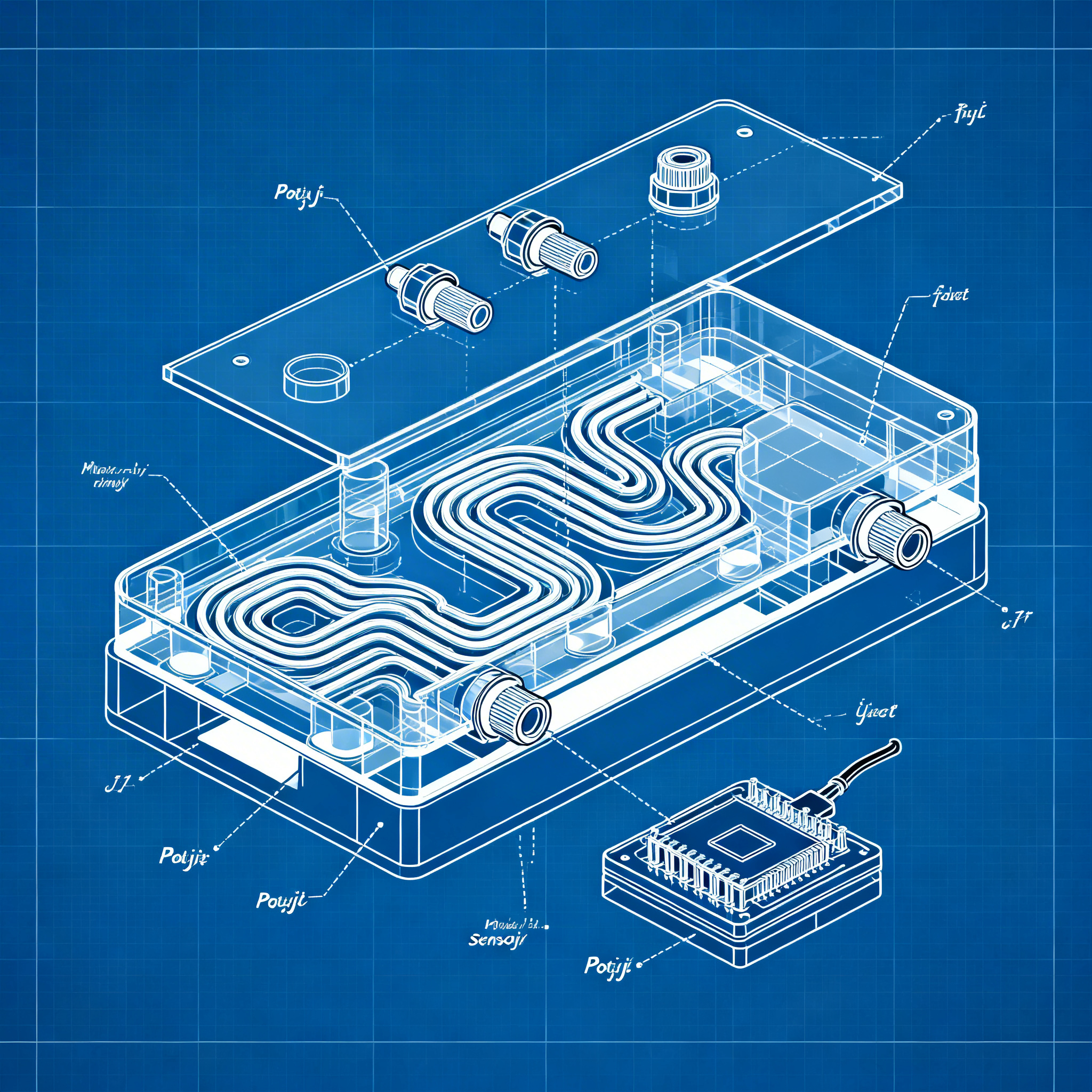
3D Printing Implementation for Microfluidic Devices: A Practical Guide to Reducing Costs and Complexity
3D printing is revolutionizing microfluidics, enabling the rapid and precise production of complex devices in a single process. Technologies such as PolyJet and PµSL now allow for the creation of entire microfluidic chips with micrometer-sized channels, eliminating manual assembly phases, critical alignments, and drastically reducing development times compared to traditional methods based on photolithography, glass processing, or PDMS molds.
Microfluidic systems manipulate small quantities of fluids in channels with dimensions often smaller than a millimeter, finding application in diagnostics, cell biology, analytical chemistry, and pharmaceutical development. The integration of 3D printing enables the design of more compact devices with complex geometries and integrated functions in a single body, reducing development times, assembly phases, and overall costs.
Choice of 3D Printing Technology for Microfluidic Applications
High-resolution 3D printing technologies such as PolyJet and Projection Micro Stereolithography (PµSL) offer micrometer precision and optical transparency, fundamental requirements for creating functional microchannels and smooth surfaces.
High-resolution 3D printers now allow for the creation not only of channels and chambers but of entire microfluidic devices complete with reservoirs, distribution structures, input and output interfaces, and even arrays of micro-needles, directly from a CAD model. This approach eliminates the need to align and glue multiple layers, work with photolithographic masks, or first build a master mold to then cast PDMS.
Stratasys's PolyJet systems have been used by various research groups to create chips with micrometer-sized channels, with good optical transparency and complex geometries such as serpentine shapes. The Projection Micro Stereolithography (PµSL) technology from Boston Micro Fabrication allows for printing entire microfluidic devices with high precision, reducing assembly phases and enabling rapid design iterations on the order of weeks, instead of the months characteristic of traditional processes.
Horizon Microtechnologies uses BMF's PµSL technology to produce tiny, accurate parts, which are then enhanced with proprietary coatings. This combination of micro-scale 3D printing with advanced coatings enables the creation of leak-free devices with fully three-dimensional channel networks, without glued layer interfaces, and in many cases with much simpler or absent capillary priming.
Design for Additive Manufacturing: Key Principles for Microfluidics
The design of microfluidic geometries must consider the specific limitations and advantages of additive technologies, optimizing print orientation, minimum channel sizes, and accessibility for post-process cleaning.
To achieve submicrometer channels with commercial 3D printers that have resolutions of tens of micrometers, innovative methods have been developed. A patented approach involves modeling micropores in the 3D model, orienting the minimum diameter output in the direction of the printer's layer thickness, and subsequently applying controlled heat and pressure to form submicron-sized fluid channels through the close contact of two points that form the minimum pore diameter.
Functional examples include Y-channel chips with input channels of 300 µm and a main channel of 500 µm, obtained by printing adjacent walls with an equivalent gap, and micromixer serpentine channels of 500 µm. The qualitative verification of the fluidic behavior is demonstrated by injecting colored solutions that maintain distinguishable laminar flows in the main channel.
Design for microfluidic 3D printing requires particular attention to complex internal geometries and the need to remove support material or unpolymerized resin from internal channels without compromising their structural integrity.
Materials and Chemical Compatibility in 3D-Printed Microfluidic Systems
Material selection must balance mechanical properties, optical transparency, biocompatibility, and chemical resistance to biological fluids or reagents used, with particular attention to functional coatings.
Horizon Microtechnologies has developed coatings that can make devices biocompatible, optically transparent, and electrically conductive. The coatings can make parts hydrophilic and can be used to protect surfaces. A channel could be coated with one material, while another channel could be coated with a conductive material; meanwhile, the exterior of the part could remain uncoated. Resins are tested according to ISO 10993-1:2018 to ensure biocompatibility.
A plug-and-play electrochemical module called MICRO, entirely made via 3D printing, was developed to simplify the integration of sensors in microfluidic devices. The measurement chamber, flow channels, and sensor seats are printed in PLA or similar materials, while the sensor modules are inserted as standard, easily replaceable connections. Magnetic sealing allows the device to withstand pressures up to over 300 kPa without leaks.
The system hosts conductive thermoplastic electrodes (TPE) that can be fabricated or integrated with additive techniques and subsequent surface activation steps, supporting three-electrode configurations with adaptable geometries and optimized positioning relative to the channel to maintain a stable response even under flow conditions.
Integrated Workflow: From CAD to Device Characterization
The complete production process includes optimized CAD modeling, high-resolution printing, specific post-treatments for microfluidics, leak testing, and functional validation of fluidic behavior.
The workflow starts with the CAD modeling of the microfluidic device, considering from the outset the constraints of the chosen printing technology. For printing with technologies such as PµSL, the model is processed and printed with micrometric resolutions, producing polymer parts with integrated complex geometries.
The post-processing phase is critical for microfluidic devices. Production requires impeccable cleaning of internal channels to avoid obstructions or contamination. Advanced industrial systems are designed to handle not only the printing phase but also the removal of resin residues and final polymerization, reducing delivery times from weeks to a few days.
After cleaning, devices can undergo surface treatments or the application of functional coatings. In the case of Horizon Microtechnologies, expertise in controlling the immersion process for coatings allows for the production of 3D printed parts with superior performance, with optimized electrical, optical, and wettability properties for specific applications.
Leak tests are essential to verify the integrity of channels and junctions. Devices must withstand operational pressures without leaks, as demonstrated by the MICRO module which withstands over 300 kPa. Functional validation includes tests with colored fluids to verify flow behavior, voltammetric measurements for integrated sensors, and characterization of the response under continuous flow conditions.
Industrial Case Studies: Cost and Time Reduction with 3D Printing
Companies like Intrepid Automation and Rapid Fluidics demonstrate how the integration of 3D printing into the microfluidic production process enables the transition from research to mass production, drastically reducing time-to-market.
Intrepid Automation, specialized in large-scale industrial 3D printing solutions, has signed a collaboration agreement with Rapid Fluidics, a British company expert in the design and manufacture of custom microfluidic devices. This union aims to expand access to rapid microfluidic technologies in the North American market, combining specialist design with automated production capabilities.
Intrepid Automation's approach, which uses high-speed photopolymerization systems, allows for overcoming the limits of traditional processes. Their machines are designed to handle high production volumes while maintaining the geometric precision required for complex internal channels, reducing delivery times from weeks to a few days.
Rapid Fluidics brings
article written with the help of artificial intelligence systems
Q&A
- What are the main advantages of 3D printing in the production of microfluidic devices?
- 3D printing enables the rapid and precise production of complex devices in a single process, eliminating manual assembly phases and reducing development times. It also allows for the realization of complex geometries and integrated functions, cutting costs and complications typical of traditional methods.
- Which 3D printing technologies are most suitable for microfluidic applications and why?
- PolyJet and Projection Micro Stereolithography (PµSL) technologies are the most suitable due to micrometric precision, optical transparency, and the ability to fabricate complex channels within a single body. These features are essential to ensure the correct operation of microfluidic devices.
- How does 3D printing design influence microfluidic devices?
- Design must consider the limits and advantages of additive technologies, such as print orientation and post-process cleaning. Innovative techniques enable the fabrication of submicrometric channels and complex geometries, improving the efficiency and functionality of the final devices.
- What materials and surface treatments are used in 3D-printed microfluidic devices?
- Biocompatible and transparent resins are used, often certified according to ISO 10993-1:2018. Special coatings can add hydrophilic, conductive properties, or optimize wettability, improving the performance and reliability of the devices.
- What is the complete workflow for fabricating a microfluidic device via 3D printing?
- The workflow includes CAD modeling, high-resolution printing, post-processing for cleaning and polymerization, followed by leak testing and functional validation. This integrated process enables the production of ready-to-use devices quickly and with high performance.