Implementing Direct-to-Consumer in the Industrial Sector: An Operational Plan for Regional Expansion
The transition to direct-to-consumer sales models and regional expansion on a larger scale requires a structured approach that goes beyond simple online exposure or production capacity. The success of the Direct-to-Consumer (DTC) model in the industrial additive production sector depends on the construction of a complete end-to-end workflow, the integration of secure digital platforms, and the rigorous governance of distributed production capacity.
Defining the DTC model: beyond simple online sales
An effective DTC strategy requires total control over the value chain, from the user interface to logistics, clearly distinguishing itself from a generic print farm.
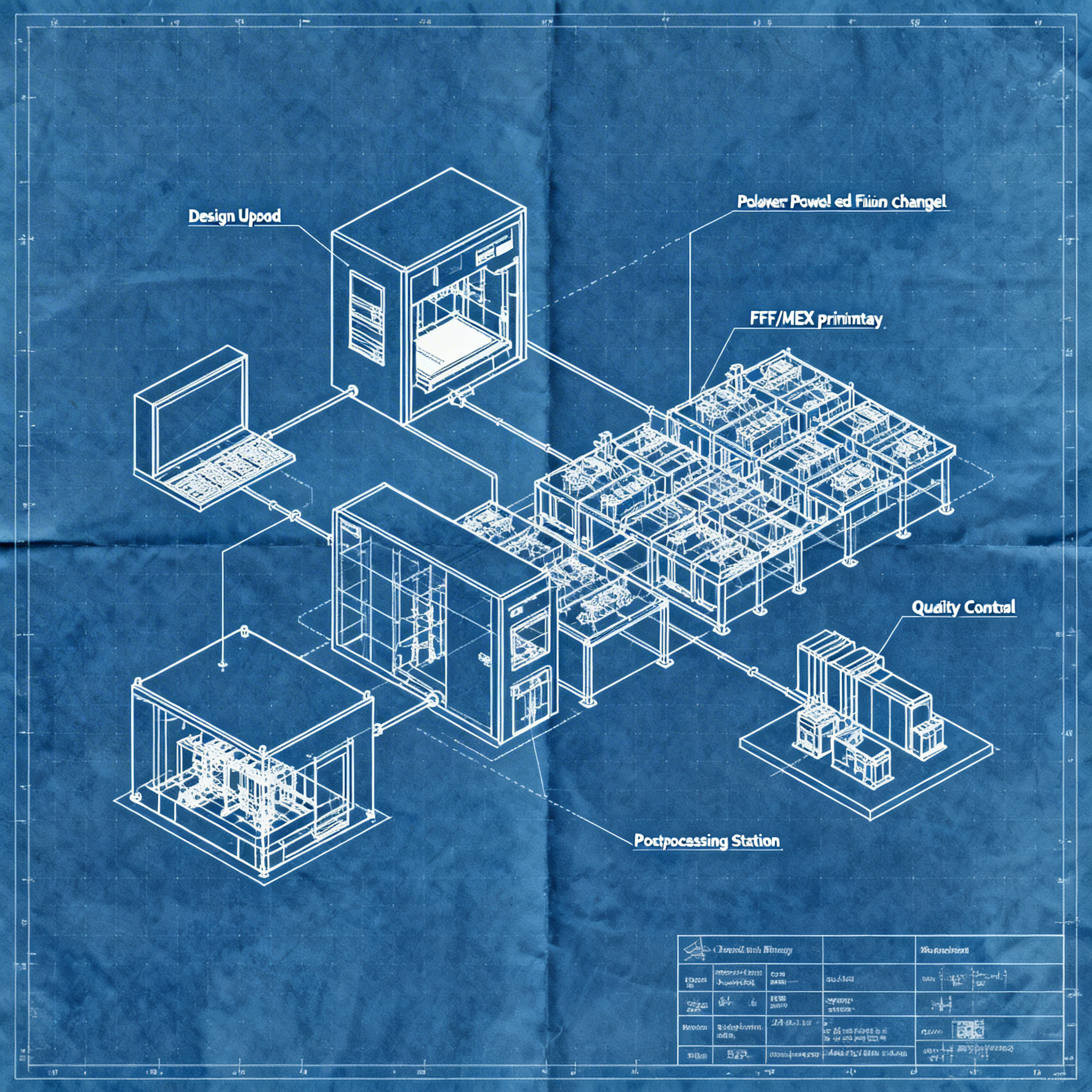
The DTC model in the industrial sector represents much more than an e-commerce channel. As demonstrated by the opening of the Automation Alley Digital Transformation Center (DTC) to companies outside the member network, the offering includes access to industrial-grade additive production technologies: polymer powder-bed fusion (SAF), high-performance large-format FFF/MEX printing, and Directed Energy Deposition (DED) for metals. Crucial is the integration of post-processing, inspection and validation tools, with a dedicated technical team.
The fundamental difference from a generic printing service lies in the promise to provide functional parts, tooling, and short-run or bridge production through managed and repeatable workflows. The industrial user does not purchase machine hours, but a complete pipeline with defined responsibilities. Polymaker recently extended its DTC webshop to six European countries (United Kingdom, France, Germany, Poland, Czech Republic, and Spain), offering direct access to the entire filament portfolio, with the goal of providing faster shipping, localized service, and price transparency.
End-to-end workflow: integration between design, production, and delivery
A fluid and standardized process guarantees quality consistency and competitive response times even during regional expansion, eliminating the bottlenecks typical of fragmented production.
Implementing an end-to-end workflow requires the integration of every phase of the production process. The Juise Mobility case perfectly illustrates the operational benefits: for an order of 12 components (three Juise Bars with four Ports each), the company was able to rely on the DTC, avoiding investments in capital and internal resources. “For many, 12 is not a large number, but for us it is very significant,” stated the company's manager. “We did not have the internal capacity to produce them in a timely manner with our limited resources.”
Each Port consists of four 3D-printed parts, with the front plate polished and colored, while the rest of the enclosure is used as printed. This approach allowed Juise Mobility to reinvest the saved capital in hiring qualified staff rather than purchasing 3D printing equipment and materials. Outsourcing production also reduced delivery times, demonstrating how a structured workflow can turn capacity constraints into competitive advantages.
Digital platforms and transparency in quoting
Advanced digital systems enable automation and personalization, increasing customer trust and service scalability through secure and repeatable processes.
The element that distinguishes a structured DTC from a traditional provider is the digital component. Users can submit designs via a secure portal, receive transparent quotes, and work directly with experts to determine appropriate materials, processes, and workflows for their applications. All orders are managed through secure digital workflows that protect intellectual property and allow for repeatable production for future orders.
As emphasized by Pavan Muzumdar, CEO of Project DIAMOnD and COO of Automation Alley: “The Digital Transformation Center was built to help companies move from experimenting with additive production to real production. By opening the DTC to companies outside of our member network, we are removing another barrier to the adoption of this powerful technology and offering more companies a low-risk path to validate products, scale production, and compete using additive production.”
This level of front-end transforms the user experience: one does not purchase machine hours, but a complete pipeline (order → production → inspection → delivery) with defined times and responsibilities, typical of modern service bureaus but with the flexibility and accessibility of the direct model.
Regional expansion with distributed capacity: governance and security
The use of external production capacity must be governed by clear contracts and monitoring systems to protect intellectual property and performance, preventing the distribution of workload from becoming a dispersion of value.
Regional expansion through distributed production capacity represents a governance challenge. DIAMOnD announced in 2025 a peer-to-peer marketplace where companies can submit requests “at scale” and the network distributes orders among participating manufacturers, with logic for cost and payment allocation and objectives for protecting intellectual property.
In theory, this model can reduce the typical criticalities of traditional service bureaus (limited capacity, queues, demand peaks) by aggregating the capacity of many SMEs. In practice, it shifts the issue: if a job moves from the traditional service bureau to the DIAMOnD network, it changes who captures margin and the relationship with the customer. Governance therefore becomes crucial to ensure that the distribution of production capacity does not lead to a loss of quality control or dispersion of value along the chain.
Key metrics to evaluate success include: how many parts are produced with added value (tooling, end-use), how much production remains within the network's SMEs, how revenues are distributed among participants, how many external companies use the DTC and then internalize skills (design, DfAM, quality), and what times/costs result for part categories.
Case studies: common errors and best practices
Comparative analysis of DTC implementations highlights how specialization and end-to-end control determine success, while a purely transactional approach leads to competitive failure.
The success of Juise Mobility demonstrates how a well-implemented DTC model allows startups to focus resources on innovation and talent rather than on infrastructure. The company was able to keep capital costs low and meet tight timelines, critical elements for a startup with growing demand from a still-limited revenue base.
In contrast, service bureaus that compete exclusively on piece price, without offering specialization in quality, supply chain, certifications, or end-to-end services, risk having their demand drained by competitive DTC models. Specialization makes the difference: the service bureaus that resist better are those that compete not only on price, but on quality, supply chain integration, certifications, and end-to-end capabilities.
Polymaker's expansion in Europe illustrates another critical aspect: the company stated its commitment to working with European retailers despite the expansion of the webshop. This hybrid approach recognizes that DTC does not necessarily have to cannibalize existing channels, but can complement them by offering direct access where demand requires it, while maintaining strategic partnerships for value-added services.
Conclusion
The DTC model, if well implemented, offers a significant competitive advantage in the industrial sector, but requires meticulous attention to operational details and governance. It is not enough to open an online portal or aggregate production capacity: it is necessary to build an integrated system that guarantees quality, IP protection, transparency, and repeatability. Companies that manage to balance the accessibility of the direct model with the rigor of industrial processes can scale effectively, while those that neglect one of the two aspects risk losing competitiveness or control.
Evaluate your current processes and map criticalities along the value chain: only in this way can you scale safely. Identify where your organization has gaps in the end-to-end workflow, which digital skills are missing to guarantee transparency and security, and how to structure governance if you intend to use distributed production capacity. The success of industrial DTC is not a matter of technology, but of operating system.
article written with the help of artificial intelligence systems
Q&A
- What are the key elements for the success of a Direct-to-Consumer (DTC) model in the industrial sector?
- An effective DTC model requires end-to-end control of the value chain, from user interface to logistics. It is essential to integrate secure digital platforms, guarantee post-processing and inspection, and provide a complete pipeline with defined responsibilities.
- How does an end-to-end workflow contribute to the regional growth of industrial companies?
- A standardized end-to-end workflow ensures consistent quality and competitive response times during expansion. It helps avoid bottlenecks related to production fragmentation and allows companies to scale without investing in new infrastructure.
- How do digital platforms improve the customer experience in the DTC model?
- Digital platforms allow for the secure sending of designs, the receipt of transparent quotes, and direct collaboration with experts. They guarantee intellectual property protection, repeatable processes, and a user experience similar to modern service bureaus but with greater flexibility.
- What challenges does regional expansion based on distributed production capacity present?
- Expansion requires rigorous governance to protect intellectual property and maintain high quality. Without clear contracts and monitoring systems, the distribution of capacity can lead to value dispersion and loss of control over production processes.
- What is the main competitive advantage of the DTC model compared to traditional service bureaus?
- The DTC model offers a complete and repeatable pipeline, with a focus on quality, tooling, and functional production, rather than simple machine hours. Furthermore, it allows for greater transparency, speed, and scalability thanks to digital integration and centralized governance.