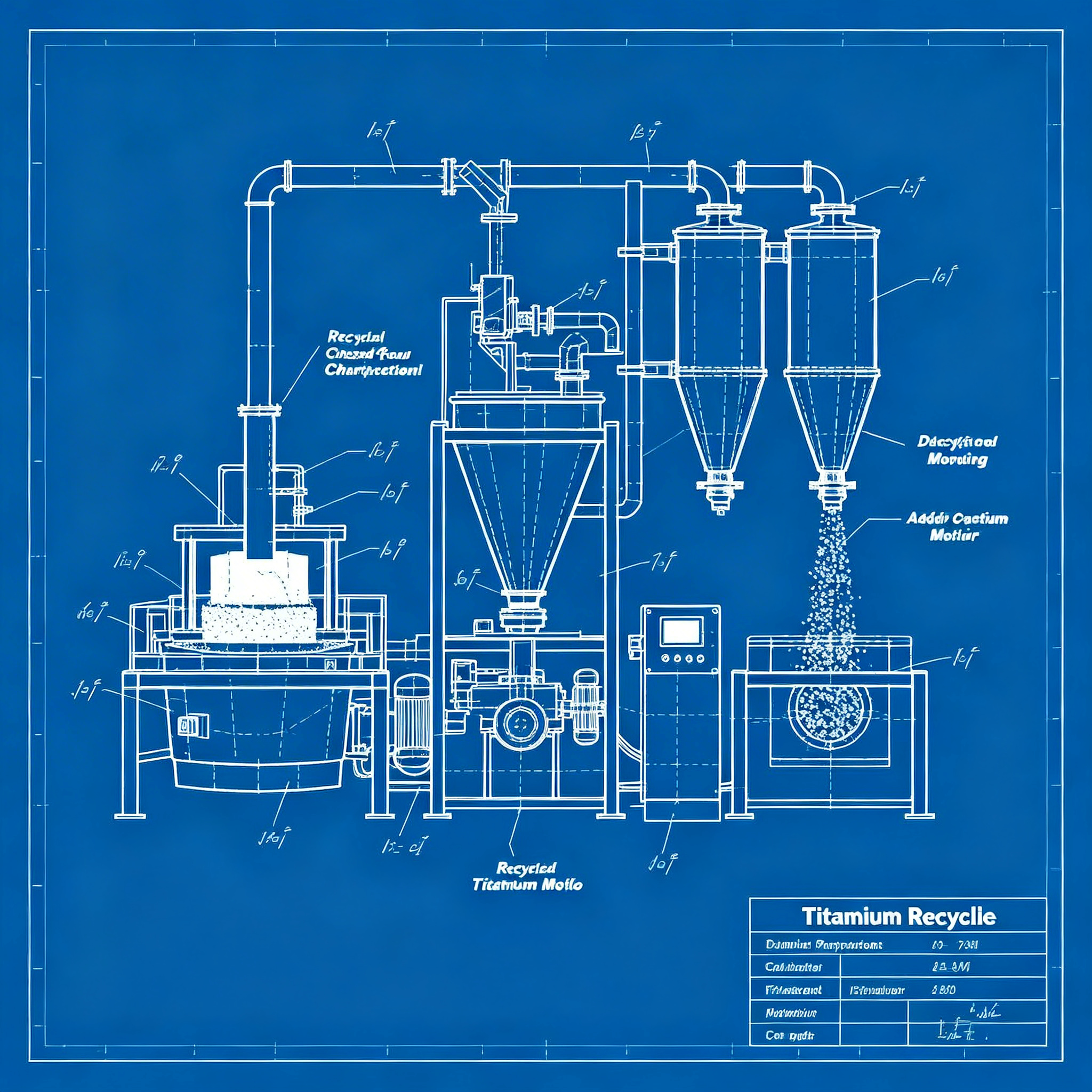
Titanium Recycling Rewrites the Rules of Safety in US Supply Chains
Recycled Titanium: A New Strategic Frontier for US Defense
Titanium recycling is emerging as a crucial solution to strengthen the strategic self-sufficiency of the American defense sector, reducing dependence on foreign suppliers concentrated in China and Russia.
Recycled titanium is not just sustainability: it is a key move to strengthen American military and industrial supply chains. IperionX, a company based in Charlotte specialized in titanium extraction and processing, is demonstrating how local recycling of this critical material can reduce costs and guarantee a strategic supply for the defense sector. The $300,000 order received from American Rheinmetall, a top-tier Pentagon supplier based in Michigan, for over 700 prototype components destined for US Army ground vehicle systems marks a turning point: it is not just a contract, but the signal of a scalable partnership in the strategic materials sector.
The current geopolitical context has transformed the control of critical resources into a strategic imperative. The supply of aerospace-grade titanium is geographically concentrated, with China and Russia dominating the global market. For the United States, reducing this dependence through domestic recycling is no longer an option, but an operational necessity that redraws the rules of security in supply chains.
IperionX and the Closed-Loop Model: Operational Efficiency and Savings
IperionX's technology allows for complete recycling of titanium, reducing weight and costs along the entire production chain, with direct impacts on logistics and the operability of military systems.
The “closed-loop” model implemented by IperionX represents a paradigm shift in the management of critical materials. The prototype components destined for US Army ground vehicles are produced entirely in the United States using 100% recycled feedstock, demonstrating that circular economy and industrial performance can coexist. According to the company, the titanium prototypes designed as alternatives to steel components should generate a weight reduction of 40-45% per unit compared to the parts they replace.
This weight reduction is not a marginal technical detail: it translates into concrete savings on logistical and operational costs. Lighter vehicles consume less fuel, require less maintenance and offer greater tactical mobility. In a military context where every kilogram counts, recycled titanium becomes a measurable tool of operational efficiency.
The CEO of IperionX, Taso Arima, emphasized how the company is “the only domestic producer of commercial primary titanium”, positioning itself uniquely to support “national defense priorities with secure, low-carbon emission and cost-competitive titanium products, manufactured entirely in the United States”. This statement highlights how supply chain security and economic competitiveness are now inseparable.
American Rheinmetall Injects Resources into Local Recycling: A Signal of Change
The $300,000 investment by American Rheinmetall indicates growing industrial interest in local suppliers of critical materials, paving the way for higher volume orders.
Although $300,000 may seem modest compared to the nearly $50 million contract received by IperionX from the Department of Defense, this type of low-volume initial order typically represents the precursor to subsequent, larger orders. IperionX itself emphasizes this in its announcement, highlighting how these pilot contracts serve to validate technologies and processes before scaling production.
American Rheinmetall, as a Tier 1 supplier to the Pentagon and across a full range of heavy industrial sectors, is field-testing the operational feasibility of recycled titanium. The order for over 700 prototypical components for ground vehicle systems represents an industrial qualification phase that, if successfully passed, could pave the way for multi-year supply contracts.
The Pentagon recently provided IperionX with nearly 300 tons of high-quality titanium scrap for free, with the company covering only transportation costs. This win-win formula could realistically transform the entire US metals supply chain if scaled. Considering the volumes of scrap on which the US defense industrial base sits, the potential is significant.
Resilient Supply Chains Thanks to Domestic Recycling
Reducing dependence on external supplies through internal recycling represents a competitive and logistical advantage for strategic companies, with direct implications for operational continuity.
The current geopolitical environment has made the Pentagon's need to secure its supplies of critical resources a strategic imperative. The fact that the United States' strategic competitors have such singular control over global mineral supplies means that recycling must be a fundamental part of the Department of Defense's procurement strategy.
A bipartisan group of legislators is currently evaluating the creation of a $2.5 billion ’independent agency“ dedicated to building stockpiles of critical minerals in the United States. Although there is no specific mention yet of the role of recycling in this agency, it is reasonable to expect that it could be one of the options on the table.
There is no shortage of pathways currently available for companies seeking to form public-private partnerships focused on building stockpiles of strategic resources. The additive manufacturing industry could experience a monumental transformation if it manages to play even a small role in this growth trajectory.
IperionX's model demonstrates that supply chain resilience is not just a matter of national security, but also of economic efficiency. Producing recycled titanium locally reduces lead times, eliminates uncertainties related to imports, and creates qualified jobs within the country.
Titanium recycling is no longer just an environmental issue, but an operational tool to strengthen the security and efficiency of US supply chains. Companies that integrate titanium recycling into their processes can obtain immediate competitive advantages in terms of costs and resilience, strategically positioning themselves in a market where material self-sufficiency is becoming an increasingly critical success factor.
article written with the help of artificial intelligence systems
Q&A
- What is the main strategic advantage of titanium recycling for US defense?
- Titanium recycling allows the United States to reduce dependence on foreign suppliers such as China and Russia, ensuring an autonomous and secure supply of critical material for the military industry.
- How does IperionX contribute to the security of American supply chains?
- IperionX produces aerospace-grade recycled titanium entirely in the United States, adopting a 'closed-loop' model that reduces costs, weight, and logistical times, increasing the operational efficiency of military systems.
- What operational impact does recycled titanium have compared to steel in military components?
- Recycled titanium components are 40-45% lighter, with a consequent reduction in logistical costs, lower fuel consumption, and greater tactical mobility of military vehicles.
- What is the significance of the American Rheinmetall order for IperionX?
- The order represents a pilot phase that could lead to multi-year contracts; it signals growing industrial interest in local suppliers of critical materials and technological validation of the recycling process.
- How is the US government supporting titanium recycling?
- The Department of Defense provided IperionX with nearly 300 tons of free titanium scrap, covering only transportation costs, to promote the development of a sustainable domestic supply chain.