HP MJF Technology in Industrial Services: How to Implement It for Resilient and Responsive Production
HP Multi Jet Fusion (MJF) is not just a 3D printing technology, but a key to rethinking industrial production and supply chain management. It enables companies to transition from a traditional model to a flexible, responsive, and resilient system, capable of rapidly addressing the needs of highly specialized markets such as aerospace, defense, data center, and medical.
The implementation of HP MJF in industrial services offers a concrete opportunity to reduce lead times, eliminate dependence on physical inventory, and improve customization capabilities without compromising quality. Companies like Future Form, with over fifty years of experience in engineered production, have recently integrated this technology into their production workflows, complementing it with CNC machining, carpentry, and full assembly.
Specific Use Cases of HP MJF in Industry 4.0
HP MJF demonstrates its operational value in concrete applications in the aerospace, defense, medical, and data center sectors, where the ability to produce complex geometries and customized components becomes a strategic competitive advantage.
In the data center, sector, where the need for reduced time-to-power is crucial, HP MJF enables the rapid design and production of components such as ducts, supports, interfaces, and liquid or air cooling systems. The technology also allows for the creation of customized sensor housings based on the specific layout of each structure, addressing the growing complexity of modern infrastructures.
In the aerospace and defense sector, additive manufacturing has already reached high levels of adoption. Major players use HP MJF for flight-certified components, leveraging the ability to create complex internal geometries and integrated cooling systems. The technology enables the consolidation of multiple parts into a single component, reducing weight, assembly times, and failure risks.
In the medical sector, HP MJF is enabling the production of customized orthopedic and prosthetic devices. The combination of biocompatible materials like PA 11 Gen2 with certified post-processing processes allows for components with excellent ductility, vibrant colors, and mechanical properties suitable for dynamically stressed applications.
Implementing the Digital Warehouse with HP MJF
Digitizing inventory through 3D printing radically transforms industrial logistics, reducing lead times and increasing supply chain resilience in the face of global disruptions.
The concept of “digital warehouse” represents one of the most strategic benefits of implementing HP MJF. Instead of physically stocking large quantities of spare parts, companies can archive validated files and produce components on-demand. This strategy drastically reduces risks related to global supply chain disruptions, transportation costs, and procurement times.
Future Form adopted this approach precisely to respond to ongoing supply chain issues, favoring leaner management of spare parts and product variants. HP and various partners have demonstrated how this model is particularly effective in sectors requiring complex but low-volume parts, such as nautical, process industries, and industrial automation.
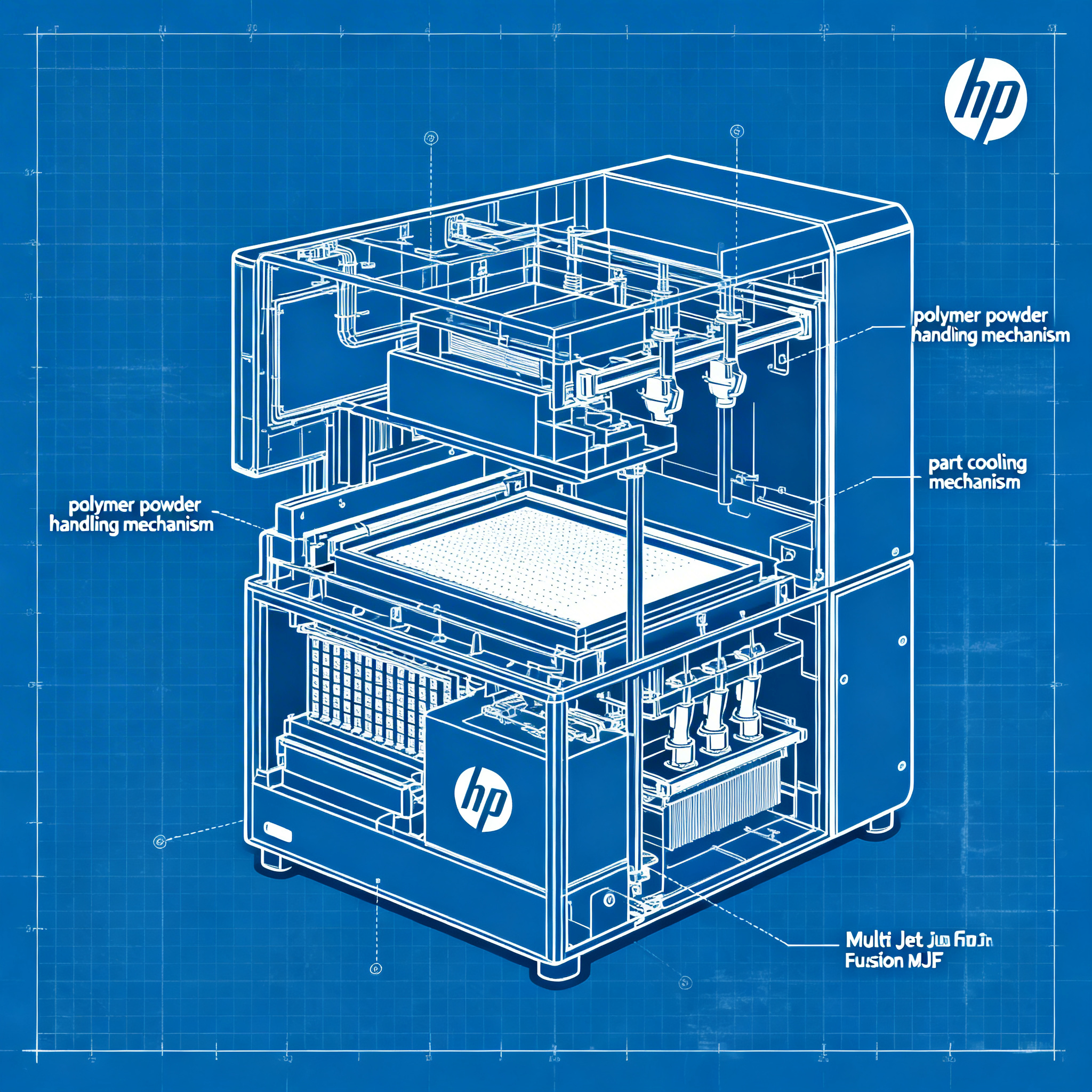
HP MJF technology is based on a polymer powder bed on which fusion and detailing agents are selectively deposited, followed by infrared irradiation. This process allows for parts with homogeneous mechanical properties across three axes, high detail definition, and high density of packed parts in the build chamber, optimizing cost per part. The most common materials are technical polyamides like PA 12 and PA 11, which offer an excellent compromise between mechanical strength, dimensional stability, and performance in demanding industrial environments.
Operative Strategies for Integrating HP MJF into Existing Processes
The adoption of HP MJF within complex and highly regulated production workflows requires precise operational strategies, from process automation to material management and part certification.
The integration of HP MJF into existing processes requires a structured approach. Service bureaus like AMufacture have expanded their fleets of HP MJF systems with automatic material changeover and robotic part handling, reducing downtime between jobs. These systems, equipped with automatic build changeover units, allow consecutive prints to be started without operator intervention, maintaining a stable utilization rate and bringing the production model closer to true line continuity.
For companies that choose to bring additive know-how in-house, like Future Form, integration with traditional production lines becomes fundamental. The combination of 3D printing and conventional machining allows customers to be guided from rapid prototyping to stable production, keeping design, quality, timelines, and costs aligned throughout the supply chain.
A critical aspect is the material management. HP has reduced the carbon footprint per part by over 70% in the last three years through innovations like HP 3D HR PA 11 Gen2, which supports up to 80% powder reusability. Tools like the HP PrintOS Carbon Calculator integrate sustainability into daily production decisions, providing manufacturers with the data needed to balance speed, costs, and environmental impact.
Photogrammetry certification and validation of parts is essential in regulated sectors. The ability to store validated files in the digital warehouse ensures that every on-demand component produced meets the same quality and regulatory standards as parts produced with traditional methods.
Conclusion
HP MJF represents an operational breakthrough for modern industry, capable of improving flexibility, efficiency, and production responsiveness. The technology enables companies to overcome the limits of traditional production, enabling complex geometries, part consolidation, and business models based on the digital warehouse. The adoption of HP MJF in industrial services is no longer an experiment, but a concrete strategy to gain competitive advantages in high-value-added sectors.
Evaluate today how to integrate HP MJF into your industrial services to obtain immediate competitive advantages and sustainable ones in the long term. Investment in this technology, supported by a rapidly expanding ecosystem and by materials that are increasingly performing and sustainable, can radically transform your capacity to respond to the challenges of the global market.
article written with the help of artificial intelligence systems
Q&A
- What are the main advantages of implementing HP Multi Jet Fusion (MJF) technology in industrial services?
- HP MJF allows for the reduction of lead times, the elimination of dependence on physical stock and the improvement of component personalization without compromising quality. Furthermore, it allows for greater flexibility and reactivity in production, adapting rapidly to the needs of specialized markets.
- In which industrial sectors does HP MJF demonstrate the greatest operational impact?
- HP MJF has a strong impact in the aerospace, defense, medical and data center sectors. In these contexts, the technology allows for the production of complex geometries, customized components and integrated systems, improving the efficiency and performance of final products.
- How does HP MJF contribute to the digitalization of stock and the resilience of the supply chain?
- With HP MJF it is possible to implement a 'digital warehouse', archiving validated files to produce the necessary components on-demand. This drastically reduces storage costs, delivery times and increases resilience in the face of logistical interruptions.
- What materials are commonly used with HP MJF and what characteristics do they offer?
- The most utilized materials are technical polyamides such as PA 12 and PA 11. They offer a good balance between mechanical resistance, dimensional stability and performance in demanding industrial environments, making them ideal for high-performance applications.
- What operational strategies are necessary to integrate HP MJF into existing production processes?
- Integration requires process automation, efficient material management, and part certification. It is also important to combine 3D printing with traditional machining to ensure production continuity and constant quality.