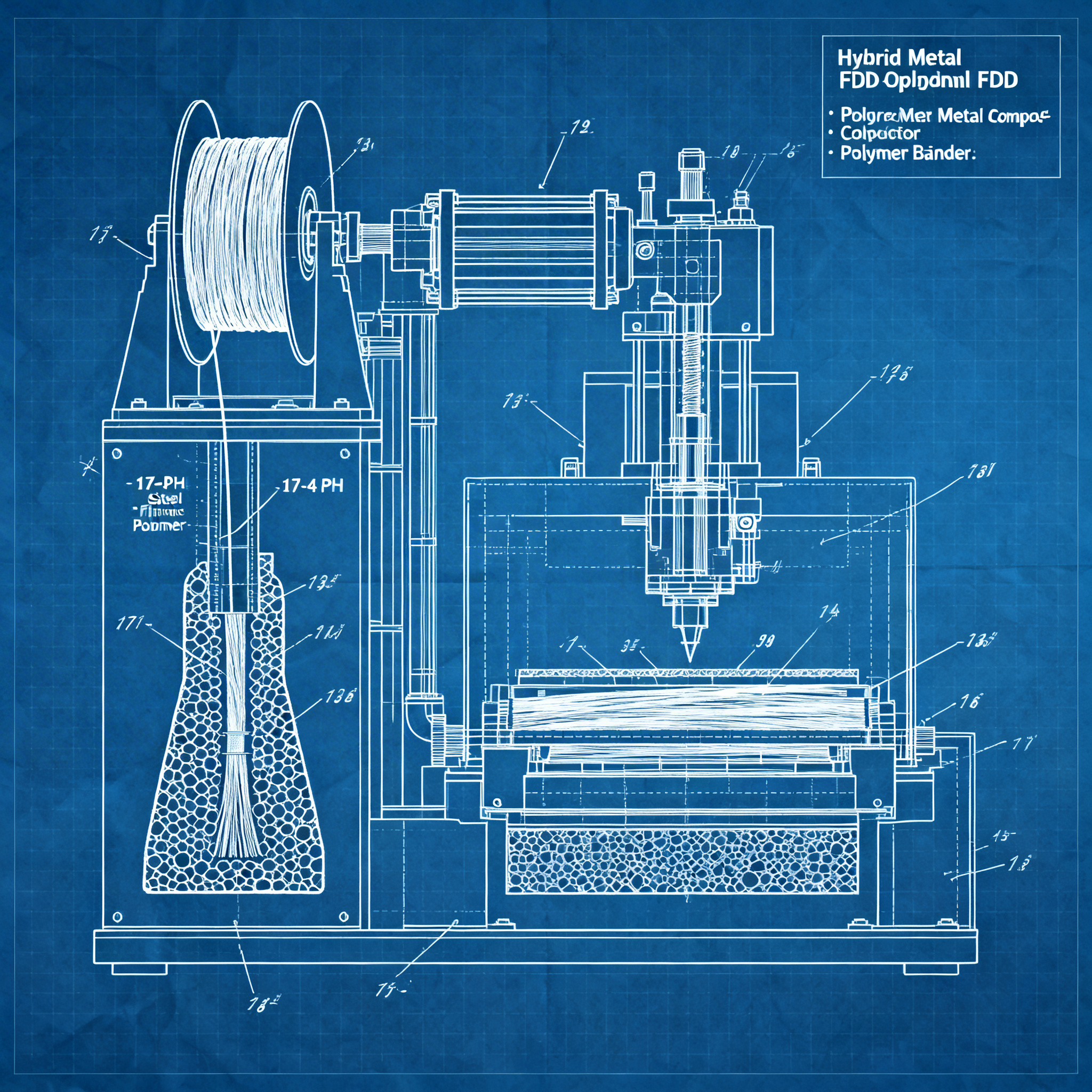
Hybrid Metal-Polymer FDM Extrusion: How It Works and What Are Its Industrial Applications
Hybrid metal-polymer extrusion in FDM 3D printing is redefining the boundaries between plastic and metal, opening new engineering possibilities in the manufacturing industry. This technology combines composite filaments loaded with metal particles and polymers to obtain advanced mechanical properties, allowing the direct production of semi-finished parts with metal characteristics without complex post-processing steps. Applications range from lightweight structural components to thermal or conductive inserts integrated in a single operation, representing an accessible and safe solution for metal additive manufacturing.
What is Hybrid Metal-Polymer Extrusion
Hybrid extrusion combines metal powders bonded to polymers in composite filaments, allowing to print parts with metal properties using modified FDM printers.
The hybrid metal-polymer extrusion process, also known as Metal FFF (Fused Filament Fabrication), represents the most accessible and easy-to-use method for the additive production of metallic components. Unlike traditional metal 3D printing technologies that require direct powder handling and controlled environments, this technology uses composite filaments containing metal powders bonded by thermoplastic polymers.
Available materials include stainless steels such as 17-4 PH (with strength up to 880 MPa and stiffness up to 190 GPa), tool steels such as H13 and A2, superalloys such as Inconel 625, and conductive metals such as copper. These composite filaments allow printing of complex geometries while maintaining the operational simplicity typical of polymeric FDM printers, without requiring extensive personal protective equipment during the printing phase.
The technology stands out for its ability to produce parts with real metal properties through a three-phase process, eliminating the need for specialist expertise in the management of metal powders and significantly reducing entry costs compared to laser or electron beam melting systems.
How the Hybrid FDM Process Works
The process is divided into three distinct phases: printing of the composite filament, removal of the polymeric binder (debinding), and high-temperature sintering to consolidate the metal.
The first phase consists of printing of the component using the metal-polymer composite filament. During this phase, the material is extruded layer by layer as in a normal FDM printer. The component is scaled in advance to compensate for the shrinkage that will occur during subsequent sintering. At the end of this phase, what is defined as the “green part” is obtained, which still contains all the polymeric binding material.
The second phase is the wash (wash), during which the green part is immersed in a debinding fluid that selectively dissolves the plastic material surrounding the metal particles. This chemical process removes most of the polymeric binder while maintaining the shape of the component. At the end, a “brown part” is obtained, which is more fragile but already partially consolidated.
The third phase is the sinterization, where the brown parts are placed in a high-temperature furnace. The residual heat burns the remaining binder and brings the metal particles to a temperature sufficient to partially melt between them, creating a solid and dense metal component. During this process, the component shrinks by 15-20%, reaching the expected final dimensions and the complete mechanical properties of the chosen metal.
Technological Advantages and Production Efficiency
Hybrid extrusion drastically reduces production steps and costs compared to traditional methods, maintaining high quality and operational safety.
The main advantage of Metal FFF technology lies in its accessibility: does not require dedicated operators, complex dust management systems, or extensive personal protective equipment. The printer itself has no particular installation requirements, while only the washing and sintering stations require extraction systems. This contrasts sharply with laser fusion systems that require inert gas chambers, active powder management, and strict safety protocols.
From a production standpoint, the system allows for obtaining functional metal parts in rapid times, with the possibility of producing complex components that would be difficult or impossible to realize with traditional subtractive manufacturing. The technology enables printing geometries with internal channels, lattices, undercuts, and other features typical of additive manufacturing, while maintaining the mechanical properties of solid metal.
Operating costs are significantly lower compared to laser fusion technologies: composite filaments are more economical than virgin metal powders, maintenance is reduced, and energy consumption is limited mainly to the sintering phase. Furthermore, the possibility of using the same software and workflow as polymer FDM printers reduces the learning curve for operators already familiar with the technology.
Current Industrial Applications and Future Prospects
Implementations range from aerospace to automotive, with a particular focus on tools, thermal components, and complex structural parts that require specific metal properties.
In the manufacturing and tooling sector, hybrid extrusion is used to produce H13 steel cutting tool bodies, copper thermal inserts for molds, assembly fixtures, and 17-4 PH steel robot grippers. These components benefit from the ability to integrate conformal cooling channels, topology-optimized geometries, and features that enhance performance compared to traditional solutions.
In the aerospace and defense, the technology finds application in the production of nozzles, lightweight structural components, and Inconel 625 parts that maintain mechanical properties in high-temperature and corrosive environments. The ability to produce functional prototypes rapidly accelerates development cycles and enables real-world validation before mass production.
The’automotive leverages the technology for bolt-fastening fixtures, test components, and on-demand spare parts, reducing machine downtime and eliminating the need for extensive warehouses. The ability to print in tool steels enables the production of small-batch molds directly, bypassing traditional long lead times.
Future prospects include expansion toward multi-material hybrid structures, where metal and polymer sections are integrated into a single component, and the development of new alloys optimized specifically for the FFF process. Research also focuses on improving interfaces between different materials and reducing sintering times, making the technology even more competitive for large-scale industrial production.
Conclusion
Metal-polymer hybrid extrusion represents a significant breakthrough for the manufacturing industry, offering integrated, high-performance solutions that combine the accessibility of FDM printing with the mechanical properties of metals. The technology eliminates traditional barriers of metal additive manufacturing, making it possible to produce complex components without prohibitive investments in infrastructure and specialized expertise. With an expanding material portfolio and contained operating costs, this solution positions itself as a concrete alternative for companies seeking production flexibility and reduced development times.
Discover how this technology can optimize your production processes and request a technical demo to evaluate its applicability to your specific components.
article written with the help of artificial intelligence systems
Q&A
- What is hybrid metal-polymer extrusion in FDM 3D printing?
- Hybrid metal-polymer extrusion combines metal powders bound by polymers into composite filaments, allowing to print parts with metal-like properties using modified FDM printers. It is an accessible technology to obtain metal components without complex post-processing steps.
- What are the main phases of the hybrid metal-polymer extrusion process?
- The process is divided into three phases: printing the component with composite filament, removal of the polymeric binder (debinding) via chemical washing, and high-temperature sintering to consolidate the metal and impart the final mechanical properties.
- What advantages does this technology offer compared to traditional metal 3D printing techniques?
- Compared to traditional techniques, hybrid extrusion is more accessible, does not require direct handling of powders or protected environments, has lower operating costs, and allows the use of already known software and workflows for polymeric FDM printing.
- What materials can be used with this technology?
- Available materials include stainless steels such as 17-4 PH, tool steels such as H13 and A2, superalloys such as Inconel 625, and conductive metals such as copper. These are provided in the form of ready-to-use composite filaments.
- In which industrial sectors does this technology find application?
- It finds application in the aerospace, automotive, manufacturing, and tooling sectors. It is used to produce tools, thermal inserts, complex structural components, functional prototypes, and custom parts with intricate geometries.