
Distributed e Gigafactory: How Integrated Production Works on an Industrial Scale
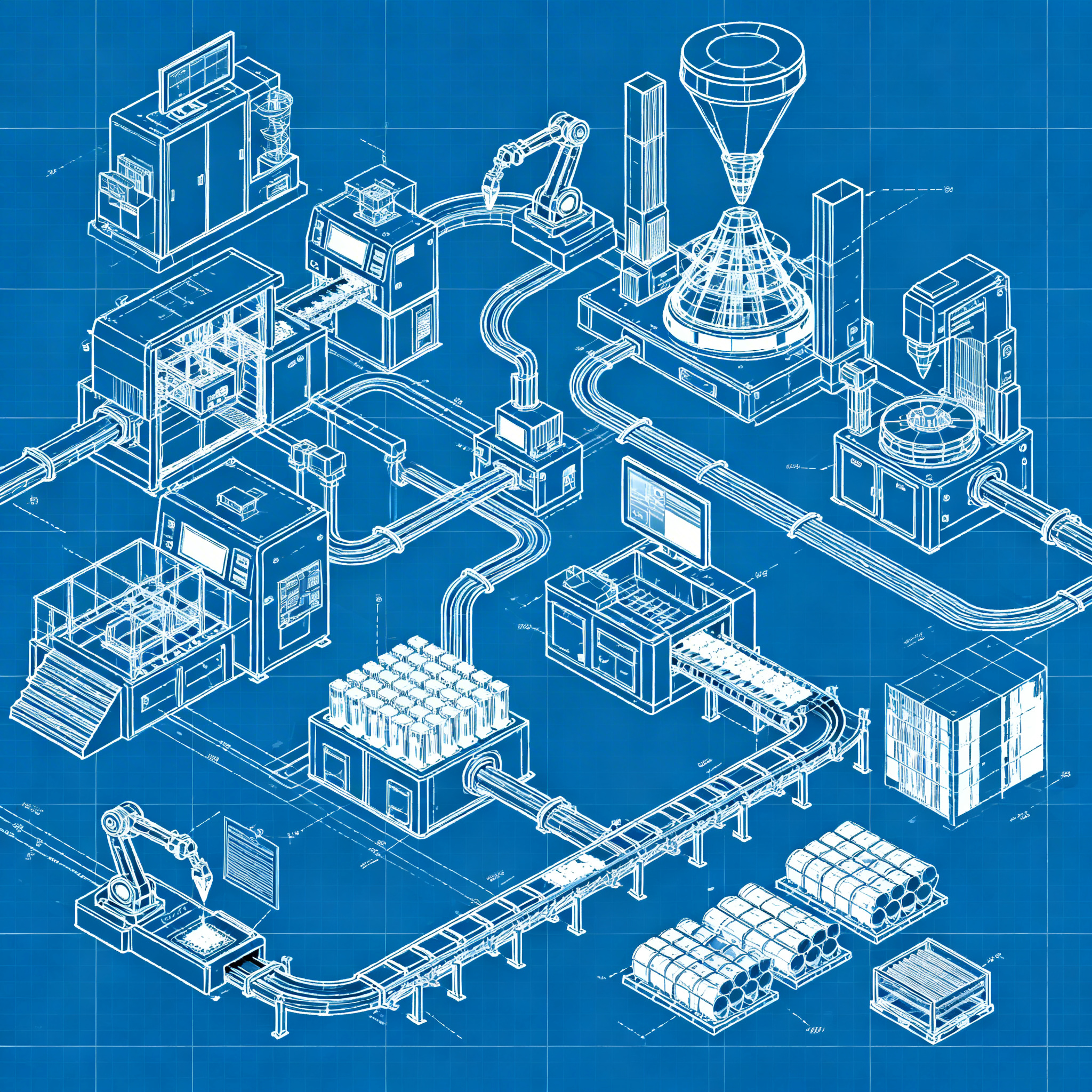
The factory of the future is no longer a collection of isolated machinery, but an integrated system where every phase of production collaborates in real time. This paradigm shift is redefining the manufacturing industry through the physical and digital integration of production processes, transforming traditional plants into intelligent ecosystems capable of self-optimization.
Horizontal Integration: The Key to Production Efficiency
Digitally connecting every production phase enables a reduction in cycle times and greater process predictability, eliminating the structural inefficiencies of traditional plants.
Traditional manufacturing production still operates according to fragmented logic: additive in one area, turning in another, heat treatments and quality control often in completely separate structures. Every transfer of a component between these isolated stations introduces latency, variability, and hidden costs. The true limit no longer lies in the capacity of individual machines, but in the physical and operational distance that separates them.
Horizontal integration solves this fundamental problem by treating the entire facility as a single continuous flow. When additive, subtractive, thermal, and inspection processes share a common level of data and automation, every step becomes a subsystem of a larger machine. Data flows freely instead of stopping at department boundaries, enabling synchronized decisions in real time.
This approach drastically reduces sources of variability: every time a part is handled, re-fixtured, or transferred between isolated disciplines, the distance traveled by atoms adds costs, variations, and delays. The factories that outperform competitors are those that shorten this distance, consolidating steps and designing flows where material and energy follow the most direct path possible.
In the advanced metal production sector, environments that combine dense additive capabilities, scaled mechanical processing, and integrated quality and computation systems are already demonstrating the benefits of a coordinated architecture. A project in the energy sector reduced delivery times for critical components from 30 months (with traditional casting) to just three months with convergent manufacturing, demonstrating superior or comparable performance with fewer internal defects.
Factory-as-a-Machine: Automation and Data Sharing
Transforming the entire production line into a single controlled entity allows for real-time optimization of resources and flows, overcoming the structural limits of fragmented plants.
The “factory-as-a-machine” model represents a profound conceptual evolution: the plant is no longer a set of discrete equipment, but a unified system operating from a shared level of intelligence. The most fitting analogy comes from the evolution of computing: early systems kept storage, software, and hardware separate; real gains were achieved when these levels were unified into coherent platforms.
Artificial intelligence becomes the conductor that holds this system together. Models trained on multi-phase data can see patterns invisible at the single-instrument level: anticipate thermal variations that affect both additive and mechanical processing, guide superalloys based on predicted distortion, adjust process conditions as builds develop, interpret inspection results to refine the subsequent production cycle.
The result is cumulative intelligence: every completed piece strengthens the system. When thermal behavior is predicted and managed across the entire workflow instead of being addressed in isolation, and inspection becomes an active contributor to process planning rather than a final checkpoint, the factory begins to operate in a fundamentally different way.
Rivian, an electric vehicle manufacturer, implemented this model by distributing over 35 industrial 3D printers dedicated to prototyping, with 38% of additive manufacturing requests coming directly from employees through an accessible system. In the fourth quarter of 2025, 86% of requests were completed in five days or less, with automation components printed every 15 meters in the production facility.
Continuous Flow: From Input to Finished Product Without Interruptions
Designing the layout and internal logistics to minimize interruptions generates scalable efficiencies at the gigafactory level, transforming production into a fluid, uninterrupted process.
Continuous flow represents the physical manifestation of digital integration. Every interruption in the production path introduces inefficiencies that no single-machine optimization can resolve. Layout design therefore becomes crucial: arranging stations in logical sequence, minimizing movement, automating transfers between phases.
Hybrid manufacturing exemplifies this principle: combining metal 3D printing and CNC machining in a single cell reduces times from 10 weeks to 72 hours, with material waste reduction up to 97%. This is not just a speed gain, but a fundamental reconfiguration of the process that eliminates waiting, transfers, and re-tooling.
At the gigafactory scale, this approach multiplies. Shenzhen Huafast Industry has built a farm of 5,000 FFF 3D printers (with a goal of 10,000 units) capable of fulfilling orders of 40,000 pieces in one week. With a theoretical capacity of over 2.2 million pieces per week at full capacity, the plant operates as a flexible, digitally reconfigurable “anything factory,” without the need for tooling or mold changes typical of traditional techniques.
The location in Shenzhen is not random: the local ecosystem of printer manufacturers, electronics, mechatronics, and supply chain facilitates the procurement of hardware, components, and materials, in addition to the availability of technical expertise to install, maintain, and scale machine parks from thousands of units.
Realized Cases: From Tesla to CATL, Scalable Architectures
We examine concrete examples of industrial implementation where the integrated model has revolutionized production, demonstrating measurable benefits in stability, repeatability, and throughput.
Automotive and battery gigafactories represent the pinnacle of industrial-scale production integration. Tesla pioneered the concept of the factory as a single system, where automation, data management, and physical flow are designed jointly from the outset. This approach has enabled the scaling of electric vehicle and battery production to previously impossible volumes.
In the battery sector, Material Hybrid Manufacturing is developing a multimaterial 3D printing platform to produce complete conformal batteries in a single step. After initially targeting the automotive market, the company has identified drones and wearables as the ideal product-market fit, where conformal geometries increase energy density by up to 50%, enabling greater autonomy or weight reduction.
The MIT is developing a multimaterial printing platform capable of fabricating fully functional electric motors in about three hours, using five different materials with an estimated cost of 50 cents per unit. The system integrates four specialized extruders that process conductive, magnetic, and structural materials layer-by-layer, eliminating the need for complex assembly and global supply chains.
Siemens and Nvidia are collaborating to develop the first fully AI-driven manufacturing site, starting with the Siemens electronics factory in Erlangen, Germany, as a blueprint. Using an “AI Brain” powered by software-defined automation and industrial operations software, combined with Nvidia's Omniverse libraries and AI infrastructure, factories will be able to continuously analyze their digital twins, test improvements virtually, and transform validated insights into operational changes on the production floor.
Towards Self-Optimizing Production Systems
Distributed models and gigafactories represent a paradigm shift towards hyperconnected and self-optimizing production systems. The competitive advantage has shifted from the performance of a single tool to the design of the continuous flow of material and
article written with the help of artificial intelligence systems
Q&A
- What characterizes industrial-scale integrated production?
- Industrial-scale integrated production is distinguished by the physical and digital integration of production processes, where each phase collaborates in real time. This approach transforms traditional plants into intelligent ecosystems capable of self-optimizing, reducing inefficiencies and cycle times.
- What are the benefits of horizontal integration in production?
- Horizontal integration digitally connects every production stage, reducing latency, variability, and hidden costs related to transfers between departments. It enables synchronized real-time decisions and drastically reduces sources of variability in the production process.
- How does the 'factory-as-a-machine' model work?
- The 'factory-as-a-machine' model treats the entire production line as a single controlled entity, where automation and data sharing enable real-time optimization. AI coordinates the system, anticipating variations and continuously improving the process.
- What does 'continuous flow' mean in a production context?
- Continuous flow refers to a layout and logistics designed to minimize interruptions in the production path. This leads to scalable efficiencies, reduced waste, and drastically lower production times, as in the case of hybrid manufacturing that combines 3D printing and CNC.
- Which companies have successfully implemented integrated production models?
- Tesla has applied the concept of the factory as a single system, while Rivian has distributed industrial 3D printers for rapid prototyping. Other examples include CATL, Siemens, and Nvidia, which develop AI-driven platforms for smart factories.


